
Gas furnace replacement in Orange County, CA
Furnace replacement starts with a safety and installation check, not just replacing the old unit with a new one. The job should confirm furnace condition, airflow, duct restrictions, venting, gas connection, thermostat wiring, and South Coast AQMD low-NOx furnace requirements for homes in Lake Forest, Foothill Ranch, Irvine, Mission Viejo, and nearby Orange County communities.
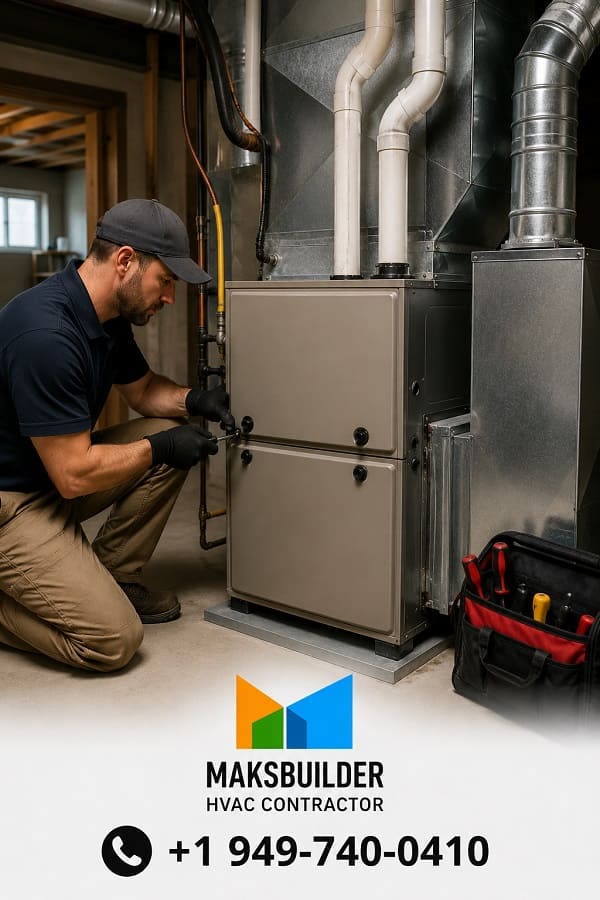
Direct answer: furnace replacement makes sense when an older heating system has repeated repairs, unsafe operation concerns, high gas use, loud startup, uneven heating, limited parts availability, or heat exchanger and venting issues that make another repair a short-term fix.
A furnace does not need replacement only because it is old. Replacement becomes the responsible option when age, repair history, comfort complaints, operating cost, safety risks, and equipment condition all point in the same direction.
Older furnaces can keep running, but the decision should include heat exchanger condition, ignition reliability, blower performance, parts availability, venting condition, and current efficiency.
Recurring igniter, flame sensor, blower, inducer, pressure switch, board, or safety circuit problems often mean the system is becoming less dependable, even when each individual repair looks manageable.
Cold rooms, weak vents, long run times, noisy returns, or poor recovery can come from the furnace, blower setup, return air, ductwork, filter restriction, or a system that no longer fits the home.
Rattling, scraping, rumbling, booming, whining, or heavy blower noise should be checked before another season of use. Some noises are repairable; others point to mechanical wear, delayed ignition, or airflow trouble.
Rising gas use may come from aging equipment, poor combustion, duct losses, restricted airflow, short cycling, or an older low-efficiency furnace that works harder than it should.
If a heat exchanger issue, rollout mark, soot, unstable flame, blocked vent, carbon monoxide alarm, CO reading, or combustion safety concern is present, the furnace should be checked before any repair or replacement decision is made.
The right answer depends on equipment age, safety condition, repair cost, part availability, airflow, and whether the existing furnace can still heat the home safely and evenly.
Repair may be the better choice when the furnace is newer, the cabinet and heat exchanger condition look acceptable, the failure is isolated, parts are available, and the duct system can support normal heating. Common repair candidates include thermostat faults, dirty flame sensors, igniter failures, minor wiring faults, blower capacitors, pressure switch issues, or control problems found during diagnostics.
If the furnace is safe to operate and the repair solves the actual failure point, replacement can wait.
Replacement becomes more practical when the furnace is 15–20+ years old, repair costs keep stacking up, the system is noisy or inefficient, heating is uneven, safety concerns are present, or the furnace no longer matches the home’s airflow and comfort needs.
In those cases, another repair can delay the same decision without correcting the larger condition behind the breakdown.
Furnace replacement in Orange County is not just choosing the same BTU size from the old nameplate. The replacement furnace must fit the home, local air district requirements, the venting path, gas connection, combustion air needs, duct capacity, thermostat controls, and installation location.
Gas furnace replacement in Orange County should be selected with South Coast AQMD Rule 1111 low-NOx furnace requirements in mind. The exact furnace model should match the home, installation location, venting setup, and current product availability.
Venting must be compatible with the furnace type, location, termination, slope, clearances, and manufacturer instructions. Vent defects can create safety and performance problems even when the new furnace is correctly sized.
The visible gas shutoff, connector, sediment trap, line capacity, access, and condition should be checked before the replacement furnace is installed and commissioned.
Furnaces need proper combustion air. Closet, attic, garage, and confined-space installations should be checked before assuming the old setup is acceptable for the new equipment.
Existing thermostat wiring and low-voltage controls should be checked before choosing single-stage, two-stage, variable-speed, or connected thermostat options.
The replacement scope should account for local code, manufacturer instructions, startup safety checks, and permit or inspection steps when required for the project.
A replacement estimate should confirm whether the new furnace will work with the house, not only whether it can physically fit in the old location. The inspection covers the equipment, air side, gas side, venting, shared cooling components, and control wiring.
Furnace replacement cost depends on more than the furnace unit. Access, installation location, venting, gas connection, duct condition, control wiring, AC coil compatibility, and required safety corrections can all affect the final scope.
Garage, attic, closet, hallway, crawlspace, and tight mechanical-room installations can require different labor, protection, removal, and setup steps.
A replacement may need vent adjustments, connector updates, shutoff review, sediment trap correction, or other visible gas-side work tied to the equipment and code requirements.
A new furnace will not fix poor comfort if return air is undersized, ducts are crushed or leaking, filters are too restrictive, or the blower is fighting high static pressure.
Many furnaces share the blower cabinet, indoor coil, thermostat, and ductwork with the air conditioner. Coil access, drainage, airflow, and future AC replacement plans should be reviewed.
Single-stage, two-stage, and variable-speed options affect comfort, controls, airflow strategy, and equipment compatibility. The best choice depends on the home, not only the price.
Startup checks, temperature rise, flame behavior, venting review, blower operation, and control sequence testing help confirm that the replacement furnace is operating correctly.
Many Orange County homes have a furnace connected to the indoor AC coil and shared ductwork. A furnace replacement can affect cooling airflow, coil access, thermostat wiring, blower setup, and future upgrade options. If the AC is also old, if the coil is damaged, or if the homeowner is considering electrification, it is worth comparing furnace-only replacement with a combined AC, furnace, or heat pump plan.
MaksBuilder provides residential furnace replacement planning for Lake Forest and nearby Orange County communities.
Send the furnace age, city, equipment location, and symptoms such as no heat, loud startup, high gas bills, repeated repairs, or safety concerns. A photo of the furnace label, venting, gas connection, and installation space helps with the first review.
Replacement may make sense if the furnace is 15–20+ years old, needs repeated repairs, heats unevenly, runs loudly, increases gas bills, has limited parts availability, or shows heat exchanger, venting, combustion, or carbon monoxide safety concerns. A proper recommendation should include age, condition, safety, airflow, and repair cost.
Not always. Repair may be better for a newer furnace with an isolated failure and no major safety concern. Replacement is usually more practical when the system is old, unreliable, inefficient, unsafe, or poorly matched to the ductwork and comfort needs of the home.
Gas furnace replacement in Orange County should be planned with South Coast AQMD Rule 1111 low-NOx furnace requirements in mind. MaksBuilder checks that the recommended furnace option is appropriate for the installation type, venting path, and home setup.
It depends on the age and condition of both systems. If the AC, indoor coil, ductwork, thermostat wiring, or shared blower setup is also old or mismatched, replacing connected equipment together may improve compatibility and reduce duplicated labor. If the AC is newer and in good condition, furnace-only replacement may be enough.
Yes. MaksBuilder checks duct condition, return air, airflow, visible restrictions, and shared heating and cooling components before recommending furnace replacement. Poor ductwork can reduce comfort even when the new furnace itself is correctly installed.
Helpful details include the furnace age, brand and model label, home city, equipment location, recent repair history, unusual noise, gas bill changes, comfort complaints, thermostat type, and photos of the furnace, venting, gas connection, and surrounding installation area.