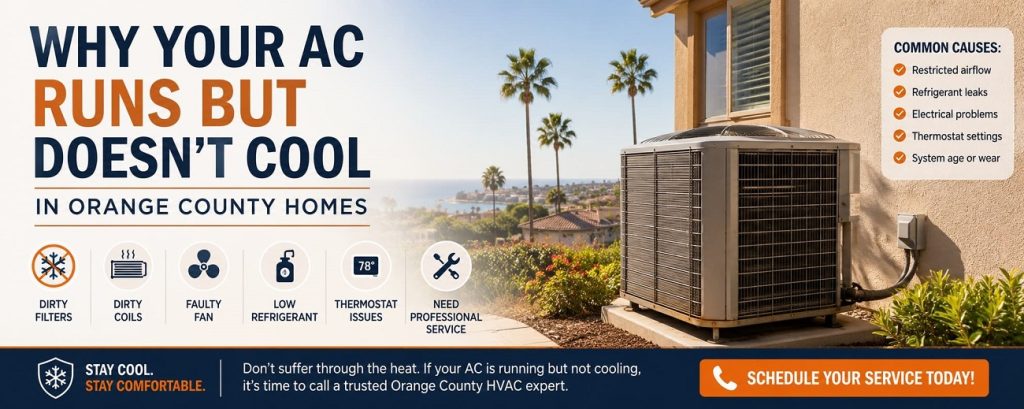
When Cool Air Is Not Enough to Reach the Thermostat Setpoint
If your AC is running and the vents are delivering clearly cooled air, but the thermostat stalls above the temperature you selected, this is different from an AC that runs while blowing warm or room-temperature air. If the vents are warm or near room temperature, see our guide to an AC blowing warm air. Here, the AC is producing cooling, but the delivered capacity is not keeping up with the home's heat gain well enough to reach or hold the setpoint. In Orange County homes, the cause may be high building heat gain, reduced delivered capacity from dirty coils or restricted airflow, duct leakage or duct heat gain, or equipment that is not properly matched to the actual cooling load. Long runtime can be normal on hotter days, but if the indoor temperature consistently stays above the setpoint, the system is not keeping up with the home's cooling load.
Why Can the AC Cool but Still Miss the Thermostat Setpoint?
The cooling that actually reaches the living space is not keeping up with the heat entering the home. That can happen because the building load is unusually high, the HVAC system is delivering less usable capacity than it should, conditioned air is being lost through the duct system, or the installed equipment is not well matched to the home’s cooling load.
What the Runtime Pattern Can Tell You
Compare runtime with outdoor temperature, supply-air temperature, and how the indoor temperature changes over time.
Runs for Long Periods During Heavy Cooling Demand
During peak cooling load, a correctly operating system may run for long periods without indicating a fault.
Temperature Drops, Then Stalls
If the indoor temperature falls initially but then remains above the setpoint as the cooling load increases, delivered cooling may be roughly matching the heat entering the building.
The Same AC Used to Keep Up
If the system previously maintained the target temperature under comparable conditions but no longer does, reduced airflow, dirty coils, duct problems or another loss of delivered capacity becomes more likely.
Short cycling is different. If the system repeatedly starts and stops before the home cools, the problem may involve controls, airflow, equipment operation or sizing rather than normal long-runtime operation.
Outdoor Conditions Can Increase the Cooling Load
A home can become harder to cool even when the HVAC equipment has not suddenly failed.
Higher Outdoor Temperature
As outdoor temperature rises, more heat can enter through the building envelope while the outdoor unit must reject heat under more demanding conditions. Runtime generally increases as the building load approaches the system’s available capacity.
Strong Solar Exposure
West-facing and other high-solar-exposure windows, walls and roof surfaces can add substantial heat gain. The effect depends on orientation, shading, glazing and construction.
Temporary Peak Versus Persistent Problem
A system that struggles only during unusually demanding conditions is different from one that cannot reach the setpoint under ordinary warm-weather operation.
Building Heat Gain May Be Driving the Temperature Gap
The HVAC system has to remove both heat entering from outdoors and heat generated inside the home.
Common Sources of Excess Heat Gain
- ✓ Direct sun through large or poorly shaded windows.
- ✓ Roof and attic heat reaching rooms below.
- ✓ Missing, compressed or uneven insulation.
- ✓ Outdoor air leaking around doors, windows and building penetrations.
- ✓ Cooking, appliances, electronics or unusually high occupancy.
Look at How the Temperature Gap Changes
If the gap between the thermostat setpoint and the actual indoor temperature becomes larger as outdoor temperature or solar load increases, building heat gain may be contributing to the problem.
If the system reaches the setpoint earlier in the day but consistently falls behind specifically during the afternoon, see why an AC cannot keep up in the afternoon.
If rooms directly below the attic remain consistently warmer, both HVAC distribution and attic conditions should be considered. For attic-related heat gain and insulation issues, see the attic insulation page.
Dirty Coils Can Reduce Available Cooling Capacity
An AC can continue to run even when heat transfer has deteriorated. Coil condition therefore matters when performance has declined from what the system previously delivered.
Indoor Evaporator Coil
Dirt on the evaporator coil can reduce heat transfer and may also contribute to airflow restriction. Coil condition should be evaluated together with the filter, blower, return airflow and overall system resistance.
Outdoor Condenser Coil
A contaminated or obstructed outdoor coil can make heat rejection more difficult, especially during higher outdoor temperatures. The unit may continue operating while its usable cooling performance falls.
If the home no longer cools as it did under comparable conditions, schedule HVAC diagnostics to identify where cooling performance has been lost.
Restricted Airflow Reduces Cooling Delivered to the Home
Rated equipment capacity does not mean the same amount of cooling will reach the rooms under every operating condition. The indoor side of the system also needs adequate airflow.
Whole-System Airflow Problems
- ✓ A dirty or excessively restrictive filter.
- ✓ Blocked or inadequate return airflow.
- ✓ A dirty blower wheel or evaporator coil.
- ✓ Incorrect blower setup or abnormal blower performance.
- ✓ Excessive resistance in the duct system.
Distribution Problems Between Rooms
If the thermostat area is comfortable but bedrooms, upstairs spaces or distant rooms stay warm, total equipment capacity may not be the main issue.
Restricted branches, weak return paths, poor balancing, damaged flexible ducts and room-specific heat gain can produce uneven temperatures even when the AC is generating cooling.
Duct Losses Can Reduce Cooling Before It Reaches the Rooms
Duct problems are especially important when ducts run through hot attics, garages or other unconditioned spaces.
Supply Leakage
A leaking or disconnected supply duct can release conditioned air outside the living space, leaving less cooling available at the registers.
Return Leakage
A return-side leak can draw hot air from an attic or cavity into the HVAC system, increasing the heat the equipment must remove.
Duct Heat Gain
Poorly insulated ducts can gain heat while carrying cooled air through a hot space. Crushed, kinked or restrictive duct runs can also reduce airflow.
For duct leakage, restrictions, return-air problems, and room-to-room airflow issues, see ductwork and airflow services for help with return capacity, duct restrictions, leakage, and room-to-room distribution.
System Size Should Match the Home’s Actual Cooling Load
Square footage alone is not enough to determine residential AC capacity. Windows, insulation, air leakage, orientation, ducts, occupancy and local design conditions all affect the cooling load.
Undersized Equipment
A system with insufficient capacity for the actual design load may run for long periods and still fail to maintain the target indoor temperature during peak conditions.
Oversized Equipment
More capacity is not automatically better. Oversizing, particularly with fixed-capacity equipment, can contribute to short cycling and poorer temperature or humidity control.
Calculate the Load Before Changing Capacity
For residential systems, ACCA Manual J provides a recognized method for calculating heating and cooling loads. Equipment can then be selected using the calculated loads, design conditions and manufacturer performance data under ACCA Manual S.
Do not assume a larger replacement is the answer until airflow, coil condition, duct losses and building heat gain have been considered. When replacement is appropriate, equipment selection should be based on the actual home rather than floor area alone. See AC installation and replacement.
What You Can Check Before Scheduling Diagnosis
Before scheduling service, note when the temperature gap appears, whether the supply air is clearly cool, and whether the problem affects the whole house or only certain rooms.
Record the Cooling Pattern
- ✓ Note the thermostat setpoint and actual indoor temperature.
- ✓ Record when the temperature gap starts increasing.
- ✓ Confirm that supply air feels clearly cooler than room air.
- ✓ Note whether the AC runs steadily or repeatedly cycles off.
- ✓ Check whether the entire home or only certain rooms are affected.
Check Accessible Airflow Conditions
- ✓ Inspect the air filter and replace it if needed.
- ✓ Keep supply registers and return grilles unobstructed.
- ✓ Look for obviously disconnected or crushed accessible ductwork.
- ✓ Keep vegetation and loose debris away from the outdoor unit.
- ✓ Compare performance during moderate and more demanding outdoor conditions.
What a Technical Diagnosis Should Measure
A technician can compare equipment performance, airflow, duct losses, and building load to find where the available cooling is being lost.
HVAC Performance
- ✓ Supply- and return-air temperature conditions.
- ✓ Filter, blower and indoor coil condition.
- ✓ Airflow and static pressure where appropriate.
- ✓ Outdoor coil and condenser airflow.
- ✓ Refrigeration performance if measured cooling output appears abnormal.
Distribution and Building Load
- ✓ Duct leakage, restrictions and insulation condition.
- ✓ Return-air capacity and room-to-room distribution.
- ✓ Solar exposure and changing temperature patterns.
- ✓ Attic insulation and obvious building air leakage.
- ✓ Equipment capacity compared with the calculated cooling load.
Technical References
Residential HVAC load calculation and equipment selection are covered by ACCA Manual J and Manual S. ENERGY STAR identifies leaks, holes and poorly connected ducts as important sources of conditioned-air loss and recommends sealing accessible duct leaks and insulating ducts in unconditioned spaces.
ACCA Manual J: https://www.acca.org/standards/technical-manuals/manual-j
ACCA Manual S: https://www.acca.org/standards/technical-manuals/manual-s
ENERGY STAR Duct Sealing: https://www.energystar.gov/saveathome/heating-cooling/duct-sealing
Frequently Asked Questions
Why does my AC run all day but never reach the set temperature?
The cooling reaching the living space may not be keeping up with the home’s heat gain. High outdoor temperatures, building heat gain, reduced airflow, dirty coils, duct losses or insufficient system capacity can all contribute.
Is it normal for an AC to run continuously on a very hot day?
It can be. Long runtime may be normal near peak cooling conditions. It is more concerning when the indoor temperature continues rising, the system performs worse than it did under comparable conditions, or cooling remains inadequate during less demanding weather.
What if the AC is running but the vents are not blowing cold air?
That is a different symptom. If supply air is warm or close to room temperature, the cooling process itself may not be operating normally. See why an AC blows warm air for that troubleshooting path.
Can leaking ducts keep the house from reaching the thermostat setting?
Yes. Supply leakage can lose conditioned air before it reaches the rooms, while return leakage can draw unwanted hot air into the system. Ducts in hot unconditioned spaces can also gain heat when insulation is inadequate or damaged.
Should I replace the AC with a larger unit if it cannot reach the setpoint?
Not based on this symptom alone. Airflow, coil condition, duct losses, building heat gain and actual cooling load should be evaluated before changing equipment capacity. Residential sizing should be based on a load calculation rather than square footage alone.