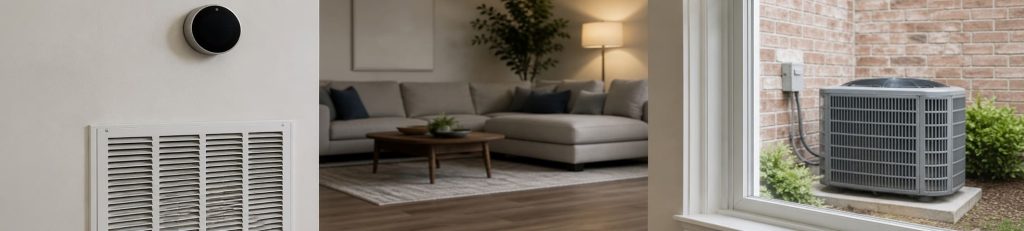
When Your AC Keeps Turning On and Off Too Quickly
If your air conditioner repeatedly turns on, runs only briefly, shuts off, and starts again soon afterward, it may be short cycling. Short cycling means the system is operating in unusually brief or frequent cooling cycles.
The thermostat may be satisfied too quickly, or airflow, electrical, refrigerant, drainage, or control problems may interrupt operation before a normal cooling cycle is completed.
What Is AC Short Cycling?
A short-cycling air conditioner repeatedly starts and stops instead of operating in a stable cooling pattern. The system may run for only a few minutes, remain off briefly, and then restart while the home still needs cooling.
One short cycle does not prove that the system has a fault. Outdoor temperature, indoor heat gain, humidity, equipment type, and thermostat demand all affect runtime. A repeated change from the system's normal operating pattern is more significant than any single cycle length.
If the pattern continues after basic filter and thermostat checks, professional air conditioning repair can identify what is causing the frequent starts and stops.
How Short Cycling Differs From Normal AC Operation
There is no universal number of minutes that every air conditioner should run. Single-stage systems, variable-capacity equipment, weather conditions, home heat gain, and thermostat settings can produce very different cycle lengths.
The concern is a repeated pattern of unusually brief operation, especially when the AC stops before the home appears to reach the selected temperature or repeatedly restarts after short off-times.
Many thermostats and HVAC controls enforce a minimum compressor off-time before allowing another start. A normal restart delay of several minutes should not be confused with short cycling.
Common Causes of AC Short Cycling
Thermostat or temperature sensor problems
The thermostat controls when cooling starts and stops. If its temperature reading does not represent the room accurately, it may satisfy the cooling call sooner than expected.
Cold supply air blowing directly toward the thermostat, a sensor problem, loose low-voltage wiring, or incorrect control configuration can contribute to abnormal cycling.
Dirty filter or restricted airflow
A heavily loaded filter or another airflow restriction can reduce air movement across the evaporator coil. In severe cases, coil temperature can fall enough for ice to form, and some systems may eventually stop through a protective control.
For more detail on airflow-specific symptoms, see why airflow from AC vents may become weak .
Evaporator coil icing
Coil icing is usually a symptom of another problem rather than the original fault. Restricted airflow, blower problems, a dirty evaporator coil, insufficient refrigerant charge, or a refrigerant-flow restriction can contribute to freezing.
As ice builds, airflow and heat transfer can deteriorate. On systems with applicable temperature, pressure, or motor protection, those conditions may contribute to repeated shutdowns.
See why an air conditioner freezes up for the separate frozen-coil troubleshooting topic.
Electrical or starting-component faults
A failing capacitor, worn contactor, loose electrical connection, unstable supply voltage, control-board problem, motor fault, or compressor starting problem can cause cooling to stop shortly after startup.
Clicking, humming, buzzing, repeated failed starts, or brief operation followed by shutdown can be useful diagnostic clues.
Refrigerant or refrigerant-flow problems
An incorrect refrigerant charge or a restriction in the refrigerant circuit can change operating pressures and temperatures, reduce evaporator temperature, or contribute to abnormal compressor operation.
On equipment with applicable pressure or compressor protection, abnormal conditions may interrupt operation. Short cycling alone cannot determine whether the problem is a leak, incorrect charge, restriction, or something unrelated to the refrigerant circuit.
Condensate safety switch
A clogged condensate drain, failed condensate pump, or rising water level can activate a float switch or another drain safety and interrupt cooling.
If a switch repeatedly opens and closes as the condensate level changes, it can create intermittent shutdowns on some installations. The exact behavior depends on how the safety is wired into the system.
Compressor or condenser protection
A dirty outdoor coil, weak condenser fan, failing fan motor, electrical problem, or another condition that reduces heat rejection can increase compressor temperature or refrigerant pressure.
On equipment with applicable temperature, pressure, current, or internal overload protection, compressor operation may stop until the protection resets or operating conditions recover.
Oversized air conditioner
An oversized single-stage AC can reduce the temperature around the thermostat quickly enough to satisfy the cooling call after a short runtime.
This can produce frequent cycles and may also reduce humidity removal. Oversizing is more likely when the behavior has existed since the system was installed. A new short-cycling problem after years of normal operation points more strongly toward a developing fault.
What the Short-Cycling Pattern Can Reveal
The way each cycle ends can help narrow the cause. These patterns are clues, not diagnoses.
| Observed pattern | What it may suggest | What to record |
|---|---|---|
| AC stops while the thermostat still calls for cooling | A safety control, electrical fault, condensate switch, compressor protection, or another equipment control may be interrupting operation. | Note whether the thermostat still displays Cool or Cooling when the equipment stops. |
| Thermostat satisfies the cooling call unusually quickly | Thermostat location, sensor error, direct exposure to supply air, or oversized equipment may be involved. | Note the displayed temperature, setpoint, and approximate runtime before the thermostat ends the call. |
| AC stops and then restarts after a short recovery period | Compressor overload or another temperature-, pressure-, current-, or control-related protection may be operating. | Record the approximate run time, off-time, and any clicking, humming, or buzzing. |
| Cycling occurs with visible ice or condensate water | Coil icing, restricted airflow, or a condensate safety may be involved in the shutdown sequence. | Look only at accessible areas around the indoor unit and insulated refrigerant line. Do not remove equipment panels. |
What You Can Check When the AC Keeps Turning On and Off
- Time the cycles. Note approximately how long the AC runs and how soon it starts again.
- Check the thermostat display. Note whether it is still requesting cooling when the equipment shuts off.
- Inspect the air filter. Replace a visibly dirty disposable filter with the correct size and type recommended for the system.
- Check visible airflow paths. Make sure major return and supply grilles are not blocked by furniture, curtains, rugs, or stored items.
- Look for visible ice or water. Check accessible areas around the indoor unit and refrigerant-line insulation without removing service panels.
- Record unusual sounds. Repeated clicking, humming, buzzing, or failed restart attempts can help a technician reproduce the short-cycling problem.
These observations can help a technician reproduce the short-cycling problem. Electrical, refrigerant, compressor, and control-system testing should be performed with the appropriate equipment and procedures.
When Short Cycling Means You Should Turn the AC Off
Stop cooling and avoid repeated restart attempts if the system is short cycling with smoke, sparking, a burning or electrical odor, severe buzzing, visibly damaged wiring, repeated breaker trips, or water near electrical components.
If visible ice is present, turn cooling off and follow the equipment manufacturer's instructions. Do not chip, scrape, heat, or mechanically remove ice from the coil or refrigerant tubing.
If a circuit breaker trips repeatedly, do not keep resetting it. Breaker trips are a separate electrical symptom that should be diagnosed rather than treated as ordinary short cycling. See why an AC breaker may keep tripping .
Do not bypass a float switch, pressure control, overload device, or another safety control to keep the system running.
How a Technician Diagnoses AC Short Cycling
Diagnosis starts with the event that ends each cooling cycle.
- Determine whether the thermostat ended the cycle. The technician checks whether the thermostat normally satisfied the cooling call or whether the equipment stopped while cooling was still requested.
- Identify any control or protective shutdown. Condensate switches, pressure controls, compressor protection, motor protection, and electrical controls may interrupt operation under certain conditions.
- Find the condition behind the interruption. Depending on the observed pattern, testing may involve airflow, electrical components, refrigerant operation, compressor performance, condenser heat rejection, drainage, or system sizing.
Why Persistent Short Cycling Matters
Frequent starts can add electrical and mechanical stress to the compressor, contactor, capacitor, fan motors, and related components.
Very short cycles can also reduce comfort and humidity control because the system may shut off before conditioned air is distributed evenly or enough moisture is removed.
AC Short Cycling FAQ
Why does my AC turn on and off every few minutes?
Frequent short cycles can be caused by thermostat or sensor problems, restricted airflow, coil icing, refrigerant conditions, electrical faults, condensate safeties, compressor protection, or oversized equipment. The actual cause depends on why each cycle ends.
Is it normal for an AC to turn back on shortly after shutting off?
An occasional restart can be normal as indoor conditions change, but a repeated pattern of very brief run times and short off-times may indicate short cycling. Many thermostats and HVAC controls also prevent immediate compressor restart by enforcing a minimum off-time.
Can a dirty filter make an AC short cycle?
A severely restricted filter can reduce airflow across the evaporator coil. In some systems, the resulting low coil temperature or icing can contribute to operating conditions that interrupt cooling.
Can short cycling damage an AC compressor?
Frequent starts can increase electrical and mechanical stress, particularly when the compressor is struggling to start or repeatedly stopping through protection. Persistent short cycling should be diagnosed rather than repeatedly restarted.
Can an oversized AC short cycle even if it reaches the thermostat setting?
Yes. An oversized single-stage system may lower the temperature near the thermostat quickly and satisfy the cooling call after a short runtime. Frequent short cycles can reduce humidity removal and may leave temperatures less even throughout the home.