Find duct restrictions, leakage and airflow problems before replacing the system
Weak airflow, uneven rooms, duct noise and comfort problems that change when interior doors close can point to restrictions or leakage in the supply or return-air path.
Common causes include disconnected branches, compressed flexible duct, leaking transitions, restrictive returns and improperly positioned balancing dampers. These conditions should be identified before widespread duct replacement is considered.
MaksBuilder can inspect accessible residential ductwork for visible restrictions, leakage points, damaged sections and installation defects, and determine when additional airflow or static-pressure testing may be appropriate.
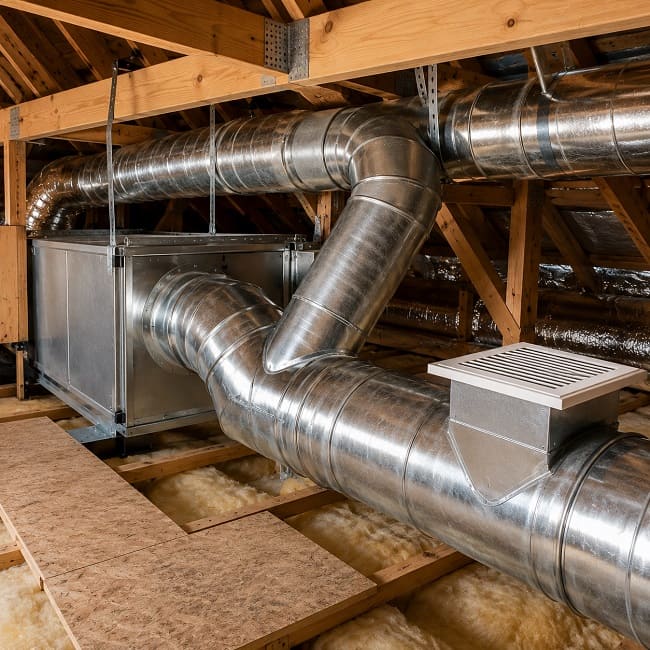
Weak airflow: what the pattern can tell you
Where the problem occurs helps narrow the inspection. One weak register, several rooms on the same trunk and weak airflow throughout the home point to different parts of the air-distribution system.
One room has weak airflow
Check the branch damper, takeoff, flexible duct, boot and register for a disconnected joint, restrictive bend, compression or obstruction.
Several nearby rooms are affected
Rooms served by the same trunk can lose airflow together when that trunk or a shared transition is restrictive, damaged or improperly adjusted.
Most rooms have weak airflow
A widespread problem calls for inspection farther upstream, including the main return and supply paths, filter opening, plenums and other shared restrictions.
The problem changes when doors close
A supplied room needs an effective return path. Closing the door can create a pressure imbalance when air enters the room faster than it can return.
What a duct inspection can and cannot confirm
Accessible ductwork can often be checked for obvious physical defects, but visual inspection does not quantify every airflow problem.
- It can identify accessible disconnected joints, crushed duct, damaged insulation and obvious installation defects.
- A visible opening can confirm a local leakage point, but not the total leakage rate of the complete duct system.
- Static pressure requires instrumented measurement at defined points.
- Delivered airflow cannot be determined accurately by how strong the air feels at a register.
- Concealed duct sections cannot be visually evaluated unless they are accessible.
Instrumented static-pressure, airflow and whole-system duct-leakage testing are separate diagnostic procedures. If one of these measurements is needed, its availability and scope should be confirmed when scheduling.
Why one room stays hotter or colder
Uneven comfort is often an airflow-distribution problem, but balancing should not be the first assumption. The supply branch and return path serving the room should be checked first.
- Restricted or compressed supply branch
- Partially closed balancing damper
- Disconnected or poorly sealed takeoff
- Excessively long or poorly routed flexible duct
- Restricted return-air path
- Pressure imbalance when the room door is closed
- Leakage at a boot, collar or branch connection
Room heat gain also affects comfort. Strong sun exposure, large windows or limited insulation can increase the airflow a room needs even when the duct is intact.
Common ductwork defects that restrict airflow
| Condition | Possible airflow effect | What should be checked |
|---|---|---|
| Disconnected branch duct | Very weak airflow at the affected register while conditioned air escapes before reaching the room | Takeoff collar, inner liner, mechanical attachment, seal and insulation jacket |
| Compressed flexible duct | Higher resistance and reduced airflow through the affected branch | Bends, routing, support, sagging, compression and available clearance |
| Excessive flex-duct sag | Increased resistance along the duct run | Support locations, strap condition and whether the run can be better supported or routed |
| Leaking boot or transition | Part of the supply airflow is lost before reaching the occupied room | Sheet-metal seams, fasteners, collars and sealant condition |
| Restricted return duct | Reduced airflow across multiple supply registers | Return grille, filter opening, return box, duct dimensions, transitions and visible obstructions |
| Closed or misadjusted damper | Reduced airflow to one branch or group of rooms | Damper position, linkage and whether the restriction is intentional |
Supply and return duct leaks affect airflow differently
Supply leaks lose conditioned air before it reaches the room; return leaks draw unintended air into the return system.
A disconnected supply branch can therefore create weak airflow in one room while releasing air into an attic or other unconditioned space. A return-side opening can draw air from an attic, crawlspace, building cavity or another unintended area while the blower operates.
Finding a visible leak confirms a local defect, but it does not establish the leakage rate of the complete duct system. Quantifying total duct leakage requires dedicated testing.
Return-air restrictions can reduce airflow throughout the home
Supply air can circulate properly only when there is a usable path back to the return side. A restrictive return can affect several rooms even when individual supply branches are intact.
Blocked return grille
Furniture, stored items or heavy debris can reduce the available return opening and increase resistance.
Restrictive filter path
A dirty filter, undersized filter opening or excessively restrictive filter can contribute to reduced system airflow.
Insufficient bedroom return path
Depending on the design, a room may use a dedicated return, transfer grille, jumper duct or another effective path back to the central return.
Restriction behind the grille
A larger grille alone does not solve a restriction if the return box, transition or duct behind it remains undersized or obstructed.
Supply-air restrictions reduce delivered airflow
The supply path includes the plenum, trunks, branches, dampers, boots and registers. Excessive resistance anywhere along that path can reduce the amount of air reaching a room.
Flexible duct is especially sensitive to sharp bends, compression, excessive length and poor support. An isolated restriction does not automatically require complete duct replacement; correcting the affected section may be enough.
Supply restrictions to check
- Compressed or sharply bent flexible duct
- Excessive sag between supports
- Partially closed balancing damper
- Restrictive transition or takeoff
- Obstructed supply register
- Duct dimensions that may be insufficient for the intended airflow
Static pressure helps identify excessive airflow resistance
High static pressure means the blower is operating against excessive resistance somewhere in the measured airflow path. The reading does not identify the restriction by itself.
Total external static pressure is measured between specified return- and supply-side locations and should be interpreted against the equipment manufacturer's rated external static-pressure limit.
Where additional pressure measurements are appropriate, they can help narrow whether excessive resistance is concentrated on the return side, supply side or across another component included in the diagnostic scope.
Static-pressure measurement is an instrumented diagnostic procedure, not part of a visual duct inspection. Its availability and scope should be confirmed before the appointment when this measurement is needed.
Duct insulation protects conditioned air in attic spaces
Ductwork routed through an unconditioned attic is exposed to temperatures well outside normal indoor conditions. Insulation reduces unwanted heat transfer between the duct and surrounding attic air.
A torn outer jacket does not necessarily mean the inner air-carrying duct is leaking. The inner liner, mechanical connection and insulation layer should be inspected separately.
If the inner duct has separated from a collar, the connection and air seal should be repaired before the insulation jacket is closed again.
Final airflow balancing comes after major restrictions are addressed
Initial airflow measurements and damper checks can help identify a problem. Final balancing adjustments are most meaningful after major duct leakage, damage and supply or return restrictions have been corrected.
Identify the affected rooms
Determine whether the problem affects one register, several related rooms or most of the home, and note whether closed doors change the condition.
Correct major airflow-path problems
Address accessible disconnected joints, severe duct compression, major leakage and significant supply or return restrictions before relying on damper adjustments.
Balance and reassess
Where balancing dampers are available, airflow can then be redistributed as appropriate and the room response checked again.
When duct repair is enough and when replacement may be justified
Weak airflow does not automatically mean that all ductwork should be replaced. The decision depends on how much of the system is damaged, whether the layout creates persistent restrictions and whether the existing ducts can provide the required airflow.
Localized repair may be appropriate when
- One accessible branch has disconnected
- A short flexible-duct section is crushed or damaged
- A boot, collar or transition is leaking
- A branch can be rerouted to remove a severe restriction
- The remaining duct system is serviceable
Broader replacement may make sense when
- Multiple duct runs are damaged or deteriorated
- Large portions of the system are compressed or poorly supported
- The main trunks or return system create persistent restrictions
- Previous modifications left an unreliable duct layout
- Airflow measurements or duct-design calculations show that existing duct dimensions cannot support the required airflow
Frequently asked questions about ductwork and airflow
Short answers to the most common questions about weak airflow, duct restrictions and room-to-room comfort differences.
Why is airflow weak from only one vent?
A one-vent problem often points to the branch serving that room, including its damper, takeoff, flexible duct, boot or register.
Can a return-air problem cause weak supply airflow?
Yes. A restrictive return duct, blocked grille or inadequate room return path can limit circulation and reduce airflow at multiple supply registers.
Does high static pressure mean the ducts need replacement?
No. High static pressure indicates excessive resistance in the measured airflow path. Additional inspection or measurements are needed to locate the cause before duct replacement is considered.
Can leaking ductwork make one room hotter than the others?
Yes. A supply leak or disconnected branch can reduce conditioned airflow to one room, although return-air restrictions and the room's heat gain should also be considered.
Can one damaged duct be repaired without replacing all the ductwork?
Yes. Localized repair can be appropriate when the defect is limited and the remaining duct material and layout are serviceable.
Schedule a ductwork and airflow assessment in Orange County
Contact MaksBuilder when vents have weak airflow, rooms remain uneven, doors affect room comfort, or accessible ductwork appears disconnected, compressed or damaged. The goal is to identify visible supply or return restrictions, leakage and duct defects before deciding whether repair, balancing or replacement is appropriate.
Service is available across Orange County, including Irvine, Mission Viejo, Aliso Viejo, Rancho Santa Margarita, Laguna Hills and nearby communities.