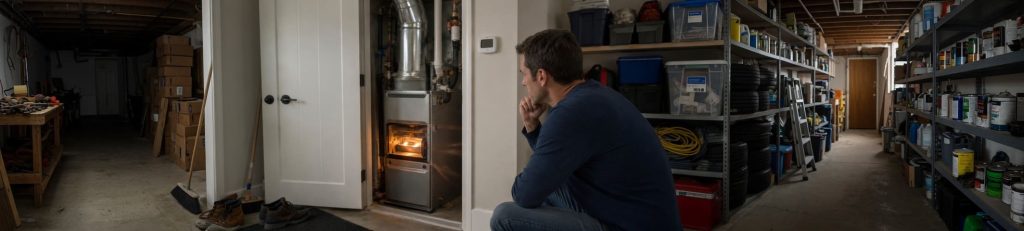
A furnace that repeatedly starts and stops before the thermostat reaches its target temperature is often short cycling. The cause may be as simple as a thermostat configuration or restricted filter, but repeated cycling can also point to overheating, weak blower performance, flame-sensing trouble, venting problems, incorrect equipment sizing, or an intermittent control fault.
What Does It Mean When a Furnace Keeps Turning On and Off?
Normal Furnace Cycling
A normal heating cycle begins when the thermostat calls for heat and ends after the indoor temperature reaches the selected setting. Cycle length changes with outdoor temperature, insulation, air leakage, thermostat configuration, furnace capacity, duct performance, and the number of heating stages.
Frequent operation during cold weather is not automatically a defect. A correctly sized furnace may operate for longer periods when the house is losing heat quickly.
When Cycling Becomes a Problem
Short cycling is more likely when the burners repeatedly shut down after a brief run, the furnace restarts without reaching the thermostat setting, or the system alternates between heating and cooldown periods.
The important question is whether the thermostat ended the call normally or a furnace safety or control circuit stopped the sequence.
- The thermostat sends a call for heat.
- The inducer starts and establishes the required venting conditions.
- The pressure circuit confirms that the startup conditions are acceptable.
- The ignition system lights the burners.
- The flame sensor confirms that a stable flame is present.
- The blower moves heated air through the duct system.
- The thermostat ends the call after the target temperature is reached.
- The blower may continue briefly to remove remaining heat from the furnace.
Different faults can create the same on-and-off symptom. Tell the technician whether the burners went out while the fan kept running, whether the flame lasted only a few seconds, or whether the entire furnace shut off.
First Identify What Is Actually Turning Off
The burners, blower, inducer, thermostat, and control board do not always stop at the same time. Distinguishing the following patterns can narrow the problem before any components are tested.
This may be a normal cooldown period if the thermostat has already reached its setting. If it happens repeatedly before the house is warm, it can indicate a high-limit shutdown caused by restricted airflow, excessive temperature rise, weak blower performance, or inadequate duct capacity.
This pattern is more consistent with flame verification, grounding, burner carryover, gas-delivery, or ignition-control trouble. The furnace may repeat the ignition sequence before entering a temporary lockout.
The furnace may be unable to establish the pressure conditions needed for safe operation. Possible areas include the intake, exhaust, inducer, pressure tubing, pressure switch, condensate trap, drain line, igniter, or related wiring.
If the inducer, burners, and blower all lose operation together, the cause may be an interrupted thermostat signal, unstable electrical supply, loose connection, door-switch issue, control-board fault, or another break in the control circuit.
Eight Reasons a Furnace May Keep Turning On and Off
Thermostat Settings, Placement, or Wiring
The thermostat controls when heating begins and ends. Weak batteries, loose wiring, poor calibration, unstable power, or an incompatible thermostat can create irregular calls for heat.
Placement matters as well. A thermostat exposed to direct sunlight, a supply register, an exterior door, a kitchen heat source, or an unusually cold wall may sense a temperature that does not represent the occupied rooms.
Short cycling can begin after a thermostat replacement if the heating-system type, number of stages, or cycle-rate setting is incorrect. Some thermostats allow the installer to set the maximum number of heating cycles per hour for different equipment types. [1]
Restricted Airflow Through the Filter, Coil, or Duct System
A furnace depends on a steady volume of return air moving across the heat exchanger. A loaded filter, incorrect filter size, backward filter installation, blocked return grille, closed supply register, dirty evaporator coil, restrictive ductwork, or high-resistance filter can reduce airflow.
The evaporator coil remains part of the airflow path even when the air conditioner is not running. Debris on the coil can therefore restrict heating airflow as well as cooling airflow.
Zoned systems may experience a similar problem when too few zones are open, dampers fail to move correctly, or the open duct area cannot carry the required furnace airflow.
Manufacturer service guidance connects excessive external static pressure with insufficient airflow, excessive temperature rise, and limit tripping. [2]
High-Limit Control Opening Because the Furnace Is Too Hot
The high-limit control is a safety device that responds when furnace temperature exceeds its permitted range. A limit fault should not automatically be treated as a failed switch. The switch is often reacting correctly to another operating condition.
Possible causes include restricted airflow, a dirty blower wheel, incorrect blower speed, weak motor performance, closed dampers, undersized return ductwork, a blocked supply path, excessive gas input, or an incorrect setup.
Temperature rise is the difference between the return-air temperature entering the furnace and the supply-air temperature leaving it. The measured result should be compared with the range specified for the particular furnace.
An incorrect temperature rise can contribute to overheating of the heat exchanger, while excessive static pressure can reduce the amount of air moved through the furnace. [2]
Blower Motor or Air-Movement Failure
The blower must start at the correct time, reach the intended speed, and remain stable throughout the heating cycle. A weak motor, failing capacitor on applicable systems, dirty blower wheel, loose connection, damaged electronic control module, or incorrect speed setting can reduce airflow.
Some failures are intermittent. A motor may start slowly, stop after warming up, run at the wrong speed, or fail only during a heating call. The burners may ignite normally at first, but the furnace can overheat when the blower does not remove heat fast enough.
Weak airflow does not automatically prove that the motor has failed. A restricted coil, high duct resistance, an unsuitable filter, or closed zoning dampers can make a functioning blower appear ineffective.
Oversized Furnace or Insufficient Duct Capacity
A furnace with substantially more heating capacity than the house requires can warm the area around the thermostat quickly and end the cycle before heat is distributed evenly. Rooms farther away may remain cool even though the furnace operates frequently.
Oversizing can also create an airflow problem. A high-capacity furnace connected to a return or supply system that cannot move the required volume of air may experience excessive temperature rise and repeated limit shutdowns.
ENERGY STAR advises that HVAC equipment should be sized from the actual characteristics of the home rather than a rule of thumb. It also notes that oversized equipment may cycle too frequently, reduce comfort, and shorten equipment life. [3]
Venting, Pressure, or Condensate Problems
Before normal burner operation continues, the furnace must establish the pressure conditions associated with its venting system. A blocked intake, obstructed exhaust, damaged pressure tube, weak inducer, improper vent configuration, or pressure-switch circuit fault can interrupt startup.
Condensing furnaces also depend on proper water drainage. Condensate must move through the collector, trap, tubing, and drain line. A restriction can change pressure conditions and cause repeated ignition attempts or shutdowns.
A pressure-switch fault code does not prove that the switch itself has failed. The underlying problem may be the vent, inducer, condensate system, tubing, wiring, or available pressure.
Furnace installation instructions require ignition, input rate, temperature rise, venting, airflow components, and condensate operation to be verified for the specific equipment. [4]
Flame Sensor, Burner, or Grounding Trouble
The flame sensor confirms that gas has ignited at the burners. If the control board cannot verify the flame, it closes the gas valve instead of allowing fuel to continue flowing without a confirmed flame.
Contamination on the sensor, incorrect sensor position, weak grounding, damaged wiring, poor burner ignition, unstable gas delivery, or a control-board fault can interrupt flame verification.
Burner carryover describes the way flame travels from one burner to the next. If ignition does not spread correctly across the burner assembly, the furnace may not establish a stable flame signal.
Control Board, Wiring, Sensor, or Safety-Circuit Faults
Furnace operation depends on a chain of switches, sensors, relays, wiring connections, grounding paths, and control-board decisions. Loose terminals, damaged thermostat wiring, unstable line voltage, moisture, an intermittent relay, or an internal board fault may interrupt the cycle.
Diagnostic lights and thermostat alerts can identify the circuit or condition detected by the control, but they do not always identify the failed component. A code should be used as a starting point for testing rather than an instruction to replace the named part.
A rollout switch responds when flame or excessive heat is detected outside the intended burner area. Manufacturer service guidance warns against bypassing safety limits and requires the cause of a repeated auxiliary-limit or rollout event to be determined. [2]
How the Timing of the Shutdown Narrows the Problem
Observe the sequence without removing furnace panels. The timing does not provide a final diagnosis, but it helps identify which part of the operating sequence needs to be tested.
| Observed pattern | Likely system area | Useful detail to record |
|---|---|---|
| Burners light and shut off within seconds | Flame sensing, grounding, burner ignition, gas delivery, or control logic | Number of ignition attempts and the displayed fault code |
| Burners run for several minutes, stop, and later restart | Airflow restriction, blower performance, temperature rise, or high-limit operation | Whether the blower continues after the flame stops |
| Inducer starts but normal ignition does not continue | Venting, condensate drainage, pressure proving, igniter, or safety circuit | Status-light code, unusual sounds, or water near the furnace |
| The entire furnace stops at once | Thermostat signal, electrical supply, door switch, wiring, or control board | Whether the thermostat also loses power or resets |
| Cycles have been short since installation | Sizing, duct capacity, blower setup, thermostat configuration, or zoning | Whether room temperatures have always been uneven |
Safe Checks a Homeowner Can Make
Basic observations can help document the problem, but furnace panels, burners, gas controls, electrical components, pressure switches, and safety limits should not be altered or bypassed.
Check the Thermostat
Confirm that it is set to Heat and that the target temperature is above the measured room temperature. Replace weak batteries and note whether the display resets or changes unexpectedly.
Inspect the Accessible Filter
Confirm that the filter is the correct size, is installed in the marked airflow direction, and is not visibly packed with dust. Do not operate the furnace without the required filter.
Keep Airflow Paths Open
Move furniture, rugs, boxes, and other objects away from return grilles and supply registers. Avoid closing multiple registers in an attempt to redirect heat.
Observe Accessible Exterior Vents
From a safe location, look for obvious debris, physical damage, or blockage at the intake and exhaust terminations. Do not insert tools or other objects into the vent.
Record the Operating Sequence
Note whether the inducer, burners, and blower start, how long the flame remains on, whether the blower continues after shutdown, and how soon the next cycle begins.
Record Codes Before Resetting Power
A photograph or short video of the furnace status light can preserve information that may disappear after power is interrupted.
Stop Operating the Furnace When Warning Signs Are Present
Turn the system off and follow the appropriate utility or emergency instructions if there is a gas odor, a carbon monoxide alarm, smoke, visible soot, scorching, electrical burning, or unusual flame outside the burner area.
Do not bypass a door switch, pressure switch, high-limit control, rollout switch, flame sensor, or any other safety device to keep the furnace running.
The U.S. Consumer Product Safety Commission recommends professional inspection of fuel-burning heating systems, including furnaces, chimneys, flues, and vents, because defective or obstructed heating and venting equipment can create carbon monoxide hazards. [5]
What a Complete Furnace Diagnosis Should Determine
The diagnosis should identify which control ended the cycle and why that control responded. Replacing a component named by a fault code without testing the surrounding system can leave the original problem unresolved.
Whether the call for heat remains stable at the furnace control terminals.
Whether the inducer, pressure circuit, igniter, gas valve, burners, and flame verification operate in the correct order.
Whether the control receives a stable flame-sensing signal while the burners are operating.
Whether the difference between return-air and supply-air temperature remains within the range specified for the furnace.
Whether the filter, evaporator coil, blower, ducts, registers, and zoning components allow the required airflow.
Whether the motor starts correctly, reaches the intended speed, and remains stable as it warms.
Whether the inducer, intake, exhaust, pressure tubing, drain trap, and condensate line operate correctly.
Whether furnace capacity, gas input, blower settings, thermostat staging, and duct capacity are compatible with the house.
Whether stored codes show a repeated pattern rather than an isolated interruption.
Whether limit, rollout, pressure, door, and related safety controls are opening for a valid operating reason.
If the pattern continues after the thermostat, filter, open registers, and accessible exterior vents have been checked, professional furnace testing and diagnosis may be needed to identify the control that is ending the cycle and the condition causing it.
Why Repeatedly Resetting the Furnace Does Not Fix Short Cycling
Disconnecting power may clear a temporary lockout, but it does not correct the airflow, ignition, venting, flame-sensing, overheating, or control condition that caused the shutdown.
Resetting power may also erase useful diagnostic information. Record the status-light code before interrupting power whenever it is safe to do so.
Primary Sources
The technical explanations in this article are based on official furnace, thermostat, HVAC-installation, and federal safety documentation. Requirements vary by furnace model, vent configuration, control system, and local code, so the instructions for the installed equipment remain the controlling reference.
Resideo T6 Pro Z-Wave Thermostat
Installer documentation covering heating-system configuration, staging, cycle-rate limits, and recommended cycles per hour for forced-air heating equipment.
Goodman Service and Troubleshooting Manual
Manufacturer guidance covering external static pressure, airflow, temperature rise, limit controls, rollout controls, blower operation, and furnace troubleshooting.
ENERGY STAR HVAC Quality Installation
Federal guidance explaining the importance of right-sized equipment, verified airflow, evaluated ductwork, and avoiding rule-of-thumb equipment selection.
Daikin Gas Furnace Installation Instructions
Manufacturer documentation covering ignition, input rate, temperature rise, filters, evaporator coils, venting, airflow, condensate drainage, and operating verification.
U.S. Consumer Product Safety Commission
Federal home-heating safety guidance addressing furnaces, fuel-burning heating systems, chimneys, flues, vents, professional inspections, and carbon monoxide hazards.
Common Questions About Furnace Short Cycling
Is every short furnace cycle abnormal?
No. Cycle length varies with outdoor temperature, building heat loss, thermostat settings, furnace staging, and equipment design. The stronger warning sign is repeated shutdown before the thermostat is satisfied.
Why do the burners stop while the blower keeps running?
The blower may be completing a normal cooldown period. If the thermostat has not reached its setting and the pattern repeats, the furnace may be removing heat after a high-limit event caused by restricted airflow, excessive temperature rise, or weak blower performance.
Why does the furnace shut off a few seconds after ignition?
This pattern often means the control did not receive reliable flame confirmation. Possible causes include flame-sensor contamination, grounding trouble, burner ignition problems, wiring faults, unstable gas delivery, or a control-board issue.
Can a new filter cause furnace short cycling?
A new filter can contribute if it is the wrong size, installed backward, unusually restrictive for the system, or added to ductwork that already has limited airflow. The filter should match the furnace and return-system requirements.
Can an oversized furnace be adjusted instead of replaced?
Some systems allow limited changes to staging, blower settings, gas input, or thermostat configuration. Any adjustment must remain within the furnace manufacturer’s specifications. Significant oversizing or inadequate duct capacity may not be correctable through settings alone.
When should a short-cycling furnace be turned off?
Stop operating the furnace when there is a gas odor, carbon monoxide alarm, smoke, soot, electrical burning, scorching, visible flame outside the burner area, or another immediate safety concern.
The Shutdown Sequence Is More Important Than the Symptom Alone
Furnace short cycling is not a single diagnosis. The burners may be stopping because the furnace is too hot, the flame is not being verified, the venting sequence is incomplete, or the thermostat has ended the call. The entire system may also be losing its control signal or electrical supply.
Note whether the burners, blower, and inducer stop together or at different times. Record the runtime and any fault code, check the thermostat and filter, and keep supply and return openings unobstructed. These details help separate an ignition problem from an airflow, overheating, venting, sizing, or control fault.