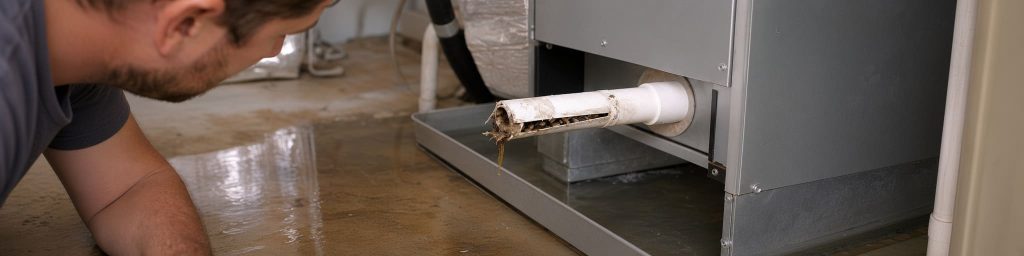
A condensate drain that clogs once may simply have accumulated enough debris to restrict the pipe. A drain that clogs repeatedly is different. When the same blockage returns after cleaning, something in the drainage system may be allowing water, biological growth, dirt, or sediment to collect faster than it should.
During normal cooling, moisture from indoor air condenses on the evaporator coil. The water falls into a drain pan and leaves the indoor unit through a condensate drain. For that process to work reliably, the pan, drain opening, pipe slope, trap, venting arrangement, downstream piping, and any condensate pump or overflow safety all need to work together.
If cleaning restores drainage only temporarily, the better question is not just “What is blocking the pipe?” It is “Why does the blockage keep coming back?”
- Biofilm, dust, and debris building up inside persistently wet piping
- A drain that is flat, sagging, or pitched in the wrong direction
- An incorrect, blocked, or improperly configured condensate trap
- A vent installed in a position that interferes with the intended drainage arrangement
- Dirt from the evaporator coil or drain pan entering the drain line
- A cracked, corroded, distorted, or contaminated drain pan
- A restriction farther downstream where the condensate line connects to another drain route
- A condensate pump or overflow-control problem that resembles a clogged line
How an AC Condensate Drain Is Supposed to Work
An air conditioner does more than lower indoor temperature. As warm indoor air moves across the cold evaporator coil, moisture in that air condenses into liquid water. During long cooling cycles or humid conditions, the system can produce a considerable amount of condensate.
Moisture forms on the evaporator coil
The coil surface operates below the dew point of the surrounding air, so water vapor condenses on the coil fins and tubing.
Condensate reaches the primary drain pan
The pan beneath the coil collects this water and directs it toward the drain opening.
The drain carries the water away
A gravity drain depends on correct piping geometry. Some installations also require a trap, vent, condensate pump, or specific arrangement to account for pressure inside the air handler.
A recurring clog usually means that something along this path is encouraging material to accumulate or preventing water from leaving consistently.
1. Biofilm Can Keep Building Up Inside the Drain
Wet condensate piping can support biological growth
Condensate drains stay damp for long periods during cooling operation. Dust, organic material, microorganisms, and residue can enter the pan and piping. Over time, a slippery buildup can develop on the inside wall of the drain.
This material is often loosely called algae or slime, but an actual blockage may contain a mixture of biological growth, dust, sediment, and other debris. As the layer thickens, it narrows the passage and traps more material.
2. Poor Drain Slope Can Leave Water Standing in the Pipe
The pipe can be open and still drain poorly
A gravity condensate line must maintain an appropriate downward route toward its discharge point. A section that is nearly level, slopes back toward the air handler, or sags between supports can hold water after the cooling cycle ends.
Standing water gives sludge and biological material more time to collect. The drain may appear clear immediately after flushing, yet return to the same condition after normal use resumes.
3. The Condensate Trap May Be Incorrect
A condensate trap is part of the HVAC drainage design
Pressure inside an air handler can affect how condensate leaves the cabinet. Depending on the equipment design and the position of the coil relative to the blower, the manufacturer may require a specific trap arrangement so water can drain properly while the system is operating.
A trap that is missing, undersized, partially blocked, incorrectly positioned, or configured differently from the equipment requirements can cause water to accumulate in the pan even when the downstream pipe is not fully obstructed.
4. Vent Position Can Affect Condensate Flow
A vent has to be in the correct location
A vent can be an intentional part of a condensate-drain configuration, but its position in relation to the trap and indoor unit matters. An opening installed in the wrong place can interfere with the pressure relationship that the drainage arrangement is designed to maintain.
Adding an open tee or standpipe simply because the drain seems slow is therefore not a universal fix. Existing piping should be compared with the requirements for the specific air handler or evaporator-coil assembly.
5. A Dirty Evaporator Coil Can Add Debris to the Drain
Coil condition and drain condition are connected
Particles that pass through or around the air filter can accumulate on the evaporator coil and surrounding surfaces. Some of that material can eventually reach the drain pan, where condensate carries it toward the outlet.
A dirty coil can also reduce airflow. If airflow becomes too low, the evaporator coil can get cold enough for moisture on the coil to freeze. When the ice later melts, the extra water can expose a drain that was already partially restricted or poorly configured.
6. The Drain Pan May Be Part of the Problem
A clear pipe does not correct a damaged or contaminated pan
The primary drain pan is intended to collect condensate and direct it toward the outlet. If the pan is contaminated, cracked, corroded, distorted, or positioned incorrectly, water and debris may not reach the outlet as intended.
Older metal pans can corrode. Other pan materials can crack or deform. Dirt and residue can also collect around the outlet and repeatedly enter the drain line after the downstream pipe has been cleaned.
Persistent standing water inside areas of the pan that should normally drain can point to pan geometry, equipment position, drain slope, or outlet problems.
7. A Shared or Downstream Drain Can Hide the Real Restriction
The visible drain near the air handler may be only part of the route
Some condensate lines terminate directly outdoors. Others connect to a condensate pump or to an approved building drainage arrangement. In those installations, the restriction may be farther downstream than the section that is easy to reach near the equipment.
A local cleaning can therefore make the upstream line look open while another restriction remains beyond a connection point. If more than one piece of equipment uses part of the same drainage route, the entire path needs to be understood.
The allowable connection and termination method depends on the installation and applicable local requirements, so an existing shared connection should be identified before it is modified.
8. A Condensate Pump Problem Can Look Like a Clogged Line
Some condensate systems rely on a pump
Where gravity drainage cannot reach the required discharge point, a condensate pump may collect water and move it through a separate discharge tube.
A failed pump, blocked discharge tube, dirty reservoir, malfunctioning float, kinked tubing, or loss of electrical power can cause water to back up even when the primary drain itself is open.
If a condensate pump is installed, the reservoir, float, pump operation, discharge tubing, and final termination should all be included in the diagnosis.
Why Repeat Drain Problems Can Cause Water Damage
Condensate is ordinary water, but the location of indoor HVAC equipment makes drainage failures important. Air handlers and evaporator coils are commonly installed in attics, closets, garages, mechanical spaces, or above finished ceilings.
A slow leak may not produce a dramatic puddle. It can repeatedly wet drywall, insulation, wood framing, cabinetry, flooring, or nearby finishes before the source becomes obvious.
If a ceiling or wall stain returns after the condensate drain was previously cleared, water is still escaping, backing up, or overflowing somewhere in the system. Repeated staining is a reason to investigate the drainage path again.
When Should the AC Be Turned Off?
A slowly draining line does not always require an immediate shutdown. Active overflow is different because the air conditioner continues to create condensate while it continues cooling.
Turn the system off at the thermostat if water is spilling from the indoor unit, auxiliary pan, ceiling, wall, or another finished area. The system should also remain off if leakage returns immediately after a restart.
- The primary or auxiliary drain pan is overflowing.
- Water is appearing through a ceiling, wall, cabinet, or flooring.
- Water is close to wiring, controls, or other electrical components.
- A condensate float or overflow switch repeatedly shuts the system down.
- The evaporator coil is visibly frozen and meltwater is beginning to accumulate.
- The drain was recently cleared but leakage resumes as soon as the AC starts operating.
If water is near electrical controls, wiring, or an electrical compartment, turn the system off at the thermostat and do not open the cabinet or touch electrical components. Turning the thermostat off does not necessarily remove electrical power from the indoor unit.
Why a Float Switch Can Shut the Air Conditioner Down
Many HVAC systems use a condensate float or overflow switch as a protective device. Depending on the installation, the switch may react to rising water in the primary drain, an auxiliary pan, or another monitored location.
The switch does not diagnose the cause of the problem. It responds to an abnormal water level and may interrupt cooling before the system continues producing additional condensate.
If a condensate safety repeatedly stops the AC, resetting or bypassing the switch does not correct the reason the water level is rising. The drain, pan, pump, and related components still need to be checked.
What Should Be Checked When the Drain Keeps Clogging?
A recurring problem deserves more than a test showing that water can pass through the pipe at one moment. The inspection should look for the condition that allows the blockage or backup to return.
Look for sludge, internal deposits, sagging pipe, unsupported runs, damaged fittings, low spots, or sections pitched back toward the equipment.
Determine whether the equipment requires a trap and whether the existing trap dimensions and placement match the manufacturer's drainage instructions.
Check where the vent sits in relation to the trap and indoor unit rather than assuming that any open vent arrangement is acceptable.
Inspect for debris, cracks, corrosion, deformation, a restricted outlet, and areas where water remains instead of reaching the drain.
Check for dirt, restricted airflow, evidence of icing, filtration problems, or contamination that may be reaching the condensate pan.
Identify where the condensate actually discharges and whether a restriction farther downstream or a shared connection could be causing the backup.
If one is installed, verify the reservoir, float mechanism, pump operation, discharge tubing, and final discharge point.
Confirm that the float or overflow switch is positioned correctly and operating as intended rather than bypassing it to keep the system running.
What Different Symptoms May Point To
Possible causes include persistent biofilm, standing water, a sagging section of pipe, contamination from the pan, or incomplete cleaning farther downstream.
The drain should be checked for trap, vent, pressure, or piping-configuration problems rather than assuming the pipe is simply blocked by debris.
A downstream restriction, shared drainage connection, condensate pump, or problem at the final termination may be involved.
A condensate safety may have operated. The elevated water level should be investigated before the system is repeatedly restarted.
The system may still be overflowing intermittently, leaking from the pan, or backing up under specific operating conditions.
One-Time Clog vs. Recurring Drain Problem
A drain that accumulated debris over a long period may return to normal service after the obstruction and contaminated material are removed and proper drainage is confirmed.
A drain that blocks again over weeks or months is more likely to have an underlying condition such as retained water, poor pitch, repeated contamination, incorrect trapping, pan problems, or a downstream restriction.
Repeated staining, water in an auxiliary pan, float-switch trips, or leakage into finished areas should be treated as a condensate-system problem rather than routine drain maintenance.
Should You Keep Pouring Cleaner Into the Drain?
There is no single chemical treatment that is appropriate for every HVAC condensate system. Equipment materials, drain configuration, manufacturer instructions, and the nature of the blockage can differ.
More importantly, a cleaning solution cannot correct a sagging drain, improper trap, damaged pan, failed condensate pump, incorrect vent arrangement, or restriction farther downstream.
If the line has already been cleaned and the same problem returns, identifying the cause is more useful than repeating the same treatment.
How to Reduce the Chance of Another Clog
- Use the correct air filter and replace or service it at an appropriate interval.
- Keep the evaporator coil and surrounding cabinet reasonably clean.
- Inspect the primary drain pan and drain outlet during routine HVAC maintenance.
- Correct condensate piping that sags or does not maintain the required drainage path.
- Keep accessible cleanouts and drain components serviceable.
- Repair cracked, corroded, or distorted drain pans when necessary.
- Correct trap or vent arrangements that do not match the equipment requirements.
- Maintain the condensate pump when the installation relies on one.
- Confirm that water reaches the intended termination after service rather than assuming that a clear upstream section proves the entire route is open.
When the Drain Problem Is Part of a Larger AC Issue
Recurring condensate trouble can sometimes be connected to a broader HVAC problem. Coil contamination, low airflow, freeze-up, equipment position, pan deterioration, or repeated safety-switch operation may all affect what appears at first to be a simple clogged drain.
For that reason, systems with repeated drainage problems may need a broader air-conditioning repair diagnostic rather than another isolated drain clearing. The purpose of that inspection is to determine whether the blockage itself is the primary fault or a symptom of another condition.
Frequently Asked Questions
Why does my AC drain clog again after it has already been cleaned?
The previous cleaning may have removed the immediate obstruction without correcting what caused it. Standing water, poor pipe slope, an incorrect trap, pan contamination, coil debris, a downstream restriction, or a condensate-pump problem can all lead to repeat blockage.
Is algae always the reason an AC drain line clogs?
No. Biological growth is common in wet condensate systems, but dust, sludge, sediment, poor drain geometry, pan deterioration, and downstream restrictions can produce similar symptoms.
Can a dirty evaporator coil clog the condensate line?
It can contribute. Material accumulating on the coil and surrounding surfaces may enter the drain pan, and condensate can carry some of that debris toward the drain outlet. A dirty coil can also reduce airflow and contribute to icing under some conditions.
Can a clogged drain cause the AC to stop running?
Yes. A system equipped with a condensate float or overflow switch may interrupt cooling when water reaches an abnormal level. The shutdown can help limit additional condensate production, but the cause of the backup still needs to be identified.
Is water in the primary drain pan normal?
Condensate moving through the primary pan during cooling is normal. Persistent standing water, overflow, water in an auxiliary pan, or leakage into surrounding materials should be investigated.
Why is my AC leaking if the drain line looks clear?
The drain line is only one possible source. A cracked or distorted pan, frozen coil, poor slope, incorrect trap arrangement, disconnected piping, condensate-pump problem, or restriction farther downstream can also cause water to appear around the indoor unit.
Should I turn off the AC if water is coming through the ceiling?
Yes. Turn cooling off at the thermostat if the system is actively leaking into a ceiling or another finished area. Continuing to cool allows the system to keep producing condensate and can increase water damage.
Does turning the thermostat off make the indoor unit electrically safe?
No. Turning the thermostat to OFF stops the cooling call but does not necessarily remove electrical power from the air handler. If water is near wiring or electrical controls, do not open the cabinet or touch electrical components.
Repeated Clogging Usually Has an Underlying Cause
A condensate drain should carry water away reliably whenever the air conditioner is operating. When the line repeatedly blocks, backs up, trips a float switch, or causes water staining, the drain should be evaluated as part of the complete condensate system.
Biofilm may be involved, but so can pipe slope, trap configuration, vent placement, evaporator cleanliness, pan condition, downstream connections, condensate pumps, and overflow protection.
Finding the condition that allows the problem to return is more useful than simply reopening the drain each time it clogs.