
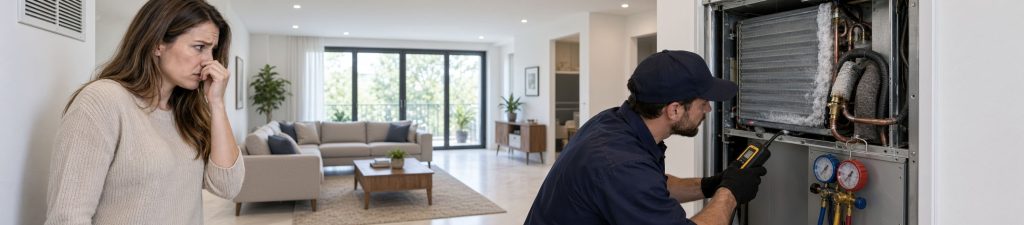
What Does a Refrigerant Leak Smell Like? Signs Your AC May Be Leaking Refrigerant
Most residential AC refrigerants have little noticeable odor, although some are described in safety data sheets as having a faint ether-like smell. A refrigerant leak cannot be confirmed by smell alone. More useful clues include reduced cooling, evaporator or refrigerant-line icing, persistent hissing, and fresh oily residue near refrigerant components.
There is no single dependable smell that identifies an AC refrigerant leak. A faint chemical or ether-like odor may sometimes be noticeable, but many leaks produce no obvious odor at all.
What Does an AC Refrigerant Leak Smell Like?
Refrigerant odor depends on the specific refrigerant, the amount released, ventilation, and the location of the leak. Some refrigerant safety data sheets describe an odor as slight or ether-like, while odor thresholds may not be established. That makes smell an unreliable diagnostic method.
Common residential AC refrigerants are colorless, and refrigerant escaping from a system can rapidly vaporize at atmospheric pressure. A small leak may therefore produce no visible liquid and no smell that a homeowner can clearly identify.
Older and newer air-conditioning systems may contain different refrigerants, including R-22 in older equipment, R-410A in many existing systems, and refrigerants such as R-32 or R-454B in equipment specifically designed for them. Their properties and safety requirements are not identical.
Signs That May Point to a Refrigerant Leak
Changes in AC operation are generally more useful than odor. No single symptom proves that refrigerant is leaking, because airflow restrictions, dirty equipment, control problems, and mechanical faults can create similar symptoms.
| Possible sign | What you may notice | What it may indicate |
|---|---|---|
| Reduced cooling | The AC runs, but rooms cool more slowly than before. | A low refrigerant charge can reduce cooling capacity, although airflow and equipment faults can do the same. |
| Ice or frost | Ice appears on the evaporator coil or refrigerant line. | A sufficiently low refrigerant charge can contribute to low evaporator temperature, but restricted airflow is another common cause. |
| Persistent hissing | A new hissing sound is noticeable near a coil, fitting, valve, or refrigerant line. | Pressurized refrigerant escaping through an opening can produce a hissing sound. |
| Fresh oily residue | A greasy area appears around a refrigerant joint, coil, valve, or fitting. | Escaping refrigerant can sometimes carry compressor lubricant with it. |
| Longer cooling cycles | The AC takes longer to reach the thermostat setting. | Loss of cooling capacity can increase runtime, but weather, airflow, ducts, and equipment condition can also affect cycle length. |
Reduced Cooling and Longer AC Runtime
A system that has lost refrigerant may still start and move air normally while producing less cooling than expected. Because the refrigeration circuit is no longer operating under the conditions for which it was designed, the system may take longer to remove heat from the home.
Reduced cooling is not specific to refrigerant loss. Dirty filters, restricted return airflow, dirty coils, blower problems, duct leakage, thermostat issues, compressor problems, and extreme outdoor conditions can produce similar symptoms. A broader explanation is available at https://maksbuilder.com/air-conditioning-repair/.
Ice on the Evaporator Coil or Refrigerant Line
A sufficiently low refrigerant charge can reduce evaporator pressure and contribute to coil temperatures falling below freezing. Moisture from the surrounding air can then freeze on the evaporator or nearby refrigerant tubing.
Ice does not automatically mean the system is low on refrigerant. A clogged air filter, dirty evaporator coil, blower malfunction, blocked return grille, or another airflow restriction can also cause the coil to become too cold.
Useful distinction: Ice shows that the system is operating abnormally, but it does not identify the cause by itself.
Persistent Hissing Near a Coil or Refrigerant Line
Refrigerant in an operating air-conditioning system is under pressure. If it escapes through a small opening in a coil, connection, valve, or line, a hissing sound may be audible near the leak.
Sound alone is not enough to confirm a leak. HVAC systems can also make brief refrigerant-flow or pressure-equalization noises during normal operation. A new, persistent hissing sound is more significant when it appears together with reduced cooling, icing, or fresh oily residue.
Fresh Oily Residue Around Refrigerant Components
Refrigeration systems circulate lubricant with the refrigerant. When refrigerant escapes through a physical opening, a small amount of oil can sometimes escape as well.
Fresh oily residue around a refrigerant joint, valve, coil, or tubing connection can support suspicion of a leak. It is not conclusive evidence, because old service residue, dirt, or other contaminants may look similar.
- Evaporator coil tubing
- Condenser coil tubing
- Brazed joints
- Service valves and valve cores
- Mechanical or flare connections where used
- Refrigerant lines affected by vibration, rubbing, corrosion, or physical damage
Is a Sweet or Chemical Smell Proof of a Refrigerant Leak?
No. Terms such as sweet, chemical, and ether-like are sometimes used to describe refrigerant odors, but they are not reliable diagnostic criteria.
Different refrigerants have different properties, people perceive odors differently, and a residential leak may release too little refrigerant for an odor to be obvious. The absence of a noticeable smell does not rule out a leak, and a chemical smell does not prove that refrigerant is the source.
Other AC Smells That Can Be Mistaken for Refrigerant
Musty or Damp
More commonly associated with persistent moisture, biological growth, a wet filter, condensate problems, or damp material near the air handler or ductwork.
Burning or Electrical
May come from overheated wiring, a motor, electrical insulation, a capacitor, or another electrical component.
Dirty-Sock or Sour
Typically associated with moisture and biological material on the evaporator coil or nearby surfaces rather than refrigerant loss.
Oily
Lubricant may contribute to an oily smell near a leak, but visible fresh residue is more useful evidence than odor alone.
Can a Refrigerant Leak Be Dangerous?
The risks depend on the refrigerant, the concentration released, ventilation, and the equipment design. Potential hazards can include concentrated vapor exposure, oxygen displacement in confined spaces, cold injury from direct contact with liquid refrigerant, and refrigerant-specific toxicity or flammability concerns.
Some newer residential HVAC equipment uses A2L refrigerants. Under ASHRAE Standard 34 terminology, the A classification indicates lower toxicity and 2L indicates lower flammability. Examples include R-32 and R-454B in systems specifically designed for those refrigerants.
How an AC Refrigerant Leak Is Confirmed
Diagnosing an abnormal refrigerant charge and locating the physical leak are related but different tasks.
Checking System Operation
Refrigerant pressures, line temperatures, superheat, and subcooling may help determine whether the refrigeration circuit is operating normally.
These measurements can support a diagnosis of an incorrect charge, but they do not identify the exact location of a leak.
Locating the Leak
- Electronic refrigerant leak detection
- Bubble solution at suspected joints
- Inspection for fresh oil traces
- Isolation and pressure testing when appropriate
- Manufacturer-approved detection procedures
The correct procedure depends on the refrigerant, system design, suspected leak location, and whether enough refrigerant remains in the system for meaningful operating measurements. More information is available at https://maksbuilder.com/services/hvac-diagnostics-in-orange-county-ca/.
Does an Air Conditioner Normally Need Refrigerant Refilled?
Refrigerant is not normally consumed like fuel. It circulates through a closed refrigeration circuit.
If a system that was correctly charged later becomes undercharged, refrigerant loss should be investigated. An incorrect charge can also result from installation errors or previous service work.
Adding refrigerant may change system operation, but it does not repair a physical leak if one is present.
What Should You Do If You Suspect a Refrigerant Leak?
- Do not deliberately smell around the equipment.
- Do not loosen service fittings or open the refrigerant circuit.
- Do not use a flame or ignition source to search for a leak.
- Recognize heavy icing as evidence of abnormal operation.
- If a substantial release is suspected indoors, leave the immediate area.
- Use the equipment nameplate to identify the refrigerant type.
Frequently Asked Questions
Can you smell an AC refrigerant leak?
Sometimes, but not reliably. Some refrigerants may have a faint ether-like or chemical odor, while many small leaks produce no obvious smell.
Does refrigerant smell sweet?
Some people describe refrigerant odors as sweet or chemical, but odor descriptions are subjective and vary by refrigerant. Smell should not be used to confirm a leak.
Does ice on an AC line mean the system is low on refrigerant?
Not necessarily. Low refrigerant charge can contribute to icing, but restricted airflow, dirty filters, dirty coils, and blower problems can create similar conditions.
Can a refrigerant leak cause poor cooling?
Yes. Refrigerant loss can reduce cooling capacity, but poor cooling also has many non-refrigerant causes.
Can an AC simply run out of refrigerant?
Refrigerant is intended to remain in the sealed system. If a correctly charged system later becomes undercharged, refrigerant loss should be investigated rather than treated as normal consumption.
Bottom Line
A refrigerant leak does not have one dependable smell. Some refrigerants may have a faint ether-like or chemical odor, while many leaks produce no noticeable odor at all. Reduced cooling, icing, persistent hissing, and fresh oily residue are more useful clues, but none confirms a leak by itself.
Sources
- U.S. Environmental Protection Agency, Refrigerant Safety: https://www.epa.gov/snap/refrigerant-safety
- U.S. Environmental Protection Agency, Substitutes in Residential and Light Commercial Air Conditioning and Heat Pumps: https://www.epa.gov/snap/substitutes-residential-and-light-commercial-air-conditioning-and-heat-pumps
- Arkema, Forane R-410A Customer Specification Sheet: https://forane.arkema.com/files/live/sites/shared_arkema/files/downloads/fluorochemicals/forane-410a-_customer-specification-sheet.pdf