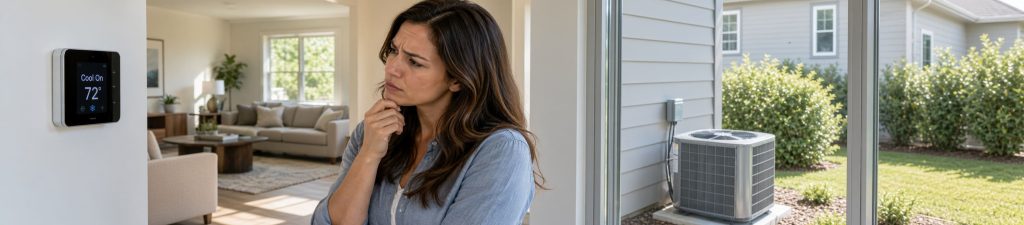
If your thermostat says “Cool On” but the AC is not running, the thermostat is usually requesting cooling, but the HVAC system has not successfully started.
That does not automatically mean the thermostat is faulty. A short delay can be normal after the system shuts down, the thermostat restarts, or power is restored. On many thermostats, a blinking “Cool On” message indicates a compressor-protection delay that typically lasts about three to five minutes.
If the message remains on and the air conditioner still does not start, check which part of the system is responding.
What the Cool On Message Tells You to Check Next
“Cool On” is blinking
Wait about three to five minutes. The thermostat may be protecting the compressor from restarting too quickly.
“Cool On” is solid and nothing runs
Check the thermostat settings, indoor-unit power, breakers, access panel, condensate safety switch, and low-voltage control circuit.
Indoor blower runs, but the outdoor unit does not
The thermostat and indoor side are responding, so the cooling sequence is stopping before or at outdoor-unit startup. Check outdoor-unit power and whether the cooling signal is reaching the outdoor controls before assuming a component has failed.
Outdoor unit runs, but there is no indoor airflow
Turn cooling off and check the indoor blower side. Possible causes include indoor-unit power, blower controls, blower motor problems, or a frozen evaporator coil.
A breaker trips again after being reset
Do not keep resetting it. Repeated breaker trips require electrical or HVAC diagnosis.
Why Does the Thermostat Say Cool On but the AC Is Not Running?
On thermostats that use a “Cool On” message, it typically means the thermostat is requesting cooling or is waiting through a compressor-protection delay.
The message does not confirm that the indoor blower, outdoor condenser, compressor, or other HVAC components have actually started.
For a typical split air-conditioning system to operate, several parts of the control chain must work correctly:
- The thermostat must have power and call for cooling.
- The indoor furnace or air handler must have power.
- The low-voltage control circuit must be intact.
- Safety switches must permit operation.
- The outdoor unit must have electrical power.
- The outdoor controls must respond to the cooling call.
- The compressor, condenser fan, and indoor blower must be able to operate.
What Cool On confirms: a Cool On message tells you what the thermostat is requesting. It does not confirm that the entire HVAC system has responded successfully.
Is a Blinking Cool On Message Normal?
Often, yes.
Many thermostats intentionally delay compressor operation after:
- switching the system to Cool;
- a recent cooling cycle;
- a thermostat restart;
- a power interruption;
- a recent setpoint change.
The delay helps prevent rapid compressor cycling. Depending on the thermostat and HVAC equipment, it commonly lasts around three to five minutes.
What to Do First
Set the thermostat to Cool, lower the set temperature below the current room temperature, and leave the controls alone for about five minutes.
Avoid repeatedly switching between Off and Cool because some thermostats restart the protection timer each time.
If the system starts after several minutes, the delay may have been normal. If the message remains on and the AC still does not operate, continue with the checks below.
Check the Thermostat Settings First
Confirm Cool Mode
Make sure the thermostat is set to Cool, not Heat, Off, or Fan-only operation.
Lower the Cooling Setpoint
The set temperature must be below the actual indoor temperature for the thermostat to request cooling.
There is no need to lower the thermostat dramatically. Setting it to 60°F does not make a conventional single-stage air conditioner cool the house faster.
Check the Thermostat Batteries
If the thermostat uses replaceable batteries, install fresh batteries if there is a low-battery warning, intermittent display, or unusual thermostat behavior.
Use the Fan Test
Temporarily change the fan setting from Auto to On.
If the indoor blower starts, the blower itself is at least capable of operating, and the problem may be more closely related to the cooling call or another part of the cooling-control circuit.
If the blower still does not start, the problem may be on the indoor-unit side, including:
- indoor-unit power;
- blower controls;
- blower motor;
- control board;
- another indoor electrical fault.
After the test, return the fan setting to Auto.
Check the Breaker, Disconnect and AC Power
A thermostat can continue displaying normally even when part of the HVAC system has lost electrical power.
Central air-conditioning systems commonly have separate power supplies for the indoor furnace or air handler and the outdoor condenser.
If Nothing Runs
- Check the furnace or air-handler breaker.
- Check the AC or condenser breaker.
- Check the accessible indoor HVAC service switch.
- Make sure the furnace or air-handler access panel is fully installed.
Many indoor units use a door safety switch that interrupts operation when an access panel is open or incorrectly positioned.
If the Indoor Unit Runs but the Outdoor Unit Is Silent
Check whether the outdoor AC breaker has tripped and whether the outdoor disconnect appears to be in its normal operating position.
Safety: do not remove electrical covers or touch exposed conductors.
If a Breaker Has Tripped
A tripped breaker can generally be reset once after the HVAC system has been switched off.
If the breaker trips again, stop resetting it. At that point the problem is no longer a thermostat-setting issue; the affected electrical circuit or HVAC equipment needs proper diagnosis.
Condensate Float Switch and Drain Problems
A clogged condensate drain can prevent some air-conditioning systems from operating.
During cooling, moisture from indoor air collects at the evaporator coil and drains through the condensate system. If the drain becomes blocked, water can rise in the drain pan.
Many installations include a float switch or condensate safety switch that interrupts cooling before the water overflows.
Signs of a Possible Condensate Problem
- Standing water near the furnace or air handler.
- Water in an auxiliary drain pan.
- A raised or wet float-switch assembly.
- Water staining around the indoor unit.
- An AC system that suddenly stopped during humid weather.
- A visibly backed-up drain line.
The exact shutdown behavior depends on how the switch is wired. It may interrupt the outdoor cooling signal, the entire cooling circuit, or another part of the control system.
Do not bypass a condensate safety switch to force the AC to run. The switch may be preventing water damage.
Indoor Blower Runs but Outdoor Unit Does Not
If air is moving through the vents but the outdoor condenser is completely silent, the thermostat and at least part of the indoor equipment are responding.
Start by checking outdoor-unit power and whether the cooling-control signal reaches the outdoor equipment.
If the Indoor Blower Runs but the Outdoor Unit Stays Off
- loss of electrical power to the outdoor unit, including the breaker, disconnect, or fuse;
- loss of the low-voltage cooling signal;
- a control or safety condition preventing the outdoor unit from accepting the cooling call;
- an equipment-level fault that requires separate outdoor-unit diagnosis.
Check whether the thermostat's cooling request reaches the outdoor equipment. If power and the cooling-control signal are present but the unit still does not start, the remaining fault is inside the outdoor equipment and requires separate diagnosis.
Humming, Buzzing or Repeated Clicking
If the outdoor unit hums, buzzes, clicks repeatedly, or repeatedly tries to start, switch the system off rather than continuing to cycle it.
These symptoms can point to an electrical, motor, control, or compressor-starting problem.
Do not handle capacitors as a DIY test. A capacitor can retain an electrical charge after power has been disconnected.
Outdoor Unit Runs but Indoor Blower Does Not
The opposite situation is also important: the outdoor condenser is operating, but little or no air is coming from the supply vents.
In this situation, turn cooling off rather than allowing the outdoor unit to continue running without normal indoor airflow.
Insufficient airflow across the indoor evaporator coil can contribute to coil freezing and additional system problems.
Possible causes include:
- loss of power to the indoor unit;
- blower motor failure;
- blower control or relay problem;
- control-board fault;
- electrical connection problem;
- a frozen evaporator coil restricting airflow.
Use the thermostat Fan On test described earlier. If the blower still does not run, the issue is more likely on the indoor-unit or blower-control side.
What If Neither the Indoor nor Outdoor Unit Runs?
If the thermostat shows Cool On but neither unit operates, start with the components that can prevent the entire cooling sequence from starting.
- Check the thermostat mode and set temperature.
- Check thermostat batteries, if applicable.
- Check the indoor and outdoor HVAC breakers.
- Check the indoor-unit service switch.
- Check the air-handler or furnace access panel.
- Look for visible condensate safety-switch conditions.
If those checks are normal, possible causes include:
- loss of 24-volt control power;
- a blown low-voltage fuse;
- a failed transformer;
- a damaged thermostat wire;
- an open safety circuit;
- a control-board fault;
- a thermostat failure.
These faults can look almost identical without electrical testing. Measuring the control circuit is more reliable than replacing parts based on symptoms alone.
When the Problem Is the Thermostat
A failed thermostat is possible, but it should not be the first conclusion.
Thermostat-related problems can include:
- failed internal switching or electronics;
- loose or damaged thermostat wiring;
- incorrect wiring after thermostat replacement;
- temperature-sensor errors;
- loss of common-wire power;
- a cooling-control output that is no longer functioning correctly.
Heat Works but Cooling Does Not
If heating works normally but cooling never starts, the thermostat becomes one possible cause, but the fault can also be in the cooling-control wire, outdoor-unit circuit, safety controls, or condenser.
Heating and cooling do not necessarily use the same control path or equipment.
Avoid Jumping Thermostat Wires as a First Test
Online troubleshooting instructions sometimes recommend removing thermostat wires and manually jumping control terminals.
This should not be the first homeowner test. Connecting the wrong terminals or working with an existing low-voltage short can create additional problems.
Check These in Order When Cool On Stays On
-
Wait three to five minutes.
Rule out a normal compressor-protection delay. -
Confirm Cool mode and the setpoint.
Make sure the thermostat is actually requesting cooling. - Check thermostat batteries if the model uses them.
-
Temporarily test Fan On.
This helps determine whether the indoor blower can operate independently. - Check the HVAC breakers and indoor service switch.
- Look for condensate water or an activated float switch.
-
Identify which equipment is running.
Check the indoor blower and outdoor condenser separately. - Stop troubleshooting if the breaker trips again, equipment overheats, or you notice burning smells, repeated buzzing, or abnormal electrical behavior.
When You Need AC Diagnostics
If the basic checks are normal but the AC still does not start, trace the cooling command to the point where it stops.
A proper HVAC diagnostic process may include checking:
- whether the thermostat is actually sending a cooling signal;
- whether the 24-volt control circuit is powered;
- whether safety switches are closed;
- whether the outdoor equipment receives the correct control signal;
- whether line voltage reaches the condenser;
- whether the outdoor equipment reports a control or equipment fault after receiving the cooling call;
- indoor blower operation and airflow.
Diagnosis becomes especially important if:
- the breaker trips more than once;
- the outdoor unit hums or repeatedly attempts to start;
- the indoor blower does not run;
- the thermostat repeatedly loses power;
- there is a burning smell;
- you see damaged or overheated wiring;
- the AC starts and immediately shuts down.
If testing confirms a failure in the air-conditioning equipment itself, further air-conditioning repair may be needed. Confirm where the control signal or electrical supply is interrupted before replacing parts.
What You Should Not Do
- Do not repeatedly reset a breaker that continues to trip.
- Do not bypass a condensate safety switch.
- Do not open live electrical compartments.
- Do not handle capacitors without appropriate electrical training and equipment.
- Do not repeatedly cycle the compressor on and off.
- Do not assume the thermostat is bad simply because it displays Cool On.
- Do not replace parts before identifying which part of the system is failing to respond.
Frequently Asked Questions
Why does my thermostat say Cool On but nothing happens?
The thermostat may be requesting cooling while the HVAC system is unable to respond. First rule out the normal compressor delay, then check thermostat settings, HVAC power, the indoor unit, condensate safety controls, and whether the outdoor condenser is receiving power and a cooling signal.
How long should Cool On blink before the AC starts?
On many thermostats, a blinking Cool On message can indicate a compressor-protection delay of approximately three to five minutes. If the system still does not start after the delay, another problem may be preventing operation.
Why is Cool On solid but the AC is not running?
A solid Cool On indication usually means the thermostat believes cooling should be active. It does not confirm that the indoor blower, outdoor unit, or compressor has successfully started.
Can a clogged condensate drain stop the AC?
Yes. If the HVAC system has a condensate float or safety switch, backed-up water can activate the switch and interrupt cooling to help prevent an overflow.
Why does the indoor fan run but the outside AC unit does not?
That pattern means the thermostat and indoor side are at least partly responding. Check whether the outdoor unit has power and whether the cooling-control signal reaches it. If both are present, the remaining fault is inside the outdoor equipment and needs separate diagnosis.
Can a bad thermostat cause the AC not to turn on?
Yes. A thermostat can have wiring, power, sensor, relay, or electronic problems. However, similar symptoms can also come from HVAC power, safety switches, control wiring, or equipment faults, so the thermostat should not automatically be blamed.
If Cool On Stays On but the AC Still Will Not Start
If your thermostat says Cool On but the AC is not running, start by waiting several minutes to rule out a normal compressor-protection delay.
Then confirm the thermostat settings, test the indoor fan, check HVAC power and breakers, look for condensate safety problems, and determine whether the indoor blower and outdoor unit are operating.
If Cool On stays on, identify where the cooling sequence stops. That distinction helps separate a normal thermostat delay from an indoor airflow problem, outdoor-unit fault, power issue, safety shutdown, or thermostat/control failure.