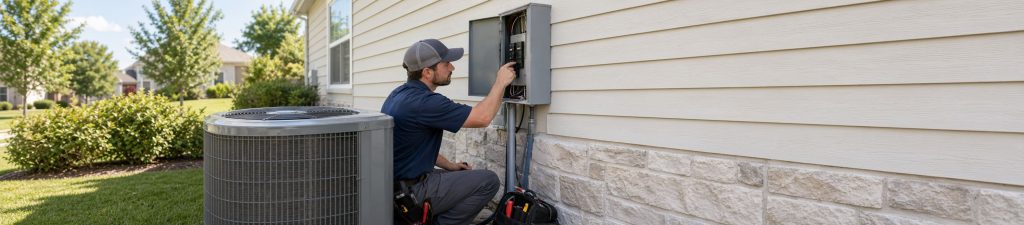
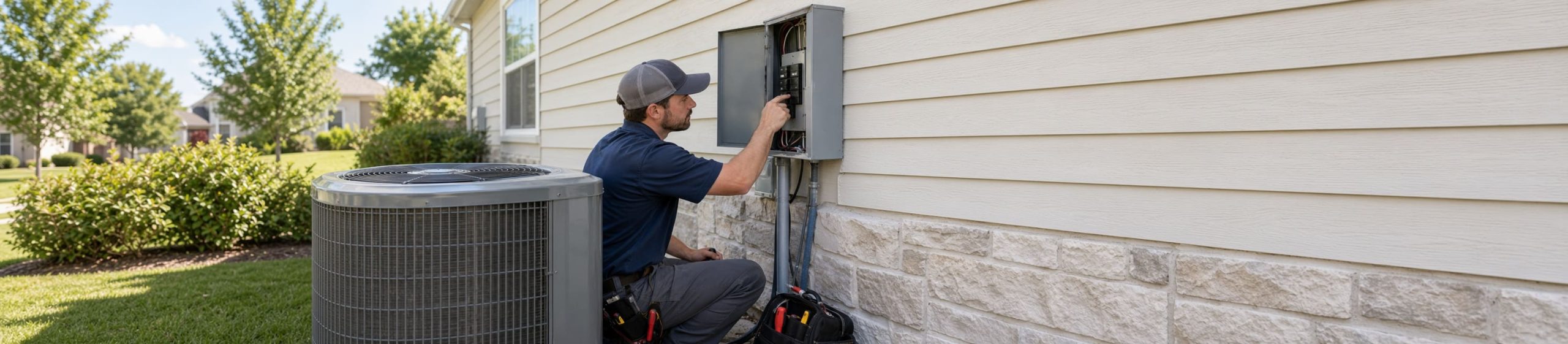
A Repeated Breaker Trip Is an Electrical Warning
If your AC breaker keeps tripping, stop running the system until the cause is identified. Repeated breaker trips usually mean the air conditioner is drawing excessive electrical current or there is an electrical fault involving the compressor, capacitor, fan motor, wiring, contactor, disconnect or breaker.
A dirty outdoor condenser can also increase compressor load, especially during hot weather. The timing of the breaker trip can help narrow down the problem, but electrical testing is usually required before a failed component can be confirmed.
Why an AC Breaker Trips
The circuit breaker supplying your air conditioner is designed to disconnect power when electrical current exceeds the level the circuit is intended to carry or when certain electrical faults occur.
Central air conditioners place a substantial electrical load on the circuit, particularly when the compressor and condenser fan start. When a component begins drawing more current than normal, the breaker may open to protect the wiring and equipment.
Seven Common Electrical and HVAC Causes
The same symptom can come from several different electrical or mechanical problems. The timing of the trip and electrical measurements help determine which component is actually responsible.
Dirty Condenser and Excessive Compressor Load
The outdoor condenser coil releases heat collected from inside the home. When the coil becomes heavily coated with dirt, dust or debris, the system has a harder time rejecting heat.
Under severe conditions, compressor operating pressure and temperature can rise, increasing the electrical load on the system. A severely restricted outdoor coil can therefore contribute to high compressor current and overheating.
Weak or Failed Capacitor
Many AC systems use capacitors to help the compressor and fan motors start and operate correctly. When a capacitor weakens, the connected motor or compressor may struggle to start and draw unusually high startup current.
- The outdoor unit hums but does not start
- The condenser fan starts slowly or intermittently
- The breaker trips as cooling begins
- The system repeatedly attempts to start
Capacitors can retain electrical charge even after power is disconnected and should not be tested or replaced as a homeowner troubleshooting step.
Condenser Fan or Blower Motor Problem
Electric motors can begin drawing excessive current when bearings wear, windings deteriorate, an internal electrical fault develops or the motor encounters mechanical resistance.
A failing condenser fan can also reduce heat rejection, forcing the compressor to operate under greater stress.
Compressor Hard-Starting or Locked-Rotor Condition
The compressor normally draws a brief surge of electrical current when it starts and then settles into a lower running current.
If it becomes difficult to start, it may remain in a hard-start or locked-rotor condition, where the compressor attempts to start but cannot rotate normally and draws very high current.
- Hard-starting compressor
- Locked rotor
- Damaged compressor windings
- Winding short
- Compressor fault to ground
- Serious internal mechanical wear
Shorted or Damaged Wiring
HVAC wiring is exposed to vibration, temperature changes, moisture and outdoor conditions. Over time, insulation or electrical connections can deteriorate.
- Damaged wire insulation
- Loose electrical terminals
- Burned or overheated conductors
- Short circuits between conductors
- Electrical faults to ground
Contactor, Disconnect or Electrical Connection Problem
A damaged contactor, loose terminal, deteriorated disconnect or overheated connection can create abnormal resistance, arcing or a direct electrical fault.
- Buzzing or crackling near electrical equipment
- Burning electrical odor
- Discoloration around terminals
- Melted insulation or plastic
- Intermittent loss of power
Faulty or Incorrectly Sized Circuit Breaker
Circuit breakers can deteriorate with age and repeated thermal cycling. However, the breaker should not automatically be blamed simply because it trips.
Breaker size must match the electrical requirements of the equipment and circuit. A larger breaker should never be installed simply to stop an AC breaker from tripping.
Can a Dirty Air Filter Cause an AC Breaker to Trip?
A severely clogged air filter can restrict airflow through the indoor system. That can contribute to poor cooling, evaporator coil icing, longer operating cycles and additional stress on HVAC equipment.
However, a dirty filter should not automatically be blamed for repeated breaker trips. Compressor, motor, capacitor, wiring and electrical faults are more direct causes of excessive current.
When Does the AC Breaker Trip?
The point at which the breaker trips can provide useful diagnostic information. It does not confirm the failed component on its own, but it can narrow down what needs to be tested.
| When the Breaker Trips | More Likely Areas to Check |
|---|---|
| Immediately when cooling starts | Short circuit, grounded component, compressor fault or damaged wiring |
| When the outdoor unit starts | Capacitor, compressor, condenser fan motor or contactor |
| After several minutes of operation | Motor overheating, compressor overcurrent, poor condenser heat rejection or deteriorating connection |
| Mainly during very hot weather | High operating load, dirty condenser, weakening compressor, motor or electrical component |
| Randomly or intermittently | Loose connection, damaged wiring, intermittent motor fault or breaker problem |
What You Can Safely Check
Homeowners can inspect a few basic conditions without opening electrical equipment.
Stop the cooling call while you inspect the system.
Replace it if it is severely clogged.
Make sure airflow is not blocked by leaves, stored items or dense vegetation.
Humming, buzzing or repeated clicking can help describe the problem.
From a safe distance, check for smoke, scorching or melted material.
Do not test capacitors or handle exposed HVAC wiring.
Why You Should Not Keep Resetting the AC Breaker
A breaker that repeatedly trips is protecting the circuit from an abnormal electrical condition. The fault needs to be identified before the AC is repeatedly powered again.
- Overheated electrical terminals or wiring
- Additional stress on a failing compressor
- Damage to a struggling fan or blower motor
- A worsening short circuit or ground fault
- More extensive and expensive equipment damage
How an HVAC Technician Diagnoses a Breaker That Keeps Tripping
A reliable diagnosis requires electrical measurements rather than replacing parts based only on symptoms.
- Confirm incoming supply voltage
- Inspect the breaker and outdoor disconnect
- Check wiring and electrical terminals
- Measure compressor startup current
- Measure compressor running current
- Measure fan and blower motor current
- Test capacitor values
- Inspect contactor condition
- Test compressor winding resistance
- Check compressor for a fault to ground
- Inspect condenser coil and fan operation
- Compare readings with equipment ratings
When to Turn the AC Off and Call for Service
Stop running the air conditioner and schedule service when:
- The AC breaker has tripped repeatedly
- The breaker trips immediately when cooling starts
- The outdoor unit hums but does not start
- The condenser fan is not running
- You hear electrical buzzing or repeated clicking
- You notice a burning electrical odor
- There is visible scorching or damaged wiring
- Smoke or unusual heat is coming from electrical equipment
Frequently Asked Questions
Why does my AC breaker keep tripping after a few minutes?
A breaker that trips after several minutes may indicate an overheating motor, compressor overcurrent, poor condenser heat rejection, a deteriorating electrical connection or a breaker problem.
Why does my AC breaker trip immediately?
An immediate trip can indicate a short circuit, grounded component, damaged wiring, compressor electrical fault or another high-current condition.
Can a bad capacitor trip the AC breaker?
Yes. A weak or failed capacitor can prevent a compressor or motor from starting correctly, causing excessive startup current.
Can a bad compressor trip the breaker?
Yes. A hard-starting compressor, locked rotor, damaged winding, shorted winding or compressor fault to ground can create very high current.
Can a dirty AC condenser cause the breaker to trip?
A severely dirty condenser can reduce heat rejection and increase compressor pressure, temperature and electrical load.
Can a dirty air filter cause the AC breaker to trip?
A severely clogged filter can cause airflow problems, but electrical components, motors, compressor condition and wiring should still be checked when a breaker repeatedly trips.
Can the AC breaker itself be bad?
Yes, but the AC equipment and electrical circuit should first be tested to determine whether the breaker is correctly responding to excessive current or an electrical fault.
Why does the breaker trip when the outside AC unit starts?
Likely areas to test include the capacitor, compressor, condenser fan motor, contactor and outdoor wiring.
Is an AC breaker that keeps tripping dangerous?
Repeated breaker trips indicate an abnormal electrical condition. Leave the system off, especially if there is burning odor, buzzing, smoke, visible wiring damage or overheating.
What to Do After a Repeated Breaker Trip
If your AC breaker keeps tripping, the circuit may be experiencing excessive current because of a weak capacitor, failing motor, hard-starting compressor, damaged wiring, electrical connection problem, dirty condenser or defective breaker.
The timing of the trip can narrow the diagnosis, but voltage, amperage and component testing are needed to confirm the actual cause. If the breaker has tripped repeatedly, leave the air conditioner off until the fault is diagnosed.
One Response