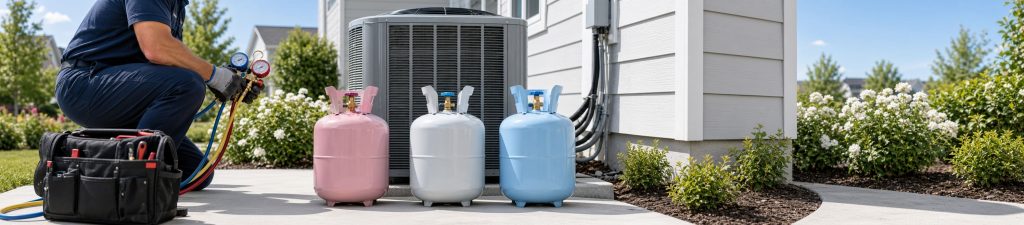
If you're replacing an air conditioner or heat pump, you'll probably encounter three refrigerant names: R-410A, R-32 and R-454B. They do the same basic job, but they aren't interchangeable.
R-410A is common in existing systems. R-32 and R-454B have lower global warming potential (GWP) and are used in newer equipment. Here's what those differences mean when you're maintaining an older AC or comparing replacement estimates.
R-410A vs R-32 vs R-454B at a Glance
The most useful differences are environmental impact, composition and safety classification. The GWP bars show each refrigerant's impact per kilogram relative to R-410A using the same 100-year measurement.
R-410A
Long-established refrigerant found in many existing central AC and heat-pump systems.
- Composition
- HFC blend (R-32 / R-125)
- Safety class
- A1 — no flame propagation
- Equipment
- Many existing residential systems
R-32
Single-component, lower-GWP refrigerant used in purpose-built newer HVAC equipment.
- Composition
- Single HFC
- Safety class
- A2L — lower flammability
- Equipment
- New systems designed for R-32
R-454B
Lower-GWP HFC/HFO blend used in newly designed AC and heat-pump systems.
- Composition
- R-32 / R-1234yf blend
- Safety class
- A2L — lower flammability
- Equipment
- New systems designed for R-454B
GWP figures use IPCC Fourth Assessment Report (AR4) values listed by ASHRAE. Other assessment methods may produce different numbers. A lower GWP means lower direct climate impact if the same mass is released; it does not indicate an AC system's electricity use.
Why HVAC Refrigerants Are Changing
Air conditioners circulate refrigerant through sealed components. If that refrigerant escapes during a leak, servicing or disposal, it can contribute to climate warming. GWP compares the warming effect of a gas with carbon dioxide over a defined period—100 years in the figures above.
U.S. rules under the American Innovation and Manufacturing (AIM) Act are reducing the use of high-GWP hydrofluorocarbons. New residential and light-commercial AC and heat-pump systems became subject to a federal 700-GWP limit in 2025, with specific transition provisions.
EPA: 2026 installation update
A final rule published May 26, 2026 removed the federal installation deadline for certain higher-GWP residential and light-commercial systems when all specified components were manufactured in the U.S. or imported before January 1, 2025.
This is a limited existing-inventory provision, not permission to manufacture unrestricted new R-410A systems.
CARB: rules for new AC equipment
California separately prohibits refrigerants with a GWP of 750 or greater in new equipment classified as “other air-conditioning” beginning January 1, 2025.
A federal installation exception does not automatically override California requirements. An Orange County project must satisfy the applicable state rules and local code.
For existing owners: the transition does not require you to remove a working R-410A air conditioner solely because it uses R-410A.
What Is R-410A?
R-410A is a blend of two HFC refrigerants, R-32 and R-125. It became common in central air conditioners and heat pumps before the move to lower-GWP equipment.
Its ASHRAE A1 classification indicates lower toxicity and no flame propagation under specified test conditions. Its main disadvantage in the transition is a comparatively high GWP of 2,088.
Existing R-410A systems can still be maintained and repaired under applicable requirements. If one is performing well, refrigerant type alone is not a reason to replace it.
What Is R-32?
R-32 is a single-component HFC refrigerant with an AR4 GWP of 675. It is used in air conditioners and heat pumps engineered specifically for it.
Because R-32 is a single refrigerant rather than a blend, it does not experience a shift in blend composition through component fractionation. Correct charging and qualified service remain essential.
R-32 has an A2L classification, so approved equipment and installation procedures must account for its lower flammability. It is used in ductless systems and some ducted products, including the Daikin FIT DH6VS heat pump.
What Is R-454B?
R-454B is a blend containing approximately 68.9% R-32 and 31.1% R-1234yf by mass. With an AR4 GWP of 466, it has the lowest GWP of the three refrigerants compared here.
Like R-32, R-454B is classified A2L. Manufacturers use it in newly designed air conditioners and heat pumps with appropriate components, safety provisions and charging specifications.
It is not an environmentally updated refill for older R-410A equipment; the complete system must be approved for R-454B.
Equipment Design and GWP
GWP tells you about a refrigerant's potential direct climate impact when released into the atmosphere. It does not tell you how much electricity a specific air conditioner will use.
Manufacturers choose compressors, heat exchangers, expansion devices and controls for the properties of a particular refrigerant. Different system designs can therefore achieve similar efficiency with different refrigerants.
Refrigerant lines, indoor coils and safety controls also need to match the equipment manufacturer's instructions—not simply fit together physically.
Can These Refrigerants Be Interchanged?
No. R-410A, R-32 and R-454B cannot be used as direct substitutes for one another in residential HVAC equipment.
Putting R-32 or R-454B into an R-410A system is not a shortcut to a lower-GWP air conditioner. Pressure behavior, approved components, charging requirements and safety provisions differ. The same applies to mixing R-32 and R-454B.
If a replacement system uses a different refrigerant, the outdoor unit and indoor components need to be selected as an approved combination.
What If You Already Own R-410A Equipment?
If your Orange County home already has R-410A equipment, base the decision on its actual condition and repair economics.
- The system works properly.
Keep up with normal maintenance. A functioning R-410A air conditioner does not need replacement simply because of the refrigerant transition.
- A repairable part has failed.
A capacitor, contactor or fan motor failure does not automatically justify a complete system replacement.
- Refrigerant service is needed.
A qualified technician should investigate any loss of refrigerant and service the equipment with its specified refrigerant. Refrigerant should not be treated as something the AC routinely consumes.
- The compressor or coil needs an expensive repair.
Compare repair and replacement costs along with equipment age, warranty coverage, reliability and parts availability. Future R-410A supply and price can also affect long-term service economics.
For leak-specific symptoms rather than refrigerant comparisons, read what a refrigerant leak may smell like and other warning signs.
Does Refrigerant Type Decide Which System Is Better?
No. Refrigerant alone does not determine cooling efficiency, comfort or equipment life. Two systems using different refrigerants can have similar efficiency ratings, while models using the same refrigerant may perform quite differently.
When comparing actual AC or heat-pump models, consider:
- SEER2 and EER2: published cooling-efficiency ratings for the matched equipment.
- HSPF2: seasonal heating efficiency for heat pumps.
- Capacity control: single-stage, two-stage or variable-capacity operation.
- Noise and comfort: equipment sound ratings and the location of the outdoor unit.
- Installation: correct sizing, adequate airflow, duct condition and startup checks.
For example, an Orange County home with restricted return airflow or leaky attic ducts may continue to have hot rooms after installing a new AC, regardless of whether it uses R-32 or R-454B.
What to Check When Buying New HVAC Equipment
Before approving an estimate, ask the contractor to identify the actual equipment being installed and how it will work with your home.
- Exact model numbers and refrigerant. Confirm both the indoor and outdoor equipment.
- Approved match. Request the AHRI-certified combination or reference number when applicable.
- System sizing. Ask how the home's cooling and heating loads were considered.
- Existing components. Confirm whether the furnace, coil, lines, ducts and controls can remain.
- Safety and permits. Confirm applicable A2L requirements, California regulations and local approvals.
- Warranty and support. Compare coverage terms, parts availability and qualified service options.
- Installed price. Get a written scope covering equipment, modifications and startup checks.
For equipment and installation information, see AC installation and replacement in Orange County or heat pump installation options.
Frequently Asked Questions
Answers to common questions about R-410A, R-32 and R-454B.
Is R-32 better than R-454B?
Not universally. R-454B has lower GWP, while R-32 is a single-component refrigerant. Neither guarantees better efficiency, reliability or cost without comparing specific HVAC models.
Is R-454B more efficient than R-410A?
Not automatically. Its GWP is much lower, but energy efficiency comes from the complete system design. Compare the matched equipment's SEER2 and other ratings.
Can I put R-32 or R-454B into an older R-410A AC?
No. Neither is a drop-in substitute. An R-410A system must use the refrigerant specified for its equipment.
Are R-32 and R-454B safe for homes?
Both are used in residential systems designed for A2L refrigerants. They have lower flammability, not zero flammability, and require compliant installation and servicing.
Is R-410A banned in California?
California restricts higher-GWP refrigerants in specified categories of new AC equipment. It does not require existing working R-410A systems to be immediately removed.
Will R-410A still be available for repairs?
R-410A remains relevant for existing-system service, including available and reclaimed supplies. Future availability and costs may change during the HFC phasedown.
Can I reuse the existing refrigerant lines?
Sometimes. The installer must check line size, condition, cleanliness, suitability and manufacturer approval for the new equipment.
How do I know which refrigerant my AC uses?
Check the outdoor unit's manufacturer label or technical documentation. A qualified technician can help if the designation is missing or unclear.
Should I replace my working R-410A AC now?
Not solely because of its refrigerant. Consider replacement when age, reliability, repair costs or worthwhile comfort and efficiency improvements support it.
Bottom line: R-410A remains common in existing equipment; R-32 and R-454B are lower-GWP refrigerants for systems designed around them. They cannot be interchanged. For a working AC, focus on condition and maintenance. For new equipment, compare sizing, matched components, rated performance, installation and support.
Technical Sources
Refrigerant data and regulatory guidance are based on the following sources:
- ASHRAE Handbook 2026 — Halocarbon and Hydrocarbon Refrigeration Systems
- ASHRAE — Refrigerant Designations and Safety Classifications
- U.S. EPA — Technology Transitions HFC Restrictions by Sector
- U.S. EPA — May 2026 Technology Transitions Final Rule Fact Sheet
- California Air Resources Board — Air-Conditioning Equipment Requirements