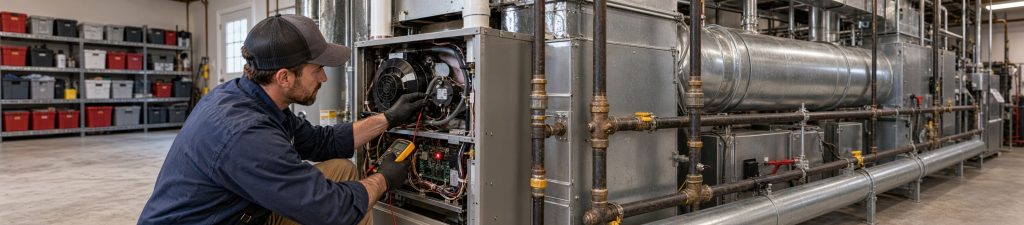
Furnace pressure switch failure symptoms include an inducer motor that runs without burner ignition, a pressure-switch fault code, or repeated heating attempts that stop before the burners light.
These symptoms identify a problem in the draft-proving system, not necessarily a broken switch. The furnace may be responding correctly to a blocked vent, poor inducer performance, or backed-up condensate. Finding out why the switch did not change state matters more than replacing it based on a fault code.
What Does a Furnace Pressure Switch Do?
Before ignition, a small fan called the draft inducer draws air through the combustion passages and establishes the draft needed to vent combustion gases once the burners light. The pressure switch responds to the draft-related pressure created by that fan. The control board checks the switch before allowing ignition to proceed.
In a common single-switch design, the contacts are open before the inducer starts and close after adequate negative pressure develops. Some condensing and multi-stage furnaces use several switches or a different sequence, so the manufacturer's service information determines what should happen on a particular model.
The switch does not detect carbon monoxide or prove that every part of the vent is clear. It verifies one pressure condition used by the furnace's safety controls.
Common Pressure Switch Failure Symptoms
A pressure-switch problem usually shows up during furnace startup. Pay attention to whether the inducer starts, whether the burners ignite, and which fault code appears.
The inducer starts, but the burners stay off
You hear the draft inducer, but the furnace stops before lighting the burners. The indoor blower may stay off or run without warm air, depending on the control.
The display shows a pressure-switch code
The control may report “did not close,” “reopened,” or “did not open.” These describe different electrical states. Flash counts and code wording vary by furnace.
The furnace retries or enters lockout
The inducer may stop and restart after a delay. Some control boards eventually lock out heating until their programmed retry period ends.
Some heat calls work; others fail
Wind at an outdoor vent, water collecting in a condensate line, a loose connection, or an inconsistent inducer can make the problem come and go.
Stuck Open vs. Stuck Closed: What the Codes Mean
Stuck open (or “did not close”): The inducer has started, but the board does not see the expected closed circuit. Draft may be too weak, the vent or sensing tube may be blocked, or the switch or its wiring may be faulty. If the switch opens during a heating cycle, the board may stop the burners and show a related code.
Stuck closed (or “did not open”): In systems that check for an open switch before starting the inducer, the board detects a closed circuit too early. A mechanically stuck switch is one possibility; trapped pressure in the sensing line, a wiring short, or a control problem can also require investigation.
Neither message is enough to justify replacing the switch without testing. The exact meaning and timing of each code depend on the furnace model.
Inducer Runs but Burners Do Not Ignite
Hearing the inducer does not mean it has created enough draft. The fan may be turning while an exhaust vent is restricted, a pressure-sensing tube is obstructed, or the inducer is failing to move enough air.
In a typical heating cycle, the thermostat calls for heat, the inducer starts, the board checks the pressure switch, the igniter operates, the burners light, and the flame is verified before the indoor blower delivers warm air. If the pressure check fails, the igniter and gas valve may never be activated.
If the burners light briefly and then go out, flame proving or another safety shutdown becomes more likely. If the igniter activates but the burners never light, the igniter, gas valve command, and other ignition components need separate checks.
Venting, Condensate and Control Problems
A pressure-switch code can come from problems with combustion airflow, accumulated water, or the electrical signal reaching the control board.
Restricted combustion air or exhaust
Leaves, nesting material, damaged vent pipe, an excessively long vent run, or an underperforming inducer can prevent the required pressure from developing. The allowed vent length, diameter, slope, and termination arrangement are specific to the furnace model.
Condensate backing up
High-efficiency condensing furnaces produce water as they run. A clogged condensate trap or drain, poor drain routing, or water collecting where it should not can interfere with the pressure-sensing system. The furnace may start normally on one heat call and fail on the next as water accumulates.
Sensing tube, switch, wiring, or control fault
A cracked, loose, pinched, or clogged sensing tube can keep the correct pressure from reaching the switch. The pressure port itself may be obstructed. If the switch responds correctly but its signal does not reach the control board, the problem may be a connector, wire, or board input rather than the switch.
Pressure Switch vs Ignitor vs Flame Sensor
All three can cause a no-heat complaint, but they act at different points in the heating sequence.
Pressure switch
Role: confirms a required draft-related pressure condition.
Typical clue: ignition is prevented before the burners light, often with a pressure-switch fault.
Ignitor
Role: initiates burner ignition using a hot surface or spark, depending on design.
Typical clue: the furnace reaches the ignition stage but the burners do not light.
Flame sensor
Role: confirms flame after burner ignition on systems that use flame rectification.
Typical clue: the burners light but go out quickly because flame is not proved.
Inducer motor
Role: moves combustion gases through the vent path.
Typical clue: it may not start, may be unusually noisy, or may run without establishing the required pressure.
The key difference is when ignition stops: before the igniter, during ignition, or after the burners have briefly lit. A technician uses that timing alongside the furnace's fault codes and electrical tests.
How a Technician Diagnoses the Fault
To distinguish insufficient draft from an incorrect pressure-switch signal, a trained technician typically:
- Identifies the furnace model, the exact diagnostic code, and the expected switch state at each point in the startup sequence.
- Checks inducer operation, intake and exhaust venting, sensing hoses and ports, and condensate drainage where applicable.
- Measures pressure at the specified test point using a suitable manometer, then compares the reading with the model's service specifications.
- Checks whether the pressure-switch contacts actually open and close when expected and whether that signal reaches the control board.
- Fixes the confirmed cause and checks that the furnace completes a heating cycle with the required safety and combustion checks.
When Is the Pressure Switch Itself Actually Bad?
If the measured draft pressure meets the manufacturer's requirement at the switch sensing point, but the contacts do not close as specified, the switch becomes a likely fault once the sensing tube, connection, and circuit have been ruled out. Likewise, contacts that stay closed when the switch should be open may indicate a stuck mechanism after other causes are excluded.
If measured pressure is too low, the technician looks for the reason in the inducer, venting, combustion-air supply, or condensate system. If the contacts respond correctly but the board registers the wrong state, wiring or the control input needs attention. A replacement switch must be the manufacturer-approved part with the correct operating specification; a different rating is not a workaround.
Can You Bypass a Furnace Pressure Switch?
No. Do not bypass, jumper, or defeat a furnace pressure switch. It is a combustion-safety interlock. Bypassing it can allow the furnace to attempt ignition without th