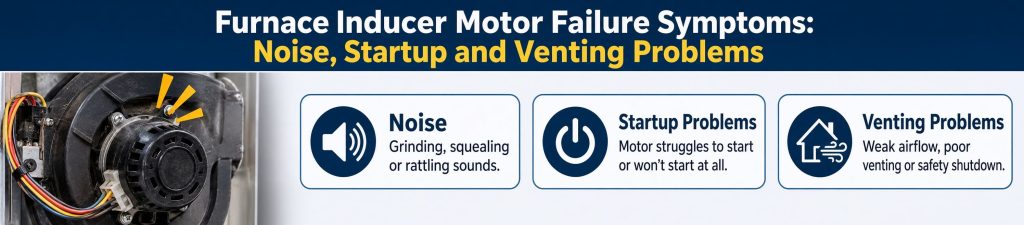
A failing furnace inducer motor may squeal or grind before ignition, hum without starting normally, or shut down during a heat call. The burners may never light.
These signs point to the combustion-draft system, not the blower that moves warm air through your home. A vent restriction or electrical fault can mimic a bad motor, so the sound, startup timing, and fault code matter more than any one symptom.
What Does a Furnace Inducer Motor Do?
The draft inducer is a motor-and-fan assembly in the furnace's combustion system. Before ignition, it draws air through the combustion passages during pre-purge and establishes the pressure condition required for startup. While the burners fire, it helps move combustion products through the heat exchanger and exhaust vent.
- Thermostat calls for heat
- Inducer starts and pre-purges
- Pressure-switch condition confirmed
- Burners ignite; flame is proven
- Indoor blower delivers heat
On many furnaces, the control checks that the pressure switch is open before the inducer starts and closes when the specified pressure develops. That check confirms one pressure condition; it does not detect carbon monoxide or guarantee that the entire vent is clear. The inducer may also run briefly after burner shutdown (post-purge). The exact sequence and motor speeds depend on the furnace model.
Inducer vs. indoor blower: the inducer serves the combustion and venting path; the indoor blower circulates household air through the ducts.
Symptoms of a Failing Inducer Motor
Pay attention to when a new noise begins. Grinding before ignition points more strongly toward the inducer than noise that starts later with the indoor blower. These clues narrow the investigation, but none identifies a failed part by itself.
Whining, squealing or grinding at startup
A sharp whine or squeal can indicate bearing wear. Scraping or grinding may mean the fan wheel is contacting its housing; loose hardware or a damaged wheel can rattle.
Humming without a normal fan start
A low hum with no familiar spinning-air sound may come from a stalled inducer or another electrical component. Whether the wheel is actually turning must be checked by a technician, not by removing a cabinet panel to look.
Intermittent or unusually slow starts
The inducer may start on one heat call and fail on the next. Intermittent wiring, motor electronics, heat-related faults or a dragging wheel are possible causes.
Draft or pressure-switch fault codes
Burner ignition may be blocked if the control does not see the expected switch state. Check for a vent, condensate or pressure-sensing issue before treating the code as proof of motor failure.
A light, consistent fan sound can be normal. A new metallic scrape, worsening squeal, or abrupt change in startup behavior is more useful evidence than noise volume alone.
Furnace Hums but Does Not Ignite
A hum does not prove the inducer is turning. It may be a stalled motor, another electrical component or the normal hum of a running fan. From outside the cabinet, note whether you hear the usual airflow sound and whether the burners ignite; a technician must confirm wheel movement.
For a suspected stalled inducer, the technician checks whether the control called for operation and whether the specified power and signals reach the motor. The cause may be mechanical binding, wiring, motor electronics, a control fault or, on designs that use one, a failed run capacitor. Many variable-speed inducers have no separate run capacitor.
If the inducer runs but ignition never begins, pressure-proving and venting checks come next. A running motor does not necessarily produce adequate draft.
Inducer Starts and Then Stops
An inducer that starts and stops is not necessarily defective. The control might abort startup after a safety check, retry after a delay or finish a normal cycle. Note what happened just before it stopped.
It stops before the burners light
The control may be aborting startup because draft was not proved, the expected pressure-switch state was missing, or the motor did not reach its required operating condition.
It stops while the burners are firing
That needs prompt evaluation. The control may be reacting to lost draft, a motor or control fault, condensate buildup, or another safety condition. Burner operation should not continue without the required combustion airflow.
Some furnace controls report inducer-speed faults; others report pressure-switch faults. Interpret the code using the specific model's diagnostic chart.
Repeated retries are not a reason to keep resetting the furnace. Record the sequence, switch the heating call off, and arrange diagnosis if the issue recurs.
Inducer Motor vs Pressure Switch Problems
The inducer creates combustion airflow; the pressure switch reports whether the specified pressure condition has been met. They work together but fail differently.
| What you notice | What it may mean | What to do next |
|---|---|---|
| No inducer sound after the expected startup delay | Motor command, electrical supply, failed motor or control | Record the code and timing. A technician should check power and the start command before replacing parts. |
| Grinding or scraping before burner ignition | Worn bearings or contact between the wheel and housing | Stop the heating call if the noise is severe and have the assembly inspected. |
| Fan sounds normal, but burners stay off with a pressure-switch code | Insufficient draft, restricted vent, condensate or sensing fault | Share the code with the technician. Diagnosis requires pressure and circuit measurements. |
| Inducer starts, then cuts out during startup | Interrupted safety sequence, motor-control or venting problem | Record when it stops; do not repeatedly reset the furnace to clear the fault. |
For stuck-open and stuck-closed switch faults, see furnace pressure switch failure symptoms.
Motor Bearings, Electrical Faults and Vent Restrictions
Bearings and fan wheel
Worn bearings may squeal or grind; a bent, corroded or loose wheel may rub or vibrate. Many inducer assemblies use sealed bearings and are replaced as an assembly rather than lubricated in place.
Motor wiring and controls
Loose wiring, incorrect supply voltage, a run capacitor fault where fitted, or failed motor electronics can prevent startup. Technicians check model-specific voltage, current and feedback signals.
Exhaust, intake and condensate
A blocked vent termination, restricted intake, leaking inducer gasket or damaged vent can reduce draft even with a healthy motor. On condensing furnaces, a clogged drain or trap can allow water to collect where it disrupts operation.
Repair or Replacement
Correcting loose wiring, a capacitor fault where fitted, a clogged condensate trap or a vent restriction may restore operation without a new inducer. Seized bearings, failed windings or electronics, and a damaged fan wheel generally call for the approved motor or inducer assembly rather than lubrication or improvised repair.
The replacement must match the furnace model's wheel, motor control, gaskets and venting requirements. After installation, the technician should verify pressure-switch response, vent connections and burner operation, not just that the motor spins.
What affects the repair estimate? Whether the manufacturer supplies a motor separately or as an assembly, OEM parts availability, access to the furnace, replacement seals and required post-repair safety checks. A quote should identify the confirmed fault rather than rely on a pressure-switch code alone.
How a technician confirms the problem
- Identify the furnace model, fault history, startup timing and any unusual sound.
- Verify the control's command to the inducer and the electrical supply or motor feedback required by that design.
- Inspect the wheel, bearings, housing, seals, intake, exhaust and condensate system where applicable.
- Use a suitable manometer at manufacturer-designated pressure test points and compare readings under the specified operating conditions.
- Repair the confirmed cause, then verify pressure-switch response, ignition, combustion/vent operation and a complete heating cycle.
For an older furnace with other major faults, compare the full repair estimate with replacement options. Equipment condition and combustion-safety findings matter more than age alone.
FAQ
Can a bad inducer motor keep a furnace from igniting?
Yes. If the inducer cannot start or establish the required draft, the furnace control normally prevents burner ignition. The same no-ignition symptom can also come from the vent, pressure-sensing system or control circuit.
Does a pressure-switch code mean the inducer motor is bad?
No. It means the control did not see the expected pressure-switch condition. The actual cause could be inadequate draft, an obstructed sensing tube, condensate, wiring or the switch itself. Pressure and electrical tests distinguish them.
Can an inducer motor run but still be faulty?
Yes. A motor can turn while a damaged wheel, incorrect speed, weak electrical operation or a leaking assembly prevents adequate draft. But if the motor is running normally, vent and condensate restrictions also need investigation.
Can you oil a squealing furnace inducer motor?
Not as a general fix. Many modern inducer motors have sealed bearings and no lubrication points. Follow the manufacturer's service guidance; adding oil to a sealed motor will not repair worn bearings.
Why does the inducer keep running after the heat shuts off?
A short post-purge period can be normal. Running much longer than the model's specified sequence, especially with a fault code or no thermostat heat call, calls for control and safety-circuit diagnosis.
Is it safe to keep using a furnace with a grinding inducer?
Do not ignore new severe grinding or repeated startup failures. Stop the heating call and have the motor and combustion venting checked. Never bypass a pressure switch or repeatedly reset a furnace to force it to run.
For persistent startup noises or no-heat shutdowns, the furnace repair service in Orange County covers diagnosis of the inducer, venting and safety controls.