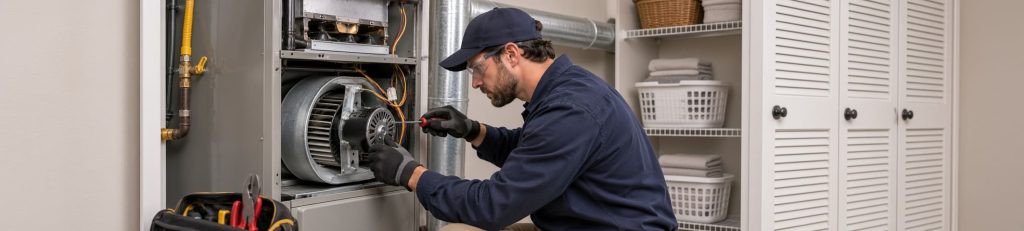
Furnace blower motor failure symptoms include humming without spinning, grinding or squealing noises, a blower that will not start, and a fan that stops unexpectedly during a heating cycle.
These signs can indicate a failing motor, but a bad PSC run capacitor, faulty ECM module, missing control signal, or mechanical obstruction can cause similar behavior. The motor should be tested before it is replaced.
Common Furnace Blower Motor Failure Symptoms
Notice whether the blower starts, what it sounds like, and when it stops.
Blower does not start
No air comes from the vents when the blower should be running. The motor may have failed, or it may not be receiving the necessary power or command.
Humming without rotation
An electrical hum with no fan movement can indicate a weak PSC run capacitor, a binding motor, or an electrical fault.
Unexpected stops and restarts
The blower starts normally but stops during operation. Thermal protection, intermittent wiring, or ECM electronics may be involved.
Grinding, scraping, or squealing
Noise that follows blower operation may come from worn motor bearings, a loose fan wheel, or contact between the wheel and housing.
Weak airflow, higher blower noise, and frequent furnace shutdowns also deserve attention. However, these symptoms can result from duct or filter restrictions even when the motor itself is working.
Blower Motor Symptoms: Diagnostic Guide
The blower's behavior helps narrow down the possible causes.
On a narrow screen, scroll horizontally to see all diagnostic columns.
| Blower behavior | Likely areas to investigate | What distinguishes the fault |
|---|---|---|
| Completely silent | Power supply, fan command, wiring, motor, or ECM module | Verify that the furnace requests blower operation and that the motor receives the specified supply and signal. |
| Hums but will not turn | PSC capacitor, motor bearings, winding, or supply problem | Identify the motor type, test the run capacitor if applicable, and inspect for mechanical binding. |
| Starts slowly | Weak PSC capacitor, incorrect voltage, motor drag | Compare capacitor condition, supply voltage, mechanical resistance, and motor current with specifications. |
| Stops and restarts | Motor thermal overload, intermittent supply or command, ECM module | Determine whether the motor stops while the proper electrical command remains present. |
| Grinding or scraping | Motor bearings, blower wheel, mounting or housing | Inspect the blower assembly for bearing wear, looseness, and physical interference. |
| Runs with weak airflow | Filter, coil, dirty wheel, duct resistance, motor speed or output | Check static pressure and delivered airflow before treating the motor as defective. |
| Breaker trips or electrical odor | Motor, wiring, electronics, or another electrical fault | Stop using the equipment. Electrical diagnosis is needed before restarting. |
The table is a troubleshooting guide, not a substitute for model-specific electrical testing.
What Does a Furnace Blower Motor Do?
The blower motor turns a fan wheel that circulates indoor air through the furnace, supply ducts, and return-air system. During heating, it moves air across the heat exchanger and distributes that heat throughout the home. In a combined heating and cooling system, the same blower typically serves the air conditioner.
The indoor blower is not the draft inducer. The inducer moves combustion gases through the combustion and venting path, while the blower circulates household air. They have separate functions and different failure patterns.
PSC vs. ECM Blower Motors
Knowing which motor the furnace uses changes the diagnosis. A conventional PSC blower and an electronically controlled ECM blower do not use the same starting and control components.
PSC Motor
Permanent Split Capacitor
A conventional AC induction motor commonly found in older or basic furnace designs.
- Normally uses a separate run capacitor.
- Often has selectable fixed speed connections.
- A failed capacitor can prevent normal starting.
- Worn bearings or winding damage may require motor replacement.
ECM Motor
Electronically Commutated Motor
An electronically controlled motor with operating characteristics determined by its design and programmed settings.
- Uses electronic motor controls.
- Does not normally use an external PSC-style run capacitor.
- May use constant-torque or constant-airflow control.
- A failed module or incorrect control signal can prevent operation.
Not all ECM blowers behave alike. A constant-airflow ECM is designed to adjust speed as duct resistance changes, within its operating range. A constant-torque ECM follows a different control strategy and does not necessarily maintain the same airflow.
Bad Blower Motor vs. Bad Run Capacitor
A PSC motor depends on its run capacitor for the electrical phase relationship needed to operate properly. If the capacitor loses capacitance, the motor may struggle to start, hum without rotating, or run abnormally.
Replacing a failed capacitor may restore normal PSC blower operation without replacing the motor.
Evidence of capacitor failure
The motor is a PSC design, and the run capacitor measures outside its specified tolerance. Motor windings, bearings, and other relevant components must also be checked before the capacitor is identified as the complete cause.
Evidence of motor failure
The motor has seized or badly worn bearings, fails prescribed winding or insulation tests, or cannot run properly despite correct electrical supply and verified supporting components.
ECM Module or Furnace Control Board?
An ECM blower may have the mechanical ability to run but receive no valid command from the furnace. Conversely, the correct command may reach the motor while its electronic module fails to respond.
Two different diagnostic outcomes
Required supply and control signal are present: The technician investigates the motor assembly, module, wiring connections, and any motor-specific diagnostic indications.
Required supply or command is missing: The investigation moves toward the furnace control board, wiring, connectors, power distribution, or a safety condition preventing the command.
Some ECM modules are replaceable separately; others are supplied as part of a matched motor assembly. A replacement must have the correct electrical characteristics, connectors, controls, and programming. Similar-looking ECM motors are not necessarily interchangeable.
Blower Motor Failure vs. Restricted Airflow
A blower can be operating correctly while the house receives too little air. Restricted filters, dirty blower wheels, obstructed cooling coils, and undersized or blocked ducts can all reduce delivered airflow.
Motor-related fault
The blower fails to rotate when commanded, runs at an incorrect speed due to a motor or control fault, or shows confirmed electrical or mechanical failure.
Airflow-system fault
The motor runs, but excessive resistance in the filter, coil, blower wheel, or ductwork prevents the expected airflow.
Increasing static pressure generally reduces airflow from a PSC blower. A constant-airflow ECM may respond by increasing motor speed and electrical demand as it attempts to maintain its airflow target. Once the motor reaches its operating limits, delivered airflow can still fall.
A technician can compare total external static pressure, expected blower performance, and furnace temperature rise with manufacturer specifications. These measurements help determine whether the problem originates in the motor or the air distribution system.
Motor Overheating vs. Furnace High-Limit Shutdown
Both problems may interrupt heating, but the component that stops first is different.
Motor thermal overload
The motor itself stops because its thermal protection interrupts operation. It may restart after cooling if the protection automatically resets. Bearing drag, electrical faults, capacitor problems on PSC motors, or abnormal operating conditions may contribute.
Furnace high-limit trip
The furnace becomes too hot and the high-limit control shuts off burner operation. The control system commonly keeps the blower commanded on to cool the equipment, provided the blower is capable of running.
A blocked filter or restricted duct is more directly associated with low system airflow and possible high-limit trips than with a specific diagnosis of motor failure. Repeated limit trips require correction of the underlying cause, not repeated furnace resets.
What You Can Check Before Calling for Service
These observations do not require opening the blower compartment or touching electrical components.
- Check the thermostat: Verify the heating call and allow time for the normal blower startup delay.
- Check the air filter: Replace a dirty accessible filter with the correct size and type.
- Check the registers: Look for blocked supply vents or return grilles.
- Compare operating modes: If available, note whether the blower runs during cooling, continuous fan operation, or heating.
- Record the pattern: Note noises, unexpected stops, and any visible furnace fault code.
Does the Blower Work When the Thermostat Is Set to FAN ON?
If your thermostat has a FAN ON setting, it can provide a useful comparison when the equipment is otherwise operating safely. Change the fan setting only through the thermostat; do not attempt to force the blower on electrically.
Runs with FAN ON, but not during heating
The blower is capable of operating in at least one mode. The technician checks heating-stage fan commands, speed settings, control outputs, and any applicable motor-specific inputs.
Does not run in either mode
The technician checks common power and control circuits, motor condition, and ECM electronics where applicable. The result does not independently prove the motor has failed.
Different operating modes can use different speeds or control signals. A successful FAN ON test does not prove that every motor winding, ECM function, or speed setting is healthy.
How a Technician Confirms Blower Motor Failure
A humming motor isn't necessarily a bad motor. The technician needs to verify power, controls, and mechanical condition.
-
01
Identify the equipment. Verify motor type, furnace model, operating sequence, control configuration, and any stored diagnostic codes.
-
02
Verify electrical inputs. Measure required supply voltage and applicable commands at the proper test points following the service procedure.
-
03
Test the motor and components. Inspect bearings and the wheel; test PSC capacitors or follow model-specific ECM troubleshooting instructions.
-
04
Evaluate the air system. Check static pressure, blower performance, and heating temperature rise against manufacturer specifications.
-
05
Confirm the repair. Check normal startup, stable operation, temperature rise, and appropriate blower response after the faulty component is corrected.
ECM diagnostic procedures vary significantly by manufacturer. Incorrect jumper tests, control signals, or conventional PSC testing methods can damage an ECM motor or its electronics.
When Does the Blower Motor Need Replacement?
Motor replacement is appropriate when testing confirms internal mechanical or electrical damage that cannot be corrected with an approved, practical repair.
Motor replacement may not be necessary
- Only the PSC run capacitor has failed.
- A wiring connection or external control fault is confirmed.
- A blower wheel obstruction can be corrected.
- A compatible ECM module can be serviced separately under the manufacturer's procedure.
Motor or assembly replacement is justified
- Bearings are seized or severely worn.
- Motor windings or insulation fail prescribed tests.
- The motor cannot run correctly with verified supply and controls.
- The failed ECM electronics require replacement as a matched assembly.
Replacement selection must account for voltage, motor technology, rotation, mounting, blower performance, speed or torque requirements, and compatible control programming. Installing a motor with the wrong characteristics can create airflow and furnace temperature problems.
For an older furnace, the decision should also consider repair cost, replacement part availability, other equipment problems, and the condition of the heating system. A failed blower motor does not automatically mean the entire furnace needs replacement.
When to Stop Using the Furnace
Turn off the system and arrange professional service if you notice smoke, an electrical burning odor, severe grinding, repeated breaker trips, or a blower that stops while the furnace is overheating.
Do not attempt to spin the blower by hand while energized, bypass the blower compartment safety switch, or repeatedly reset a tripped breaker or furnace safety control.
If a carbon monoxide alarm sounds, evacuate and contact emergency services from outside. If you smell gas, leave without operating electrical switches and contact the gas utility or emergency services from a safe location.
Frequently Asked Questions
Can a blower motor work during cooling but not heating?
Yes. Heating and cooling can use different blower speeds or control commands. If the fan works in one mode but not another, the technician checks the relevant motor settings, wiring, and control outputs.
Why does the blower keep running after the burners stop?
A short post-heating blower run is normal. Extended operation can also result from FAN ON, a high-limit condition, or a control problem. The timing, thermostat setting, and fault code help distinguish these situations.
Can a bad blower capacitor damage the motor?
A failing run capacitor can cause abnormal operation and overheating in a PSC motor. Continuing to operate a motor that struggles to start may contribute to damage. The capacitor and motor should both be checked.
Is a grinding blower always a bad motor?
No. Worn motor bearings are one possibility, but a loose or misaligned blower wheel can also scrape against the housing. The assembly needs a mechanical inspection before the motor is condemned.
What to Do Next
If the blower will not start, stops unexpectedly, or makes mechanical noise, record when the symptom occurs and whether the fan works in another operating mode. Check the accessible filter and thermostat settings, but leave electrical testing and blower disassembly to a qualified technician.
Professional diagnosis can establish whether the repair requires a capacitor, motor module, complete blower motor, or correction of an airflow or control problem. For local heating-system diagnostics, see MaksBuilder furnace repair in Orange County.