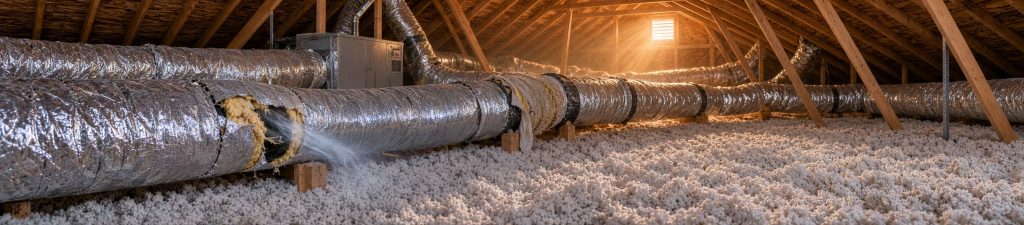
Missing, compressed or wet attic duct insulation can warm cooled supply air before it reaches your rooms, even when the ducts are airtight.
Common attic duct insulation problems include torn flex-duct jackets, bare metal fittings, compressed wrap and moisture damage. The repair depends on which part has failed: the air-carrying liner, the thermal insulation or the outer protective jacket.
Why Attic Ducts Need Insulation
In many Orange County homes, air-conditioning ducts cross a vented attic before reaching ceiling registers. The attic is outside the conditioned living space. On sunny days, its air and nearby roof surfaces can be much hotter than the indoor air the AC is trying to deliver.
Insulation slows heat transfer through the duct wall. Without an effective thermal layer, cooled supply air picks up heat during its trip across the attic. That reduces the cooling available at the room, even if the air handler and evaporator coil are doing their jobs.
A proper insulation assembly has more than a thickness rating. It needs continuous coverage, contact with the duct, insulation that has not been crushed, and a suitably sealed outer vapor-retarder jacket where required. Metal collars, register boots and transitions also need attention; insulating the flexible runs while leaving these fittings bare creates weak spots.
Heat Gain vs. Air Leakage: Two Different Problems
A hot bedroom does not tell you whether cooled air is escaping or simply warming up on the way to the register. Both problems can occur in the same attic, but the repair begins at a different layer of the duct.
Heat passes through the duct wall
The inner air passage and connections can remain sealed. Missing or compressed insulation allows more attic heat to cross the duct surface and warm the moving air.
Typical correction: restore properly fitted, continuous insulation and its protective outer jacket.
Air passes through an opening
A hole, failed seam or disconnected inner liner can release cooled supply air into the attic. A return-side opening can draw hot attic air into the system.
Typical correction: repair the air passage or connection first, then restore insulation over the repaired area.
Putting fresh insulation over an open connection does not seal that connection. If the main concern is airflow escaping from a duct rather than heat crossing its walls, see Signs Your Air Ducts Are Leaking for the separate leakage diagnosis.
Signs of Damaged Attic Duct Insulation
The clearest evidence is often visible at an accessible duct section. Room comfort and temperature readings can support that finding, but neither proves an insulation defect by itself.
Torn or open outer jacket
Fiberglass is visible through the flexible duct's foil-like covering, or the covering has pulled away at a connection. The inner liner may still be intact.
Bare metal or insulation gaps
Sections of a metal trunk, elbow, boot or plenum have little or no wrap, leaving a direct path for heat gain.
Compressed or displaced wrap
Tight straps, poor supports or disturbed insulation leave thin spots. A product's labeled R-value does not describe a compressed installation.
Damp or stained insulation
Wet insulation may perform poorly and deteriorate. Condensation, a roof leak or another moisture source must be identified before rewrapping.
Which clue should you check first?
Normal airflow, but warmer supply air
Compare temperatures after the AC stabilizes. Check insulation continuity and rule out air mixing.
Noticeably weaker airflow
Check for a crushed run, disconnected liner or other restriction; insulation alone will not restore airflow.
Fiberglass visible through a torn jacket
Confirm the insulation is dry and the inner liner is intact before choosing a jacket repair.
Wet or darkened duct wrap
Find the moisture source and assess affected materials before covering or replacing the wrap.
West-facing sun, equipment faults and attic-floor insulation can also affect room temperature. Compare conditions before drawing conclusions from comfort or utility bills.
Flexible Duct vs. Metal Duct: What Can Be Damaged?
Flexible insulated duct
Insulated flex duct has an inner air liner (usually supported by a wire helix), surrounding insulation and a protective outer jacket that also acts as a vapor retarder.
Inspect where the split occurs. A torn jacket seam is different from insulation that has slipped away from the duct wall. Dry insulation that remains properly positioned can often be covered again with a compatible jacket repair.
At collars, check the inner liner's mechanical attachment; sharp bends and failed supports can also narrow the air passage, even when the insulation looks undamaged.
Rigid sheet-metal duct
Metal conducts heat readily, so its external wrap must cover straight runs, elbows and transitions without leaving exposed areas. Missing wrap can allow unwanted heat gain even when metal seams are tight.
If a metal seam or collar leaks, the joint should be mechanically sound and sealed with an approved duct-sealing system before new insulation is installed.
Corrosion, a damaged section or a badly fitted transition may need sheet-metal repair rather than simply another layer of insulation.
The three layers of insulated flex duct
- Outer jacket: helps limit humid attic air from reaching cold duct surfaces by acting as a vapor retarder. It is not waterproofing against roof leaks.
- Insulation: limits heat transfer between attic air and conditioned air.
- Inner liner: carries air; a tear or disconnected collar can cause an actual duct leak.
How a Hot Attic Changes Supply-Air Temperature
Heat enters a duct whenever the surrounding attic is warmer than the cooled air inside. The effect depends on attic conditions, duct surface area and length, insulation quality, and how much air is moving through the branch. A long, poorly insulated run may deliver noticeably warmer air than a shorter, well-insulated one.
During steady cooling operation, a technician might record the following temperatures:
The 7°F temperature rise is illustrative, not a diagnostic failure threshold.
How a technician avoids misleading readings
- Measure during steady operation. Allow the system to cool continuously long enough for temperatures to settle, rather than recording the first warm burst after startup.
- Measure air, not metal. Compare supply air downstream of the cooling coil with the moving airstream at the distant branch outlet. Keep the register probe away from the metal grille and surrounding room air.
- Record the conditions. Note attic temperature, fan setting, branch location and airflow issues. Check for outside-air mixing or leaks before blaming the insulation.
The measured rise does not prove damaged insulation or quantify lost cooling by itself; estimating that loss also requires airflow information. A brief warm burst at startup may simply be air that warmed while the system was off.
Duct Damage, Consequences and Corrective Work
The visible damage is the starting point; the air-carrying surface and insulation should be checked separately before choosing a repair.
| Damage | Likely consequence | Corrective work |
|---|---|---|
| Torn flex-duct outer jacket; insulation remains dry | Exposed or displaced insulation and an interrupted vapor-retarder layer; the inner air passage may still be sealed. | Confirm the inner liner is intact. Restore the insulation and jacket using compatible materials and sealed overlaps. |
| Missing or compressed wrap on a metal trunk | Increased heat flow into supply air along the exposed or thinly insulated section. | Fit duct-rated insulation to the required R-value without crushing it; secure and seal the outer facing. |
| Bare metal boot, collar or elbow | Localized heat gain and possible surface condensation when moisture conditions allow. | Check and seal the joint if needed, then insulate the fitting continuously with its vapor retarder. |
| Wet, stained or deteriorated insulation | Reduced thermal performance and possible moisture-related material damage. | Find and correct the moisture source; assess duct condition and replace affected insulation rather than trapping it under new wrap. |
| Torn or disconnected inner flex-duct liner | Cooled air escapes through the actual air passage or an unintended air path develops. | Repair or reconnect with suitable mechanical fastening and approved sealing; replace the section if reliable repair is not possible. |
| Crushed, kinked or severely sagging flex duct | Restricted airflow and reduced delivered cooling; extra wrap will not restore the duct's cross-section. | Correct routing and supports if the duct recovers its shape. Replace irreversibly deformed or damaged sections. |
| Corroded, punctured or poorly joined metal duct | Loss of duct integrity, possible air leakage and an unreliable base for insulation. | Repair or replace the affected metalwork and seal joints before restoring the insulation assembly. |
How a Technician Separates Insulation Damage From Duct Damage
The inspection should identify the affected run, document the failed layer and show why that particular repair is needed.
- Map the affected branch. Identify the warm room and its duct run; record whether the problem worsens during peak attic heat.
- Photograph visible defects. Document torn jackets, uncovered metal fittings, wet insulation, compressed sections and sagging supports.
- Verify duct integrity. Inspect accessible inner flex liners, collars and sheet-metal seams before rewrapping; test for leakage if an opening is suspected.
- Check actual delivery. Compare air temperatures after stabilization and evaluate branch airflow when restriction, leakage or poor cooling is suspected.
- Confirm the completed repair. Check insulation coverage, dry materials, sealed jacket seams and supports; repeat relevant airflow or temperature checks if they were abnormal.
What a complete inspection record should show
Useful documentation identifies the affected run and includes photos, the condition of its inner air passage and insulation, the specific correction needed, the installed insulation R-value and jacket materials, and any post-repair checks. These details distinguish an insulation-only repair from air sealing or duct replacement.
An infrared camera can help locate temperature differences, but reflective foil can distort surface readings. Thermal images alone cannot establish a leakage rate or the amount of cooling lost.
When Rewrapping or Insulation Repair Is Enough
A localized repair is appropriate when the inner duct and its connections are sound, insulation is dry, and the run is supported without crushing. Examples include a small outer-jacket tear or missing wrap at a metal elbow or register boot.
What a durable insulation repair includes
- Sound duct first: fix loose inner-liner connections or metal seams before the insulation hides them. Use the mechanical fastening and duct sealant specified for that system.
- Full thermal coverage: replace damaged insulation with duct-rated material of the required installed R-value; cover fittings and avoid compression from tight straps.
- Continuous outer facing: close jacket seams and overlaps with manufacturer-compatible, approved materials so the vapor retarder is restored.
A patch over wet fiberglass or a disconnected inner liner is not a completed repair. Ordinary cloth-backed duct tape is not a substitute for rated duct or jacket materials.
What R-value should attic duct insulation have?
R-value describes resistance to heat flow, but the installed value depends on insulation staying at its intended thickness. R-8 is common for replacement flex duct, while the legal minimum for a specific job depends on the code, duct location and scope of work.
California Title 24: R-6 vs. R-8
The 2025 California Energy Code applies to permit applications submitted on or after January 1, 2026. Its mandatory minimum for many supply and return ducts in unconditioned space is generally R-6; higher requirements may apply to particular projects.
For alterations to existing single-family homes, Section 150.2(b)1D generally applies when more than 25 feet of new or replacement space-conditioning ducts are installed. For new ducts in unconditioned space covered by that provision, Table 150.2-D specifies R-6 in climate zones 3 and 5-7 and R-8 in zones 1, 2, 4 and 8-16. Additions, equipment replacements, garage ductwork and completely new systems can trigger other requirements or verification rules. A small outer-jacket patch is not automatically equivalent to installing more than 25 feet of duct.
Orange County includes multiple climate zones. Check the property's zone using the California Energy Commission climate-zone tool and verify the applicable requirements with the local building department.
When a Duct Section Should Be Replaced
Replace the affected section when its air-carrying liner or shape cannot be restored reliably. A torn outer jacket alone is not a reason to replace the entire duct run. Replacement may be appropriate when:
- The inner liner is torn or brittle and cannot be reliably reconnected or sealed.
- Flex duct is crushed, sharply kinked or permanently deformed.
- Moisture, pests or contamination have damaged material beyond practical restoration.
- A rigid duct section has significant corrosion or failed metalwork.
- The existing run has an unsuitable size or routing that cannot be corrected by insulating it.
One damaged attic branch does not automatically justify replacing every duct in the house. The decision should account for how much ductwork is affected, whether the remaining system is serviceable, and whether the proposed replacement will address the confirmed problem.
What Homeowners Can Check Safely
From a safe, accessible vantage point, you may be able to spot a torn shiny jacket, exposed fiberglass or an obviously unsupported run. Note which rooms are warmest and whether the problem gets worse as the day heats up. Photos can help a technician identify the location.
Do not climb onto ceiling drywall, step on ducts, pull on electrical wiring or enter an overheated or unsafe attic. Avoid disturbing unidentified insulation, suspected asbestos-containing materials, or rodent-contaminated areas. Repairing inner liners, duct connections and vapor-retarder jackets requires materials and methods suited to the specific duct system.
FAQ
Can duct insulation be damaged without an air leak?
Yes. On insulated flexible duct, the outside jacket and insulation can be torn while the inner air-carrying liner remains intact. This can increase heat gain without necessarily allowing supply air to escape.
Will adding duct insulation fix weak airflow?
Not if the airflow problem comes from a crushed run, disconnected liner, restricted return, dirty filter or equipment issue. Insulation limits heat transfer; it does not open a blocked air passage.
Can damaged attic duct insulation cause condensation?
It can. If a cold duct surface becomes exposed to air with a dew point above that surface temperature, moisture can condense. Wet insulation can also come from roof leaks or other sources, so the moisture source needs to be checked.
Is foil tape enough to fix a torn duct jacket?
Sometimes an approved jacket-repair method can close a minor outer tear, provided the insulation is dry and correctly positioned. Tape on the outside does not fix a damaged inner liner or loose duct connection. Ordinary cloth-backed duct tape is not a durable substitute.
How can you tell whether an insulation repair worked?
The repaired section should have dry, continuous insulation at the intended thickness, intact supports and a sealed outer vapor-retarder facing. If warm supply air prompted the inspection, air temperatures can be compared after cooling stabilizes, with airflow and operating conditions taken into account. No single register-temperature reading proves success.
Does every attic duct need R-8 insulation?
No. California's 2025 Energy Code has an R-6 baseline for many ducts in unconditioned space, but some work requires R-8. For certain alterations involving more than 25 feet of new or replacement duct, Table 150.2-D sets the R-value by climate zone. Other project rules may apply even below that length.
Repair the failed layer, not just the visible covering. A dry, intact flex duct with a small jacket tear may need only a local patch. A crushed run, failed inner liner or corroded metal section may need duct repair or replacement before the thermal wrap is restored.
A sound repair leaves the air passage intact, insulation continuous and the outer facing properly sealed. If a room still receives weak or unusually warm supply air afterward, check airflow, leakage, attic conditions and equipment performance separately rather than adding more insulation.