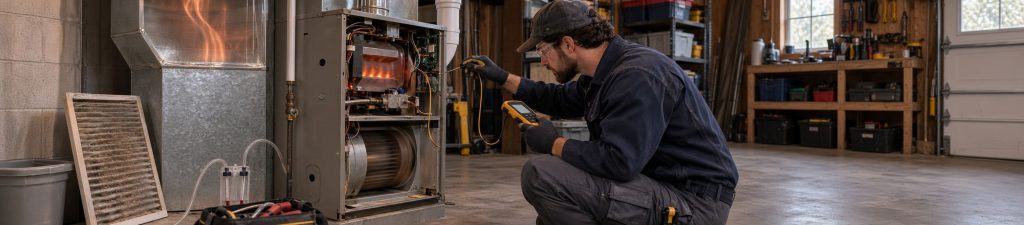
A furnace high limit switch keeps tripping when the temperature inside the furnace reaches its safety limit, often because too little air is moving across the heat exchanger.
Common causes include a clogged filter, a weak or failing blower, restrictive ductwork, and excessive heat input. The burners shut off while the indoor blower typically continues cooling the furnace. An open limit-circuit fault does not always mean the switch itself has failed.
What Does a Furnace High Limit Switch Do?
The primary high limit is a temperature-operated safety switch located in the furnace's heated-air path, commonly near the heat exchanger or supply-air area. Its job is to interrupt burner operation if the temperature at the switch exceeds its specified limit.
Under normal conditions, the switch contacts remain closed. When excessive heat causes the switch to open, the furnace control closes the gas valve. The indoor blower normally continues operating to remove heat from the furnace.
Many primary high limit switches reset automatically as they cool. Depending on the control board, heating may resume after the limit closes, or the furnace may enter a fault or lockout state after repeated events. The switch responds to temperature rather than measuring airflow directly.
Two Different Problems: Tripping During Heating vs. an Open Limit Before Startup
If the burners operate for several minutes before shutting off, overheating is a likely concern. If the safety circuit is already open before ignition, the technician needs to identify which component or connection is preventing startup.
Limit opens during heating
The burners ignite and run, then shut off while the thermostat still calls for heat. The indoor blower may continue for an extended period.
First suspects: Excessive temperature rise, inadequate blower airflow, duct restrictions, or excessive furnace heat input.
Limit circuit is open before ignition
The furnace does not begin normal burner operation because the control detects an open safety circuit.
Possible causes: A limit that has not cooled and reset, an open auxiliary limit, a tripped rollout switch, damaged wiring, or a control-circuit fault.
Some furnace models use a shared circuit for several temperature-related safety switches. A diagnostic code labeled "open limit" may not identify the individual device that opened. The manufacturer's wiring diagram and fault-code definitions are needed to separate them.
Burner and Blower Behavior: What the Shutdown Pattern Suggests
Burners and the indoor blower do not always stop together. Their behavior can help distinguish normal cooldown from overheating and other safety-circuit problems.
| Condition | Burners | Indoor blower | Likely explanation |
|---|---|---|---|
| Normal thermostat shutdown | Stop when the thermostat is satisfied. | Continues through the normal fan-off delay. | Expected cooldown, not a limit trip. |
| Restricted filter or return airflow | Light normally, then stop after excessive heat builds. | Usually keeps running, but delivered airflow may be weak. | Possible high-limit trip from insufficient airflow. |
| Blower motor or control failure | May ignite and then shut off as temperature rises. | Fails to start, stops unexpectedly, or cannot maintain airflow. | Heat is not removed adequately from the furnace. |
| Restrictive ducts or dirty indoor coil | May operate for several minutes before shutting off. | Runs, but actual airflow may be too low. | High static pressure and inadequate airflow are possible. |
| Excessive heat input | May stop on limit despite apparently normal blower operation. | May appear to operate normally. | Gas input or furnace configuration may require testing. |
| Safety limit already open at startup | May not ignite. | May be commanded to run continuously or enter another fault response. | An open high limit, auxiliary limit, rollout device, or circuit fault. |
| Flame rollout switch opens | Shut off or cannot restart. | Response depends on the furnace control. | Potential combustion hazard. Stop using the furnace. |
Check the model's service manual for its exact shutdown sequence. A failed blower may also prevent the normal cooling response after a limit opens.
Why Does the High Limit Switch Keep Tripping?
Clogged or restrictive filter
A heavily loaded filter reduces return airflow. A new filter with excessive resistance can create a similar problem in a system with limited duct capacity.
Blower motor or wheel problems
A failing motor, incorrect heating airflow setting, dirty blower wheel, or damaged motor control can reduce the amount of air crossing the heat exchanger.
Excessive duct resistance
Undersized return ducts, closed zoning dampers, compressed flexible ducts, or too many closed supply registers can prevent adequate circulation.
Restricted evaporator coil
On a furnace-and-AC system, air may pass through the indoor cooling coil during heating. A coil packed with debris can restrict airflow even when cooling is off.
Excessive furnace input
Incorrect manifold gas pressure, improper firing rate, or staging problems can produce excessive heat relative to the available airflow.
Defective switch or electrical circuit
A faulty limit, loose connection, damaged wire, or control-board input problem is possible when measurements do not support actual overheating.
Why a clean filter does not rule out airflow trouble
Consider a furnace connected to a small return duct. Installing a clean, high-resistance filter may increase the pressure the blower must overcome. The filter looks fine, but the system can still move too little air at its heating setting.
An ECM variable-speed blower may compensate for some added resistance by increasing its output, but it cannot necessarily maintain the required airflow under every duct condition. Measuring airflow and static pressure is more useful than judging by fan noise. For duct-related restrictions, see ductwork and airflow diagnostics.
High Limit Switch vs. Flame Rollout Switch
High limit switch
Location: Typically in the heated-air path near the heat exchanger or supply-air area.
Purpose: Stops burner operation when furnace temperature becomes excessive.
Reset: Common primary high limits reset automatically after cooling.
Flame rollout switch
Location: Near the burner compartment or other manufacturer-designated combustion safety locations.
Purpose: Responds to abnormal heat outside the intended combustion path.
Reset: Commonly manual-reset and requires investigation before resetting.
How Temperature Rise and Static Pressure Help Diagnose Overheating
Temperature rise shows how much the furnace heats the circulating air. Total external static pressure (TESP) helps assess the resistance the blower works against. Neither measurement identifies a failed component on its own.
Temperature rise
The difference between supply-air and return-air temperature under the specified operating conditions.
125°F supply − 68°F return = 57°F rise
A 57°F rise is acceptable only if it falls within the rating-plate range for the operating stage and the measurement follows the manufacturer's instructions.
Total external static pressure
The resistance the blower works against in the external air-distribution system, measured at the locations specified by the manufacturer.
The reading is compared with the blower's performance data and the furnace's rated operating conditions. A single static-pressure number does not establish actual CFM or identify which component is restrictive.
Reading the Measurements Together
| Temperature rise | Static pressure | How a technician may interpret the combination |
|---|---|---|
| Above rated range | Excessive | Restricted airflow is a strong possibility. The filter, coil, duct system, dampers, and blower performance need closer evaluation. |
| Above rated range | Within equipment specification | Inadequate blower output, incorrect heating airflow settings, excessive gas input, or measurement issues may still be present. |
| Within rated range | Excessive | The blower may be compensating for system resistance. Duct restrictions still deserve attention, but this combination does not prove a current high-limit trip. |
| Within rated range | Within equipment specification | If a limit fault remains, investigate intermittent operating changes, localized overheating, switch placement or condition, wiring, and control-circuit faults. |
"Excessive" and "within range" refer to the installed furnace's specifications, not universal HVAC thresholds.
Can the high limit trip when temperature rise looks normal?
Yes. Temperature rise is measured between selected points in the return and supply air paths. It does not describe every local temperature inside the furnace.
Uneven airflow across the heat exchanger, an incorrectly positioned or defective limit, or a problem that occurs only intermittently can produce a limit event without an obviously excessive temperature rise during a later test. Measurements should be taken with the equipment assembled as required, under the appropriate heating stage, and with readings allowed to stabilize when the manufacturer's procedure calls for it.
Why Replacing the High Limit Switch Alone Can Be Dangerous
If a blower moves too little air through the furnace, the heat exchanger can overheat regardless of whether the limit switch is new. Installing another switch with the same rating will not correct the airflow problem.
Repeated high-limit trips expose furnace components to excessive temperatures and may contribute to heat-exchanger damage.
A switch should be replaced only when testing establishes that the device is defective or does not meet the manufacturer's operating requirements. The replacement must have the correct specifications and be approved for the furnace. A switch with a higher trip temperature is not an acceptable workaround.
What Homeowners Can Check Safely
Recurring limit trips warrant professional evaluation before continued operation. These observations can help identify when the fault occurs.
Inspect the accessible filter
Check for heavy dust buildup, incorrect sizing, or improper installation. Use a filter compatible with the system rather than assuming a higher MERV rating is always better.
Look for blocked registers
Make sure furniture and other objects are not covering return grilles or normally open supply registers.
Record the burner timing
Note whether the burners shut off while the thermostat still calls for heat and whether the indoor blower continues afterward.
Save the fault code
Photograph an accessible diagnostic display or status light. Do not remove safety panels or repeatedly reset power to clear a code.
Never bypass a high limit, jumper a safety circuit, interfere with the blower to test overheating, or remove an access panel to watch burner operation. Internal electrical and combustion testing belongs to qualified service personnel.
How an HVAC Technician Confirms a High-Limit Problem
Identify the open circuit
Review the model-specific fault code and wiring diagram. Check whether the primary limit, auxiliary limit, rollout switch, wiring, or control input is responsible.
Measure temperature rise
Compare stabilized return-to-supply temperature rise with the furnace rating plate under the specified heating stage and test conditions.
Check airflow and static pressure
Assess the return path, filter, coil, duct system, dampers, and blower performance using appropriate pressure measurements and manufacturer data.
Verify furnace heat input
When indicated, check firing rate, manifold pressure, staging, and burner operation against the equipment specifications.
Evaluate the safety device
Determine whether the switch operates at its specified conditions and whether its electrical state is correctly reported to the control board.
Confirm normal operation
After correcting the fault, verify the required safety checks and normal heating operation with the filter and access panels installed.
When to Stop Using the Furnace
Stop operating a furnace that repeatedly trips its high limit and arrange an inspection, even if it restarts after cooling.
Treat these conditions as immediate safety concerns:
- A carbon monoxide alarm sounds.
- You smell natural gas.
- There is smoke, soot, scorching, or a strong burning odor.
- Flames or unusual heat appear outside the intended burner area.
- A rollout switch or another combustion safety control has opened.
If a carbon monoxide alarm sounds, get everyone into fresh air and contact emergency services. If you suspect a gas leak, leave the building and call the gas utility or emergency services from outside without operating electrical switches. Do not restart the furnace until the hazard has been assessed and the equipment is cleared for use.
Frequently Asked Questions
Does a high-limit fault code mean the switch is defective?
No. The code may indicate that the switch responded correctly to overheating. On some models, it can also refer to another device in the limit circuit. Temperature measurements and electrical testing are needed before replacement.
How long does a furnace high limit switch take to reset?
There is no universal reset time. An automatic-reset switch closes after cooling to its specified reset temperature. The control board may also impose delays or lockout conditions.
Can a new high-MERV filter cause a high-limit trip?
Yes, if its airflow resistance exceeds what the system can accommodate. Filter resistance depends on its design, surface area, condition, and airflow, not MERV rating alone. The filter and duct system should be evaluated together.
Can a furnace overheat even when the blower is running?
Yes. A spinning blower does not guarantee adequate airflow. A dirty wheel, incorrect heating speed, restrictive ducts, or excessive heat input can produce an overheating condition while the motor continues operating.
Technical References
For further information about furnace safety controls, heat exchangers, and circulating-air systems:
Exact limit settings, allowable temperature rise, static-pressure requirements, and diagnostic procedures depend on the installed furnace model. Use the manufacturer's rating plate and service documentation for equipment-specific limits.
What to Do About Repeated High-Limit Trips
Stop using the furnace and have the overheating or safety-circuit fault diagnosed before replacing parts. A new switch cannot compensate for inadequate airflow or incorrect furnace operation.
For other reasons a furnace repeatedly starts and stops, see the furnace short cycling guide. Homeowners in Orange County can also review MaksBuilder furnace repair and diagnostics.