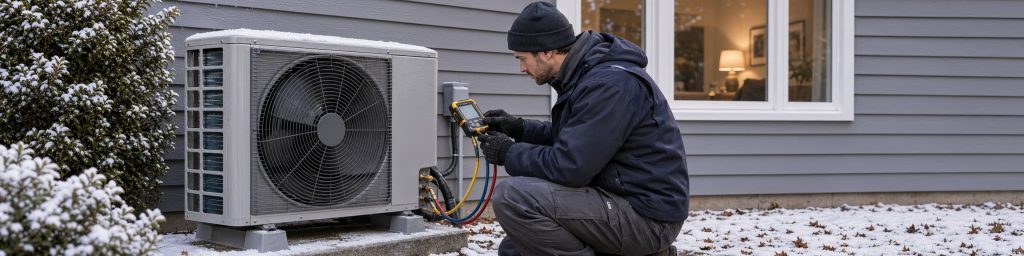
Heat pump short cycling in heating mode occurs when the compressor repeatedly shuts off after brief runs, sometimes before the thermostat reaches its set temperature.
Thermostat errors, restricted airflow, compressor protection faults, and excessive heating capacity are possible causes. But a variable-speed heat pump slowing down or an outdoor fan stopping for defrost can look like short cycling. The difference becomes clearer when you compare the thermostat's heat request with the compressor and fan behavior.
What Counts as Short Cycling in Heating Mode?
A normal heating cycle starts when the controls request heat and ends when the heating demand is satisfied or the controller determines that operation should change. On a single-stage heat pump, the compressor generally runs at a fixed output. Variable-capacity systems can reduce their output without shutting down.
A compressor that starts, runs for two or three minutes, stops, and repeats that pattern while the house remains cold is behaving differently from one that finishes a short heating call on a mild afternoon.
Normal cycling
The thermostat reaches its target, the heating call ends, and the compressor starts again after the room cools. Shorter calls can occur when outdoor temperatures are mild.
Suspected short cycling
Heating stops prematurely, the thermostat continues requesting heat, and the compressor repeatedly attempts another run. Comfort may suffer or a fault code may appear.
There is no universal five-minute or ten-minute cutoff. Cycle length depends on equipment type, outdoor temperature, heating load, and control settings. Repeated premature shutdowns are more meaningful than one unusually short run.
Inverter Modulation Is Not the Same as Short Cycling
Inverter-driven heat pumps adjust compressor speed to match the heating load. As the indoor temperature approaches the setpoint, the system may reduce compressor output, outdoor fan speed, and indoor airflow.
From outside, the equipment may become so quiet that it appears to have switched off. Sound alone cannot establish whether an inverter compressor is still operating. That distinction requires controller information or appropriate diagnostic measurements.
Modulating normally
Compressor speed decreases while the system continues delivering heat. The room temperature stays relatively stable and no shutdown fault is recorded.
Stopping repeatedly
The compressor shuts down completely and restarts after an off period. If heating demand remains active, the control sequence and any protection events need examination.
Why can a healthy inverter system still cycle?
Every inverter compressor has a minimum operating capacity. Consider a hypothetical heat pump capable of reducing its heating output to 7,000 BTU/h. If the house needs only 4,000 BTU/h during mild weather, continuous operation at that minimum output would eventually overheat the space. The controller may stop the compressor and restart it later. These figures are illustrative, not specifications for a particular model.
What the Compressor and Fans Are Doing
The compressor, outdoor fan, and indoor blower do not always stop together. Their operating sequence provides useful clues, although the exact sequence varies by model.
| Situation | Compressor | Outdoor fan | Indoor blower | Interpretation |
|---|---|---|---|---|
| Normal heating | Running | Usually running | Delivering warm air | Heat is being transferred into the home. |
| Inverter modulation | Running at lower speed | Speed may decrease | May slow down | Usually normal capacity adjustment, not a compressor restart. |
| Heating demand satisfied | Stops | Usually stops | May run briefly afterward | Normal end of a heating call. |
| Defrost | Often continues running | Usually stops | May stop or operate with backup heat | Normal if frost clears and heating resumes afterward. |
| Protection shutdown | Stops before demand is satisfied | May stop or run briefly | May continue running | Check fault history, airflow, electrical operation, and safety limits. |
| Auxiliary heat only | May be off | May be off | Running with electric backup heat | Possible on equipped ducted systems; not proof of normal compressor operation. |
Diagnostic limitation: These are typical patterns, not a universal sequence. A quiet compressor cannot reliably be classified as off without control data or testing. On systems without auxiliary heat, the final row does not apply.
A Quick Guide to the Shutdown Pattern
If the heat pump repeatedly stops, start with the thermostat's heating demand. This helps separate an ordinary control decision from an interrupted compressor cycle.
Heat pump stops before the house is comfortably warm
Is the thermostat still requesting heat?
NO — heat call ended
Check temperature control
Review thermostat readings, sensor location, schedules, control settings, and zoning. If the set temperature was reached, the stop may be normal.
YES — heat call remains
Check for an interrupted cycle
Confirm compressor status and review fault history, airflow, electrical conditions, and protective shutdowns.
Separate possibility: normal defrost
If the outdoor fan pauses during cold or humid weather, the system may be clearing frost. Confirm that the sequence finishes and heating resumes. A stopped fan alone does not prove the compressor shut down.
This is an observation guide, not a substitute for model-specific fault testing.
Common Causes of Heat Pump Short Cycling in Heating Mode
Once the operating pattern is identified, the likely causes become easier to separate.
Thermostat and temperature sensors
Direct sunlight, a thermostat close to a warm supply register, an inaccurate room sensor, or unsuitable control settings can end heating prematurely. Ductless units often sense temperature near the indoor head rather than at the center of the occupied room. Some communicating systems also require manufacturer-compatible controls.
Restricted indoor airflow
In heating mode, the indoor coil releases heat. A severely dirty filter, restricted return, clogged blower wheel, or restrictive ductwork can reduce airflow and cause the coil temperature and condensing pressure to rise. Some systems reduce output; others may eventually trigger protective shutdowns.
Compressor protection
High or low refrigerant pressure, excessive discharge temperature, overcurrent, abnormal supply voltage, and inverter-drive faults can interrupt compressor operation. The relevant protection and restart behavior depend on the equipment. Stored fault information is more useful than assuming the compressor itself is defective.
Outdoor coil and defrost faults
Heavy ice buildup, blocked outdoor airflow, a malfunctioning fan, or inaccurate coil-temperature sensors can interfere with heat absorption and defrost control. If a defrost attempt fails to clear the coil, heating performance may deteriorate or the controller may register a fault.
Oversized equipment
A system with too much heating output for the active load can satisfy the thermostat quickly and stop. This can happen with fixed-capacity equipment or an inverter whose minimum heating capacity remains too high. If cycling has existed since installation, capacity and load calculations deserve review.
Zoning and control configuration
A small active zone may provide insufficient airflow or heating load for the equipment. Zone dampers, thermostat staging, control compatibility, and minimum airflow requirements should be checked together. Adjusting a single setting without understanding the equipment sequence can make the problem worse.
What about low refrigerant?
A refrigerant leak or abnormal charge can affect operating pressures and trigger protection. It is not the first conclusion to draw from short cycling alone. Technicians also check airflow, sensors, operating conditions, and refrigerant-circuit components before deciding whether charge correction or leak repair is needed.
How Defrost Can Be Mistaken for Short Cycling
While heating, the outdoor coil absorbs energy from outside air. When its surface becomes cold enough, moisture can freeze on the coil. The heat pump periodically enters defrost to remove that frost.
In a typical reverse-cycle defrost, the compressor sends hot refrigerant through the outdoor coil while the outdoor fan stops. The indoor blower may pause to avoid a cold draft, or a ducted system may use auxiliary electric heat. Brief water vapor near the outdoor unit is common as frost melts.
Normal defrost
Frost clears, the outdoor fan resumes its usual operation, and warm airflow returns indoors. Frequency changes with weather and control strategy.
Possible defrost malfunction
Ice remains after repeated defrost attempts, the unit does not return to heating, or it reports recurring coil-sensor or defrost errors.
A stopped outdoor fan during defrost does not mean the compressor has failed. Nor does defrost have a fixed interval that applies to all models. Outdoor humidity, coil temperature, accumulated frost, and control design affect its timing.
What You Can Check Before Calling a Technician
The most useful homeowner observations do not require opening equipment panels or changing installer settings.
Check thermostat settings
Confirm Heat mode, the selected temperature, and any schedule that could be ending heating calls. Note whether the thermostat still indicates a demand for heat when operation stops.
Inspect the filter and registers
Replace an accessible, dirty filter with the specified type. Make sure returns and supply registers are not blocked by furniture or stored items.
Look at the outdoor unit
From a safe location, check for heavy ice, snow, or debris blocking airflow. Do not chip ice from the coil or reach into the fan compartment.
Record the cycle pattern
Note approximate on and off times, outdoor conditions, room temperature, and visible fault messages. A short video of the external behavior may also help.
If the indoor blower operates with the compressor off, check whether the thermostat fan is set to On rather than Auto. On equipped ducted systems, auxiliary heat may also keep the blower running. Neither observation alone establishes a compressor fault.
How a Technician Confirms the Cause
A proper diagnosis follows the recorded operating sequence and compares measurements with the manufacturer's service specifications. The tests selected depend on the heat pump design and the observed shutdown.
Confirm the control sequence
Determine whether thermostat demand ended, the system entered defrost, or the controller stopped the compressor while demand remained active.
Read manufacturer fault data
Review applicable fault history, sensor values, compressor operating information, and active protection codes before clearing them.
Measure airflow and temperatures
Evaluate filters, blower operation, coils, duct restrictions, and zoning. On ducted systems, static-pressure readings and model-specific airflow data can identify restrictions.
Test the affected system
As indicated, check electrical supply, compressor current, refrigerant pressures, line temperatures, defrost controls, and temperature sensors under specified test conditions.
Check capacity against heating load
For persistent cycling without a confirmed equipment fault, compare the home's load and active zones with the heat pump's minimum heating capacity.
Verify operation after correction
Confirm that the system completes heating calls as intended and does not repeat the original protection event under suitable test conditions.
Refrigerant pressure readings alone do not confirm an incorrect charge. Likewise, an apparent compressor stop does not establish motor failure. The diagnosis should identify the failed component, control condition, or installation limitation that explains the recorded sequence.
Information to have ready
- Indoor and outdoor model numbers
- Thermostat type and settings
- Approximate run and off times
- Outdoor temperature and weather
- Fault codes or thermostat messages
- Whether the room reaches its setpoint
When Should You Stop Running the Heat Pump?
Turn the equipment off and arrange professional service if you notice an electrical burning smell, smoke, repeated breaker trips, loud grinding, severe electrical buzzing, visible wiring damage, or heavy ice that prevents the outdoor fan from moving.
Do not repeatedly reset breakers, bypass safety switches, or work inside inverter electrical compartments. Those components can retain dangerous electrical energy even after power is disconnected. Recurring compressor protection faults also warrant diagnosis rather than repeated restarts.
Frequently Asked Questions
Is a heat pump running for only five minutes a problem?
Not always. A brief heating call can be normal in mild weather. Repeated five-minute runs while the thermostat still requests heat are more concerning, especially if the compressor shuts down on a fault or the room remains below the setpoint.
Why does the outdoor unit stop but the indoor fan keep running?
The indoor blower may run after a heating call, because the fan is set to On, or while auxiliary heat operates. It can also continue after an outdoor-unit shutdown. The thermostat status and system controls help distinguish these conditions.
Can a dirty air filter make a heat pump short cycle?
Yes. Severe airflow restriction can cause excessive indoor coil temperature or high refrigerant pressure during heating. Depending on the heat pump design, the controller may reduce compressor output or stop operation to protect the equipment.
Can an oversized inverter heat pump short cycle?
Yes. Inverter compressors can reduce output only to their minimum capacity. If the heating load falls below that minimum, the compressor may cycle even when all components are working correctly.
Does short cycling mean the compressor is failing?
No. A working compressor can be stopped by thermostat controls, airflow-related protection, temperature limits, or electrical faults elsewhere in the system. Compressor replacement should follow confirmed test results, not cycling symptoms alone.
The Key Is Knowing Why Heating Stops
A heat pump that finishes short heating calls after reaching its set temperature is not behaving like one that repeatedly stops on protection while the home still needs heat. Inverter speed changes and normal defrost can also be mistaken for compressor cycling.
If premature shutdowns continue, record the thermostat status, run times, fan behavior, and fault codes. Those observations help direct a technician toward the relevant controls, airflow conditions, and protective circuits.