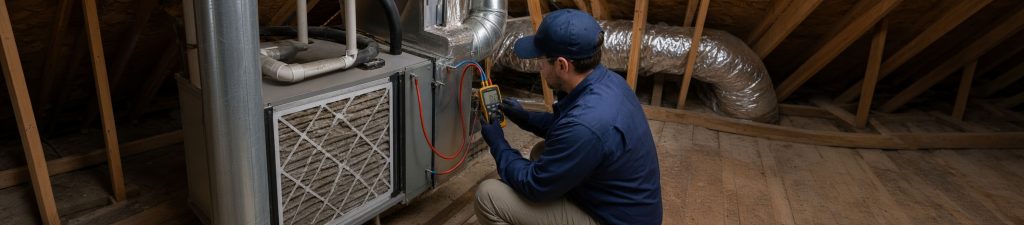
High static pressure is a measured HVAC operating condition, not simply another name for weak airflow. Diagnosis requires correctly placed static-pressure measurements, component pressure-drop checks and comparison with the blower performance data for the installed equipment.
Total external static pressure, or TESP, is the starting measurement. It describes the external pressure the blower is operating against. Return-side, supply-side and component measurements are then used to narrow down where excessive air-path resistance may be occurring.
Total external static pressure, commonly expressed in inches of water column.
Return-side and supply-side pressure are evaluated separately.
Pressure drop can be measured across filters, coils and other components.
Pressure readings must be matched to the equipment, blower setting and operating mode.
Static Pressure Diagnosis at a Glance
What Is Static Pressure in an HVAC System?
Static pressure describes pressure conditions in a forced-air HVAC system while the blower moves air through the return path, equipment and supply ductwork. It is commonly measured with a manometer and expressed in inches of water column, or in. w.c.
At common residential test locations, return-side pressure is typically negative relative to the surrounding space and supply-side pressure is positive. Those readings help show how the blower and air-distribution system are interacting.
Static pressure is not airflow. Static pressure describes a pressure condition in the air system. Airflow describes the volume of air being moved, commonly expressed in cubic feet per minute, or CFM. The relationship between them depends on the blower and system configuration.
Weak airflow, unusual duct noise or equipment performance problems can justify static-pressure testing, but those symptoms do not confirm high static pressure by themselves. For symptom-based troubleshooting, see weak AC airflow from vents.
What Is Total External Static Pressure?
Total external static pressure (TESP) is the pressure difference across the manufacturer's defined external portion of the air-moving equipment. Technicians use it with blower-performance information to evaluate how the blower is operating against the connected air system.
The measurement boundary matters. Depending on the furnace, air handler, coil, filter cabinet and accessory arrangement, individual components may fall inside or outside the external-static boundary represented by the manufacturer's performance data.
Typical residential TESP calculation
This form applies to the common test arrangement in which return pressure is negative and supply pressure is positive. The measurement locations and calculation procedure should follow the documentation for the installed equipment.
Do not apply one generic static-pressure number as a pass/fail limit for every HVAC system. The relevant external-static range and blower performance depend on the specific equipment, airflow setting, operating mode and configuration.
How HVAC Static Pressure Is Measured
A useful static-pressure test records the operating condition as well as the pressure. Multi-stage and variable-capacity equipment can use different airflow targets at different stages, so measurements should be tied to the mode and blower configuration being tested.
How Return and Supply Readings Narrow the Diagnosis
TESP provides an overall measurement. Looking separately at the return and supply sides helps identify which part of the air path deserves closer testing.
Return-Side Pressure
A strongly negative return-side reading can direct attention toward resistance before the blower. Possible test areas include the filter assembly, return duct, grille, return box and transitions.
The reading alone does not identify which component is responsible, so suspected sections may need individual pressure-drop measurements.
Supply-Side Pressure
Higher-than-expected supply-side resistance can direct attention toward the supply plenum, fittings, dampers, trunks or other downstream sections.
A high supply reading does not automatically prove that the entire duct system is undersized. A localized restriction can produce a similar pattern.
If measurements indicate that the duct system itself needs further evaluation, see ductwork and airflow services.
Component Pressure Drop: Filters, Coils and Accessories
Component pressure-drop testing answers a narrower question than TESP. Pressure is measured on both sides of a component, and the difference shows how much pressure is being lost across that section at the current operating condition.
| Measurement | What it shows | How it is interpreted |
|---|---|---|
| Filter pressure drop | Pressure difference across the filter or filter assembly. | Compare with applicable filter or equipment data, a documented baseline and the airflow being tested. |
| Coil pressure drop | Pressure difference across the evaporator coil section. | Evaluate with operating airflow, coil condition and available manufacturer data or a known system baseline. |
| Accessory pressure drop | Resistance associated with an installed air cleaner, cabinet or other accessible air-path component. | Compare the measured contribution with applicable product data and the complete system pressure profile. |
A filter does not have to look dirty to create meaningful resistance. Media area, filter size, depth, cabinet geometry and operating airflow all affect pressure drop.
Likewise, a coil pressure-drop measurement should not be labeled abnormal from the number alone. Dirt, icing, airflow and coil design all affect the result, so the measurement needs an appropriate comparison point.
Static Pressure, Blower Performance and Airflow
The same duct system can operate at different static pressures when the airflow target changes. A higher commanded airflow can increase pressure drop through the same filter, coil and duct path even when no new physical restriction has appeared.
This is why technicians separate air-path resistance from the blower operating point. Filters, coils, ducts, fittings and dampers can create physical resistance. Blower configuration determines how the equipment attempts to move air through that resistance.
PSC Blower
A traditional permanent-split capacitor blower follows its own airflow-versus-static-pressure performance curve. Airflow generally changes as external static pressure changes.
Constant-Torque ECM
A constant-torque ECM adjusts operation differently from a PSC motor but should not be assumed to maintain the same airflow as external static pressure changes.
Constant-Airflow ECM
A true constant-airflow variable-speed ECM can increase motor output within its operating range to maintain the commanded airflow as external static pressure changes.
Increasing blower speed is not a general fix for excessive system resistance. Asking the blower to move more air through the same restrictive path can raise static pressure and noise. The required airflow and the source of resistance should be evaluated separately.
Why TESP Alone Does Not Locate the Restriction
Two HVAC systems can have similar TESP readings while the pressure is being consumed in different places. One may have most of its resistance on the return side; another may have a larger pressure loss through a coil, supply transition or downstream duct section.
That is why diagnosis normally progresses from the overall TESP measurement to return-versus-supply comparison and then to targeted pressure-drop testing when needed.
TESP answers “how much external pressure is the blower operating against?” Component pressure-drop testing helps answer “where is that pressure being lost?” Blower-performance data then help relate the measured pressure to expected airflow.
Static Pressure vs Airflow: What Is the Difference?
| Measurement | What it describes | What it cannot prove alone |
|---|---|---|
| Static pressure | Pressure conditions within the air system and the external pressure seen by the blower. | The exact location of a restriction or the exact delivered airflow. |
| Airflow | The volume of air being moved, commonly expressed in CFM. | Which component is creating excessive resistance. |
| Component pressure drop | The pressure difference across a particular component or section. | Whether the remainder of the air system is correctly configured. |
Static pressure can be combined with the correct manufacturer blower data to evaluate the blower operating point. Direct airflow measurements may also be used when the diagnosis requires them.
How Technicians Find the Source of Excessive Resistance
A measurement-based sequence reduces the risk of replacing components or modifying ductwork before the actual restriction has been identified.
What Can Cause High HVAC Static Pressure?
High measured static pressure can result from excessive air-path resistance, an airflow target that the installed air path cannot support efficiently, or a combination of both.
Physical Air-Path Resistance
- restrictive or heavily loaded filter assemblies;
- restricted return ducts or transitions;
- excessive pressure drop through a coil or accessory;
- closed or incorrectly positioned dampers;
- compressed, damaged or restrictive duct sections;
- undersized or highly restrictive supply or return paths.
Operating-Point Factors
- blower settings that command more airflow;
- different heating or cooling stages;
- variable-capacity operation;
- equipment changes that alter required airflow.
These factors can change measured static pressure without being physical restrictions themselves.
When Static-Pressure Testing Leads to Corrective Work
The correction should match the measured cause. A confirmed filter restriction may require a filter or cabinet correction; a localized duct restriction may require duct repair; an excessive coil pressure drop may require further coil inspection; and an inappropriate blower setting may require configuration changes rather than duct modification.
When the problem is still unclear or involves several parts of the HVAC system, an instrumented diagnostic visit is a better starting point than assuming that weak airflow automatically means duct replacement. See HVAC diagnostics in Orange County.
Frequently Asked Questions
What does high static pressure mean in an HVAC system?
It means the blower is operating against a relatively high external pressure for the equipment, airflow and operating condition being evaluated. The measurement should be compared with the applicable equipment and blower-performance data rather than a universal number.
What is TESP in HVAC?
TESP means total external static pressure. It is the pressure difference across the manufacturer's defined external portion of the air-moving equipment and is used with blower-performance information to evaluate the system operating point.
Does high static pressure mean the ducts are too small?
No. Restrictive filters, coils, transitions, dampers, accessories and localized duct problems can also contribute. Measurements are needed to determine where the pressure loss occurs.
Can a clean air filter still create too much pressure drop?
Yes. Filter size, media area, depth, cabinet design and operating airflow all affect pressure drop. The measured drop should be compared with applicable product or equipment data or an appropriate baseline.
Can static pressure tell you the exact HVAC airflow?
Not by itself. Static pressure can be combined with the correct manufacturer blower-performance data to evaluate expected blower airflow, while direct airflow measurements may be used when needed.
Need Static-Pressure or Airflow Diagnosis?
If an HVAC system has persistent airflow, temperature or noise problems, testing can help determine whether excessive air-path resistance is concentrated at the filter, coil, return side or supply side and whether the blower configuration is appropriate for the required airflow.
MaksBuilder serves Foothill Ranch, Lake Forest, Irvine, Mission Viejo, Aliso Viejo, Rancho Santa Margarita, Laguna Hills and Laguna Woods Village. Confirm the required static-pressure or airflow testing scope when scheduling service.