... ...
Preloader

Furnace Maintenance in Orange County, CA

Heating Maintenance

What a Furnace Maintenance Visit Checks

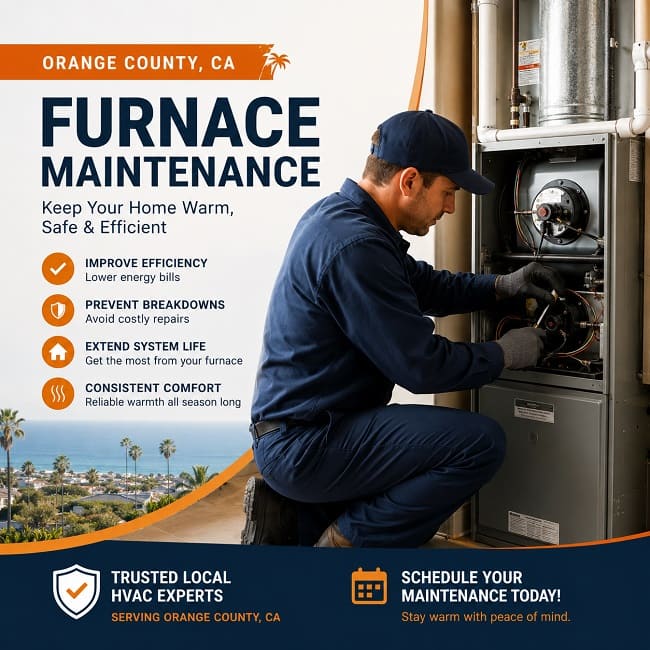
Furnace maintenance in Orange County helps verify how a gas furnace responds to a thermostat call, starts its ignition sequence, produces heat, moves air and completes a normal heating cycle. The visit also helps identify visible venting, airflow, gas-connection or safety-related conditions that may need further attention.

Furnace tune-ups are provided through Maks Builder maintenance plans.

Routine maintenance is intended for an operating furnace that needs scheduled service. A system with a no-heat condition, repeated shutdown, ignition fault or another active malfunction may require furnace repair instead.

Furnace maintenance service in Orange County, California
Full heating cycle Thermostat demand, ignition, flame, blower operation and shutdown.
System-specific readings Temperature rise is compared with the furnace's specified operating range.
Furnace Checklist

What Is Included in Furnace Maintenance?

The exact procedure depends on furnace design, manufacturer requirements, installation and system condition. The service follows the heating system through its operating sequence and checks accessible components that affect ignition, combustion, heat transfer and airflow.

Thermostat Call for Heat

The furnace is operated from the thermostat to confirm that it receives a heating demand, starts when heat is requested and shuts down after the call is satisfied. Obvious thermostat-setting or communication problems can be identified at this stage.

Ignition Sequence

On an induced-draft gas furnace, startup may include inducer operation, pressure-switch confirmation, igniter operation, gas-valve activation, burner ignition and flame proving. Repeated ignition attempts or unexpected shutdowns require further diagnosis.

Flame Observation

Burner flame is observed where equipment design permits safe access. The technician looks for unstable operation, delayed ignition or visible behavior that differs from normal burner operation.

Safety Controls

Accessible safety-related controls are reviewed as appropriate for the furnace. Repeated limit trips, pressure-switch faults or other interruptions should be investigated rather than repeatedly reset or bypassed.

Blower Operation

The indoor blower is checked for normal startup, running behavior and shutdown. Unusual noise, weak airflow or delayed operation can indicate a blower, airflow or control issue.

Filter and Return Air

The filter and accessible return-air path are checked for obvious restriction. A heavily loaded filter can reduce airflow through the furnace and increase equipment operating temperature.

Temperature Rise

When appropriate, return-air and supply-air temperatures are compared. The result should be evaluated against the range listed on the furnace rating plate or in manufacturer documentation.

Visible Venting Inspection

Accessible venting is visually reviewed for obvious disconnection, deterioration, improper support or other visible conditions that may interfere with normal exhaust flow.

Accessible Gas Piping and Connections

Visible gas piping and connections near the furnace can be reviewed for obvious corrosion, damage or conditions that justify closer evaluation.

Accessible Heat Exchanger Areas

Where furnace design and normal service access permit, accessible heat exchanger areas can be visually reviewed for obvious deterioration or abnormal conditions.

Electrical and Control Connections

Accessible wiring, terminals and control components can be reviewed for visibly loose, damaged or overheated connections. Repair or component replacement is separate from routine maintenance.

Condensate Components

On high-efficiency condensing furnaces, accessible condensate tubing, drains and traps can be checked for obvious blockage, leakage or deterioration.
Heating Cycle

A Furnace Should Be Checked Through a Full Heating Cycle

A furnace can start normally and still develop a problem after ignition. Following the equipment through the complete cycle provides more useful information than checking only whether warm air reaches a supply register.

  1. Thermostat calls for heat The furnace control receives the heating demand.
  2. Draft sequence begins On many furnaces, the inducer starts and required draft conditions must be proven.
  3. Burners ignite The control board must confirm flame before the cycle continues.
  4. Indoor blower starts Heated air begins moving through the furnace and duct system.
  5. Heating continues Airflow, operating temperature and furnace behavior can be observed.
  6. Normal shutdown occurs Burner and blower operation end according to the equipment's control logic.
Airflow and Heat

Airflow and Temperature Rise Tell Different Parts of the Story

Filter, Return Air and Blower Performance

A gas furnace depends on airflow to carry heat away from the heat exchanger and distribute it through the home. Restricted return air, a heavily loaded filter, blower problems or duct restrictions can affect both comfort and furnace operating temperature.

Airflow problems therefore cannot be evaluated by looking at the burner alone. Filter condition, return-air restriction and blower operation should be considered together.

What Temperature Rise Shows

Temperature rise is the difference between the air temperature entering the furnace and the heated air leaving it. When measured under normal operating conditions, it helps show whether airflow and heat transfer are within the expected range.

An out-of-range result does not identify the cause by itself. Furnace setup, filter condition, blower operation and duct airflow may all affect the reading.

Temperature rise must be compared with the installed furnace

There is no universal temperature-rise target for every furnace. The appropriate reference is the range listed for the specific equipment.

Carbon Monoxide

CO Alarms, Ambient Measurements and Combustion Testing Are Different

Carbon monoxide is produced by combustion and cannot be identified by smell or appearance. Routine furnace maintenance can reveal conditions that justify further investigation, but it should not be presented as proof that a home contains no carbon monoxide.

CO-related check What it tells you Next step if there is a concern
Household CO alarm Warns occupants when the alarm's response criteria are reached. It is a safety device, not a furnace diagnostic instrument. An active alarm should be treated as a potential CO event rather than as a routine tune-up issue.
Ambient CO measurement Measures carbon monoxide in the surrounding air at the location being tested. An abnormal result may require targeted investigation of combustion equipment and other possible CO sources.
Combustion or flue-gas analysis Uses professional test equipment to evaluate combustion-related conditions in the furnace or vent system. This is specialized diagnostic testing and should not be assumed to be included unless specifically stated.

CO alarm thresholds are not furnace operating limits

Residential alarm test points such as 70, 150 and 400 ppm relate to alarm-response requirements. They should not be treated as universal acceptable operating limits for a furnace.

If a carbon monoxide alarm is sounding

Do not wait for routine maintenance. Follow the alarm manufacturer's emergency instructions and obtain appropriate emergency and professional evaluation before returning affected fuel-burning equipment to normal use.

Service Boundaries

What Routine Furnace Maintenance Does Not Include

Maintenance can identify conditions that need further attention, but it does not automatically include repair, component replacement or specialized inspection work.

Repair and Component Work

  • Replacement of motors, control boards, gas valves, igniters or other failed parts.
  • Extended troubleshooting of an active furnace fault.
  • Duct repair or redesign.
  • Major heat exchanger disassembly or replacement.
  • Electrical repair after a fault is identified.

Specialized or Separate Inspections

  • Dedicated gas-line leak testing or gas piping modification.
  • Chimney or concealed flue inspection requiring specialized access.
  • Whole-home carbon monoxide certification.
  • Specialized combustion analysis unless specifically included.
  • Code corrections or installation reconstruction.
Next Step

Maintenance, Repair or Replacement?

The correct next step depends on what the furnace does during the maintenance visit and what condition is found.

Routine Maintenance

The furnace completes a normal heating cycle, accessible components do not show an obvious defect, and no operating condition requires additional troubleshooting.

Repair Diagnosis

Further diagnosis is appropriate when the furnace does not start, short cycles, repeatedly resets, fails to prove flame, trips a safety control or has abnormal blower operation.

See Furnace Repair in Orange County .

Replacement Evaluation

Replacement may be considered when a major failure, equipment condition or repeated repair history makes continued repair less practical.

See Furnace Installation in Orange County .

Maintenance Plan Access

Furnace tune-ups are currently offered through Maks Builder maintenance plans rather than as a separate one-time service.

See HVAC Maintenance Plans .

Quick Answers

Furnace Maintenance Questions

Is furnace maintenance available as a one-time tune-up?

Furnace tune-ups are currently provided through Maks Builder HVAC maintenance plans.

Is furnace repair included in routine maintenance?

No. Routine maintenance checks system operation and accessible components. Failed parts, active faults and extended troubleshooting are handled separately.

What temperature rise should a furnace have?

There is no universal temperature-rise target. The measured result should be compared with the range specified for the installed furnace.

Does maintenance prove there is no carbon monoxide?

No. Routine maintenance does not certify that a home contains zero carbon monoxide. CO alarms, ambient measurements and combustion analysis serve different purposes.

When is furnace repair the better choice?

Request repair when the furnace already has a no-heat condition, repeated shutdown, ignition problem, safety-control fault, abnormal blower operation or another active malfunction.

Where can I see the current maintenance plan options?

Current furnace maintenance options are listed on the Maks Builder maintenance plans page .

Orange County Service Area

Map & Regions

MaksBuilder serves Foothill Ranch, Lake Forest and nearby Orange County communities.

  • Foothill Ranch
  • Lake Forest
  • Irvine
  • Mission Viejo
  • Aliso Viejo
  • Laguna Hills
  • Laguna Woods
  • Rancho Santa Margarita
Call for service +1 949-740-0410
Working time Mon–Fri: 24 Hours
Weekend hours Sat–Sun: 8:00 AM - 6:00 PM
Office area Foothill Ranch, CA
For urgent HVAC service, call directly or send a request with your city and system issue. Call Now
Service Request
Send a Request

Fill out the form and MaksBuilder will contact you back.

Max file size 5MB. Accepted formats: JPG, PNG, WEBP or PDF.