Indoor Air Quality HVAC Services in Orange County, CA
Identify HVAC Conditions That May Be Affecting Indoor Air Quality
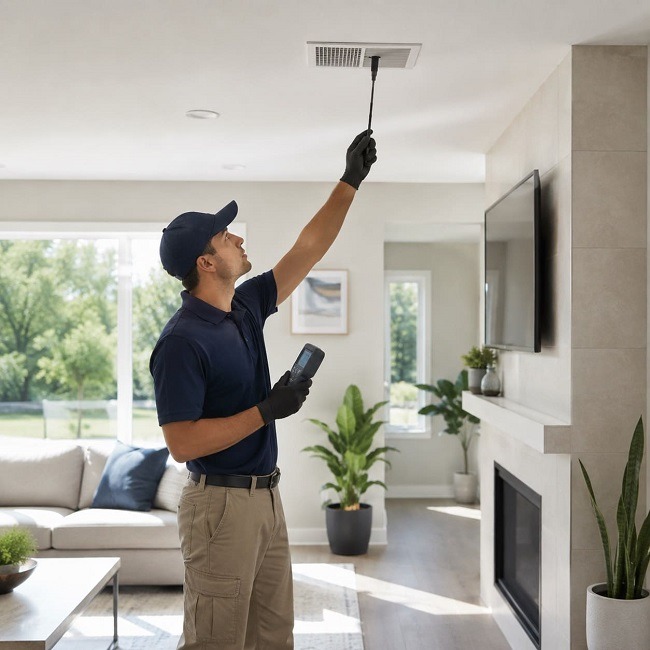
An HVAC indoor air quality assessment checks filtration, filter fit, airflow, accessible ductwork, HVAC moisture and ventilation conditions that may contribute to persistent dust, humidity, odors or poor air circulation.
MaksBuilder evaluates the HVAC side of indoor air quality concerns within its South Orange County residential service area. This is an HVAC-focused assessment, not mold identification, allergy testing or general laboratory testing for indoor pollutants.
- Filter fit and bypass
- MERV compatibility
- Return-air restrictions
- HVAC airflow
- Accessible ductwork
- Condensate moisture
- Indoor humidity
- Ventilation conditions
When an HVAC Indoor Air Quality Assessment May Be Useful
Dust, humidity or odors do not prove that the HVAC system is the source. An assessment helps determine whether filtration, airflow, ductwork, equipment moisture or ventilation conditions may be contributing to the complaint.
Filtration and airflow clues
- Dust returns unusually quickly after cleaning.
- The filter does not fit tightly in the rack.
- The filter becomes heavily loaded sooner than expected.
- Several vents have noticeably weak airflow.
- Rooms have persistent airflow differences.
Moisture and ventilation clues
- The home remains humid while cooling is operating.
- Moisture repeatedly appears near indoor HVAC equipment.
- Non-emergency odors appear when the blower operates.
- Rooms feel stale when doors remain closed.
- Outdoor smoke or particle entry is a recurring concern.
Some conditions require immediate safety attention
A gas or sulfur-like odor, carbon-monoxide alarm, visible smoke or flames should not be treated as a routine indoor air quality concern. Leave the affected area and contact emergency services or the gas utility as appropriate. For a burning or electrical odor, repeated breaker trip, or water reaching electrical components, stop operating the affected HVAC equipment and arrange appropriate safety or HVAC service before normal IAQ troubleshooting.
What We Check During an HVAC Indoor Air Quality Assessment
The inspection is focused on the reported problem rather than assuming that a stronger filter or additional air-cleaning product is needed.
| Concern | HVAC conditions checked | What the inspection can clarify |
|---|---|---|
| Persistent dust | Filter dimensions, filter seal, visible bypass, return-air pathway and accessible duct condition | Whether unfiltered air may be bypassing the media or entering through an HVAC-related pathway |
| Weak airflow | Filter resistance, return restrictions, blower-related conditions and accessible ductwork | Whether the limitation appears connected to filtration, the return path, ductwork or another HVAC component |
| Filter upgrade | Filter cabinet, media depth, manufacturer data, return restrictions and pressure conditions when appropriate | Whether a higher-efficiency filter is compatible with the installed system |
| Humidity or equipment moisture | Cooling-cycle behavior, blower operation, evaporator-coil area, drain pan, condensate drainage and visible nearby moisture | Whether HVAC operation may be affecting humidity or whether drainage or equipment conditions are creating moisture near the system |
| Stale rooms or ventilation concerns | Return pathways, exhaust conditions, room-pressure clues and existing outdoor-air pathways | Whether airflow or ventilation conditions should be corrected or evaluated further |
How We Evaluate Filter Fit and MERV Compatibility
A higher-efficiency filter is useful only when air passes through the media and the HVAC system can accommodate the filter without excessive airflow resistance.
EPA Guidance
The U.S. EPA recommends MERV 13, or the highest-efficiency filter that the system fan and filter slot can accommodate.
What we evaluate before a filter upgrade
- Correct filter dimensions
- Snug fit without bending or crushing
- Visible air bypass around the filter frame
- Available filter media depth
- Manufacturer pressure-drop information
- Return-air restrictions
- Airflow or static-pressure conditions when appropriate
MERV describes particle-capture efficiency. It does not by itself show a filter's pressure drop or confirm that a particular HVAC system can use that filter correctly.
For a broader explanation of filtration, ventilation and source control, see Indoor Air Quality and HVAC: Filtration, Airflow, Ventilation, and Source Control .
Airflow and Accessible Duct Checks During the Assessment
Central filtration depends on air reaching the return system and passing through the filter. Return restrictions, damaged ductwork or filter problems can reduce effective airflow.
Return-air conditions
- Blocked or obstructed return grilles
- Dirty or overly restrictive filters
- Visible return-duct damage
- Crushed flexible duct
- Gaps or disconnected accessible sections
Limits of a visual duct inspection
Accessible disconnections, crushed duct, damaged sections and obvious openings may be identified visually.
A visual inspection does not measure total leakage from the complete duct system. Whole-system leakage requires dedicated instrumented testing.
If weak airflow or visible duct damage is the primary concern, see Ductwork & Airflow Services in Orange County .
HVAC Moisture and Humidity Checks During the Assessment
Air conditioning removes moisture while the evaporator coil is cold and the system is operating correctly. Indoor humidity may remain elevated when cooling cycles are too short, airflow or controls are outside the intended operating range, or humid air is entering the home from another source.
HVAC conditions we may review
- Cooling-cycle behavior
- Filter and return-air restrictions
- Evaporator-coil area
- Drain pan and condensate drainage
- Visible moisture near indoor equipment
- Thermostat and blower settings
Humidity and condensate are not the same problem
A condensate drainage fault can cause retained water, overflow, local moisture, odors or equipment shutdown. It should not automatically be treated as the cause of elevated humidity throughout the home.
Continuous fan operation between cooling cycles can also increase humidity in some systems because moisture remaining on a wet evaporator coil may evaporate back into the airstream. Variable-speed equipment, zoning and manufacturer-specific control sequences can behave differently.
For a dedicated guide to this problem, see Why Is My House Humid Even When the AC Is Running? .
How Ventilation Is Reviewed During an HVAC Assessment
Filtration treats air that passes through the HVAC system, while ventilation exchanges indoor and outdoor air. Both can affect indoor air quality, but introducing more outdoor air is not automatically beneficial during smoke events, high particle levels or unfavorable outdoor temperature and humidity.
Ventilation-related conditions
- Existing bathroom and kitchen exhaust
- Return pathways from closed rooms
- Known outdoor-air pathways
- Building-pressure clues
- Outdoor smoke conditions
What this HVAC assessment does not provide
- Mold remediation
- Mold-species identification
- Medical or allergy diagnosis
- Broad laboratory screening for indoor pollutants
- Environmental testing outside the agreed HVAC scope
HVAC scope
This assessment focuses on HVAC-related filtration, airflow, accessible ductwork, equipment moisture and ventilation conditions. Roof or plumbing leaks, contaminated building materials and other non-HVAC sources may require a different qualified specialist. Suspected combustion-safety problems require dedicated safety evaluation rather than a routine IAQ assessment.
What Happens During the HVAC IAQ Assessment
Define the concern
We identify the specific dust, airflow, humidity, moisture, odor or ventilation complaint.
Inspect the relevant HVAC path
We focus on the components most likely to be connected to the reported condition.
Identify the likely source
Findings are separated into HVAC-related conditions and issues that may require another specialist.
Recommend the next step
The next step may involve filtration, airflow, ductwork, controls, moisture correction or referral outside the HVAC scope.
HVAC Indoor Air Quality Assessment FAQ
What does an HVAC indoor air quality assessment include?
Depending on the complaint, the assessment may cover filter fit, return airflow, accessible ductwork, HVAC moisture, controls and ventilation-related conditions.
Do you test for mold or allergens?
No. This HVAC assessment does not provide mold-species identification, medical allergy testing or broad environmental laboratory screening. HVAC-related moisture conditions can be inspected within the HVAC scope.
Can you check whether my filter is too restrictive?
Yes. Filter dimensions, fit, media type, manufacturer information, return restrictions and system conditions can be reviewed. Airflow or pressure measurements may be appropriate when needed.
Can a visual duct inspection prove that the whole system is leaking?
No. Visual inspection can identify accessible defects. Measuring total duct leakage requires dedicated instrumented testing.
Should I install a MERV 13 filter?
EPA recommends MERV 13, or the highest-efficiency filter the system fan and filter slot can accommodate. Compatibility and filter fit should be checked before moving to a more restrictive filter.
Official Filtration and Humidity References
What MaksBuilder Customers Say
“Came out really quickly. I really appreciated their honesty! Would hire them again & recommend to friends!”
“Prompt response and prompt appointment. Process of communication was easy and clear.”
Request an HVAC Indoor Air Quality Assessment
MaksBuilder can evaluate HVAC-related filtration, airflow, accessible ductwork, equipment moisture and ventilation concerns within its residential service area in South Orange County.
Published residential service areas include Foothill Ranch, Lake Forest, Irvine, Mission Viejo, Aliso Viejo, Rancho Santa Margarita, Laguna Hills and Laguna Woods Village. CA Contractor License #1095368.