Standard Digital Thermostat
A conventional digital thermostat can suit a straightforward furnace-and-air-conditioner system when remote access and advanced automation are not needed. It still must support the required heating and cooling stages.
A replacement thermostat has to match the HVAC equipment behind it. Before installation, the system type, available wiring, heating and cooling stages, power requirements and control setup need to be identified.
MaksBuilder installs thermostats for residential HVAC systems within its published South Orange County service area, including conventional furnace and air-conditioning systems, heat pumps, multi-stage equipment, zoned systems and compatible communicating equipment.
If the existing thermostat is blank, inaccurate, unreliable or unable to control newly installed equipment correctly, we first determine whether the control itself is causing the problem and whether the replacement will work with the rest of the system.
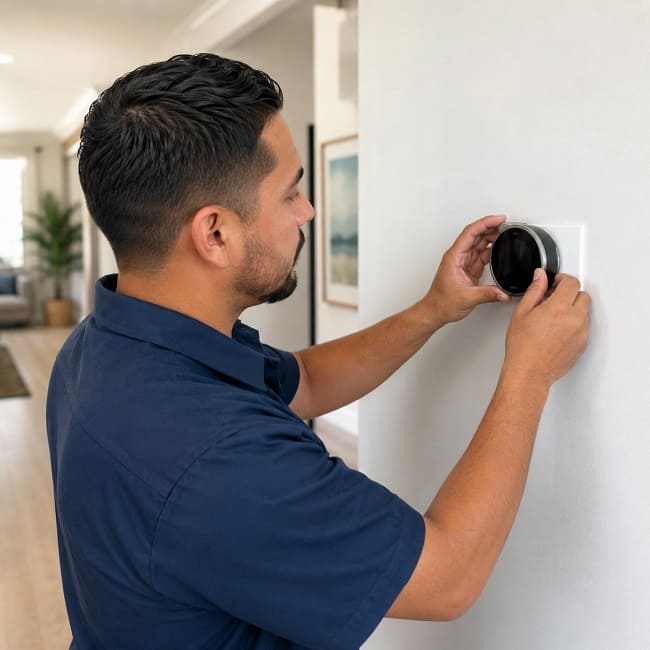
Thermostats that look similar can control HVAC equipment in different ways. The correct choice depends on the system installed in the home, not simply on the features listed on the thermostat box.
A conventional digital thermostat can suit a straightforward furnace-and-air-conditioner system when remote access and advanced automation are not needed. It still must support the required heating and cooling stages.
Smart thermostats can add app control, scheduling, occupancy features and room sensors. The selected model still needs to support the HVAC equipment, available wiring and required control functions.
A heat pump thermostat must support the required compressor stages, reversing-valve configuration and auxiliary or backup heat functions used by the installed system.
Multi-stage equipment can operate at different capacity levels. The thermostat needs to support the control strategy used by the installed equipment.
Some HVAC systems use proprietary communication between the wall control and equipment. A generic thermostat may remove supported functions or may not be compatible at all.
Zoned systems can use multiple thermostats or sensors connected through a zone control panel. A replacement control must be compatible with that existing architecture.
A compatibility check helps avoid installing a thermostat that cannot operate all of the HVAC system's required functions.
We identify the equipment and control requirements before configuring the replacement.
Many smart thermostats need continuous low-voltage power for their display, Wi-Fi connection and internal electronics. On compatible conventional 24-volt HVAC systems, the C-wire provides the common side of that power circuit.
Finding an unused conductor behind the thermostat does not necessarily mean a working common connection is available. The conductor also needs to be connected correctly at the furnace, air handler or control board.
A thermostat should not be selected only because the terminal labels look familiar. Popular smart thermostats are designed for specific compatible control systems and voltage arrangements.
Some manufacturers provide approved power accessories when a usable C-wire is not present. Proprietary communicating equipment may require a different compatible control.
The main thermostat should represent the temperature of the occupied living space rather than a local hot or cold spot. Direct sunlight, supply-air discharge, exterior-door drafts and nearby heat-producing appliances can distort the reading.
Poor placement can cause the system to satisfy too early or continue running after other parts of the home are already comfortable. If the thermostat consistently reads differently from the main occupied rooms, its location should be considered.
Some smart controls support remote sensors for temperature averaging, occupancy logic or scheduled control. Sensors can improve temperature information, but they cannot correct underlying airflow, duct or equipment problems.
Multi-stage furnaces, air conditioners and heat pumps can operate at more than one output level. Some systems receive separate stage calls from the thermostat, while others handle part of the staging logic inside the equipment control board.
The replacement thermostat therefore needs to support the staging method used by the installed equipment.
Heat pump thermostats often require additional configuration compared with a basic conventional furnace-and-AC control. Depending on the system, the thermostat may manage compressor stages, the reversing valve and auxiliary or backup heat.
Incorrect O/B configuration can cause the system to operate in the wrong mode. On systems where the thermostat manages auxiliary heat, its configuration can also affect when backup heat is called.
For complete system replacement, see heat pump installation in Orange County .
HVAC zoning uses separate temperature inputs for different areas of the home. Those inputs typically work with a zone control panel that opens and closes motorized dampers and coordinates calls to the heating and cooling equipment.
Replacing a thermostat in a zoned system requires more than matching the wires at the wall. The new control also needs to work with the zone panel and with the way that panel controls the HVAC equipment.
If different areas of the home remain at very different temperatures, replacing one thermostat may not address the cause. See HVAC zoning systems in Orange County for information about multi-zone comfort control.
A thermostat can prevent the HVAC system from receiving the correct call, but cooling, heating and comfort problems can also come from airflow restrictions, duct issues, electrical or ignition faults, refrigeration problems, equipment sizing or zoning.
If the thermostat is calling correctly but the equipment does not respond normally, replacing the wall control will not correct the underlying HVAC fault.
When the cause has not been confirmed, start with HVAC diagnostics in Orange County, CA before replacing additional components unnecessarily.
The new control is selected, wired and configured around the actual HVAC equipment rather than installed with generic settings.
We determine whether the system uses a conventional furnace and AC, heat pump, staged equipment, zoning or communicating controls.
Thermostat conductors, terminal functions and available power are reviewed before the replacement control is connected.
Heating type, cooling stages, heat pump settings and other applicable functions are configured according to the equipment requirements.
Heating, cooling, fan operation and applicable stages are tested to confirm that thermostat calls produce the expected equipment response.
Replacement makes sense when the existing thermostat is unreliable, has a failing display or controls, cannot support newly installed HVAC equipment, or no longer provides features the homeowner needs. A compatible smart thermostat can also add remote access, scheduling or room sensors, but it does not replace necessary HVAC repairs or airflow corrections.
No. Compatibility depends on the equipment type, control voltage, number of stages, heat pump configuration, zoning and whether the system uses conventional or communicating controls.
No. Many models use a C-wire for continuous power, while some support manufacturer-approved power accessories or other compatible arrangements. The correct method depends on the thermostat and HVAC system.
Yes, when the thermostat and equipment support the same control arrangement. Some systems use thermostat-managed staging, while others handle part of the staging internally.
The thermostat must support the functions required by the heat pump, which can include reversing-valve control, compressor stages and auxiliary heat. A basic conventional thermostat may not support those functions.
“Came out really quickly. I really appreciated their honesty! Would hire them again & recommend to friends!”
“Prompt response and prompt appointment. Process of communication was easy and clear.”
MaksBuilder installs compatible standard, smart, heat pump and multi-stage thermostats for residential HVAC systems within its published South Orange County service area. We check the equipment and control setup before installation and test system response after the new thermostat is configured.