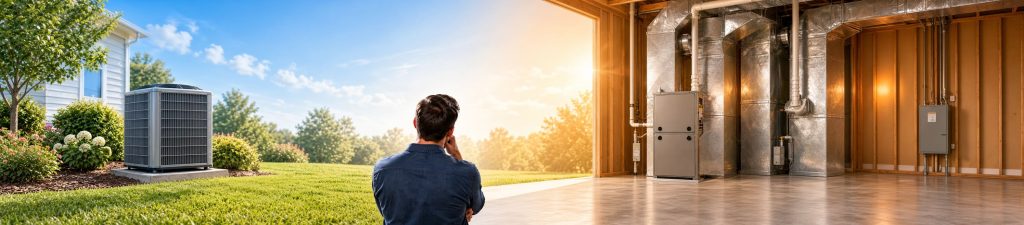
You do not have to replace your AC and furnace at the same time. If one system is in good condition and can work safely with the new equipment, replacing only the failing system may be the better use of your money.
Replacing both is worth considering when both units are worn or facing expensive repairs, or when the existing blower or controls cannot support the proposed new AC. Compare what each option would cost and what equipment can safely stay in place. Age alone is not a reason to replace both.
Do You Need to Replace Your AC and Furnace Together?
In many central HVAC systems, the outdoor air conditioner works with an indoor evaporator coil positioned above or beside the gas furnace. The furnace contains the blower that moves air through that coil and into your rooms. These parts share airflow and controls, but you can often replace one without replacing the other.
Only the AC needs work
Keep a dependable furnace if the blower, controls, and cabinet can support the selected cooling system.
Only the furnace needs work
Keep a sound AC and indoor coil when the new furnace can deliver the correct cooling airflow and fit beneath the coil.
Both have major problems
Compare replacing both during the same installation with the cost of two separate jobs later.
The evaporator coil is part of the cooling system even when it sits inside the furnace cabinet or in a separate case directly above it. Replacing the AC often means replacing the outdoor unit and its matched indoor coil, not necessarily the furnace.
When Replacing Only the AC Makes Sense
An AC-only replacement is usually reasonable when the furnace heats reliably, has no unresolved combustion or heat-exchanger safety concern, and its blower can handle the airflow the new air conditioner requires. This can be a practical choice if the furnace was installed more recently than the cooling equipment.
The contractor still needs to check how the new outdoor unit will connect to the indoor equipment. A typical split-system AC replacement involves a properly matched evaporator coil, appropriate refrigerant piping and metering components, condensate drainage, electrical work, and startup testing. Keeping an older coil simply because it is not leaking is not proof that it belongs with the new condenser.
Low airflow does not automatically mean you need a new furnace. First, the contractor should check the filter, return-air path, duct restrictions, indoor coil, blower settings, and actual fan performance. The technician can measure static pressure (the resistance air meets as it moves through the system) and compare the result with the blower manufacturer's data. If approved adjustments or upgrades cannot provide the airflow the new AC needs, replacing the furnace may be reasonable.
Where homeowners can overspend
Do not replace an otherwise sound furnace solely because a contractor recommends a “complete system.” Ask which specific safety concern, airflow result, control incompatibility, or installation cost makes replacement necessary. If the cooling system has not yet been diagnosed, see whether AC repair or replacement makes more sense.
When You Can Replace Only the Furnace
If the air conditioner cools well and its indoor coil is in good condition, you may be able to replace the gas furnace without changing the outdoor AC. This choice makes sense when the furnace has repeated costly failures, a major component cannot be repaired economically, or a qualified technician has documented a safety problem that cannot be corrected with an approved repair.
A furnace-only job requires more than matching the width of the old cabinet. The new blower must support the existing AC's required airflow as well as the furnace's permitted heating temperature rise. The installer also needs to check the coil's position, return-air opening, duct transitions, thermostat connections, venting, gas piping, and local requirements for the new furnace.
In some installations, the existing evaporator coil must be supported, repositioned, or temporarily removed so the furnace can be replaced. That adds labor, but it does not automatically mean the AC must be discarded. A faulty sensor, safety switch, or blocked vent also does not automatically mean the entire furnace must be replaced: the cause, available repair, and resulting safety must be evaluated first.
If a technician identifies a combustion, heat-exchanger, or venting hazard, do not operate the furnace until the problem has been safely corrected. Ask for the diagnosis and why repair or replacement is recommended. A working air conditioner does not make unsafe heating equipment acceptable. See the furnace installation and replacement requirements for more on the heating side of the job.
When Replacing Both Systems Makes Financial Sense
Replacing the AC and furnace together becomes more attractive when both are showing signs of wear or facing expensive repairs, not merely because they were installed in the same year. During one installation, the contractor can fit the new coil and furnace, check airflow, adjust duct connections, and test the completed system without opening the same equipment area twice.
Some installation work may only need to be done once, especially when both units share a cramped attic or closet. However, a combined job still includes two pieces of equipment and the work needed to install each. A single visit does not guarantee a big discount, and replacing a reliable furnace early has a cost.
Compare the additional cost, not just the package price
Ask for an AC-only quote and an AC-plus-furnace quote with the same proposed cooling equipment and installation scope. The difference shows what replacing the furnace now would add to the bill.
Hypothetical example for the same AC model — not actual local pricing:
Illustrative numbers only. These are not MaksBuilder prices, Orange County averages, or actual contractor quotes.
Now compare that $6,000 difference with a separate furnace-only quote and the current furnace's condition. A future job might involve another visit, coil handling, or duct changes, but those costs are not certain. If your furnace still has years of dependable service ahead, keeping it may be the better decision.
Replacing both may also make sense if the selected AC cannot work with the existing controls, if blower and duct checks show the required airflow cannot be achieved with approved corrections, or if two separate installations would mean substantial repeat work. Those are reasons to replace both — simply having older equipment is not.
Will a New AC Work With Your Existing Furnace?
Often yes, but a new unit fitting in the available space is not proof of compatibility. The contractor should identify the exact outdoor AC, indoor coil, and furnace models, then verify the required airflow and controls. Ask for the AHRI Certified Reference Number, if the proposed combination has one, and confirm it in the AHRI Directory. An AHRI rating verifies the listed equipment combination; it does not replace checks of your actual ducts and airflow.
Blower airflow and static pressure
The furnace blower must move enough air through the new cooling coil and your ducts. External static pressure is a measure of how much resistance the blower faces from the installed air path. The technician should measure it and use the blower performance data to check delivered airflow. A motor label or a furnace's advertised tonnage is not enough.
Evaporator coil and refrigerant
The indoor coil, refrigerant-control components, and outdoor AC must be approved to work together. An older R-410A coil should not be reused with an R-32 or R-454B unit unless the manufacturer explicitly allows that exact arrangement. These newer refrigerants can also introduce additional safety-control requirements, described below.
Thermostat and equipment controls
Many conventional systems can use their existing thermostat wiring after checks. Some variable-speed or communicating models need a compatible control board, interface, or thermostat. Ask which functions would be lost if you keep the current furnace.
Physical fit, drainage, and ducts
Cabinet width, coil orientation, service access, condensate routing, supply transitions, and return-air capacity all matter. A physically small replacement furnace or high-efficiency AC does not solve an undersized return or restrictive duct system.
Special check when the new AC uses R-32 or R-454B
R-32 and R-454B are A2L refrigerants, a lower-flammability classification. Depending on the system and installation, a refrigerant detection system may be required. If a leak is detected, the approved safety controls may need to stop the cooling compressor, prevent gas heating, and run the indoor blower to dilute refrigerant in the air.
An older furnace does not automatically have to be replaced. Some approved equipment combinations use an interface or sensor-adapter kit so the leak-detection system can control an existing furnace blower. Other combinations are not approved and may need different indoor equipment. The installer must follow the manuals for the exact outdoor unit, indoor coil, sensor, and furnace; a generic adapter is not a safe substitute. For one manufacturer's example, see Bosch's A2L refrigerant transition guidance.
For a broader explanation of the refrigerants themselves, read R-410A vs R-32 vs R-454B.
Different brands are not automatically incompatible. What matters is the specific approved equipment combination, installation instructions, controls, and documented performance. Some product lines allow mixed-brand or coil-only configurations; others require a more tightly matched set of components.
Four HVAC Replacement Scenarios Compared
These are the four choices most homeowners should compare when a central AC or gas furnace is approaching replacement. The extra work in the last column is not always required, but it should be considered before quotes are compared.
| Option | When it fits | Main advantage | Limitations | Possible added work |
|---|---|---|---|---|
| Replace AC only | Furnace is safe and reliable; blower and controls support the selected AC. | Keeps usable heating equipment and limits today's spending. | An older blower or incompatible controls may limit equipment choice or performance. | Matched indoor coil, refrigerant piping, condensate, electrical, airflow corrections. |
| Replace furnace only | AC and indoor coil are serviceable; furnace has a confirmed reason for replacement. | Fixes the heating problem without discarding working cooling equipment. | New furnace must physically fit and supply the required cooling and heating airflow. | Coil support or relocation, duct transition, venting, gas connection, controls, permits. |
| Replace AC and furnace | Both need major work, or keeping one creates costly compatibility or access problems. | Lets indoor and outdoor equipment, airflow, and controls be planned as one project. | Highest immediate cost among conventional gas-furnace-plus-AC options; usable equipment may be removed early. | New coil and furnace, duct or return improvements, electrical and gas/vent work, startup testing. |
| Switch to a heat pump | Owner is considering electric heating and cooling, with or without a gas-furnace backup. | One outdoor heat pump provides cooling and heating; a dual-fuel setup can retain gas backup. | Economics and design depend on electric rates, winter load, existing furnace, and controls. | Matched air handler or approved furnace/coil, electrical assessment, controls, ducts, permits. |
Any option can require duct repairs or electrical upgrades if testing identifies an existing problem. A more expensive package is not automatically a better match for the home.
What About Replacing Your Furnace With a Heat Pump?
If your AC is due for replacement, it is worth pricing a heat pump alongside a cooling-only air conditioner. A ducted heat pump can cool the home in summer and provide electric heating in winter. For many Orange County homes, mild winter conditions make that a practical option, but the operating cost depends on the system's performance and local electricity and gas prices.
There are two distinct approaches. An all-electric conversion replaces the gas furnace with an appropriate indoor air handler and uses the heat pump for heating and cooling, with supplemental heat if the design calls for it. A dual-fuel system pairs a compatible heat pump with a gas furnace, which operates under an approved heating control strategy. An existing furnace may be kept when the heat pump, indoor coil, blower, and controls are approved to work together; other designs need a different furnace or air handler.
Neither approach should be selected from an advertised efficiency rating alone. Compare heating and cooling loads, duct airflow, electrical capacity, system controls, installation cost, and expected operating costs. For the deeper gas-versus-electric decision, see whether replacing a gas furnace with a heat pump makes sense in Orange County.
How to Compare Replacement Quotes
A quote that says only “new 3-ton AC” or “complete HVAC system” leaves out the information needed to evaluate the work. Ask each contractor to show what will remain in place, what will be replaced, and what testing will confirm the system operates correctly.
- Exact model numbers. List the outdoor unit, indoor coil, furnace or air handler, and thermostat/control system. Include the refrigerant type.
- Sizing basis. Explain the home's heating and cooling loads and why the proposed equipment capacity fits; do not rely only on the old unit's tonnage.
- Airflow and match. Document blower capability, duct/return restrictions, relevant manufacturer requirements, and AHRI-rated combinations when applicable.
- Included installation work. Identify line-set work, drainage, coil transitions, venting, gas piping, electrical changes, permits, and any duct corrections.
- Startup and warranty. Specify startup tests (sometimes called commissioning), equipment and labor warranties, and what happens if the retained equipment needs replacement later.
For a fair cost comparison, use the same proposed AC model in the AC-only and AC-plus-furnace bids. A different efficiency tier or condenser size can make an apparent package discount misleading. The AC installation overview explains the cooling-side checks that belong in a replacement scope.
Frequently Asked Questions
Can I replace my AC without replacing the furnace?
Yes. A safe, working furnace can often stay in place if its blower, cabinet, and controls are suitable for the new cooling equipment. The indoor evaporator coil may still need replacement to match the new outdoor AC.
If I replace the furnace, do I need a new AC?
Not necessarily. A serviceable AC and coil may remain if the new furnace provides the right airflow and the physical and electrical connections are compatible. The installer must check the coil's support and placement during furnace replacement.
Do the AC and furnace need to be the same brand?
No blanket rule requires the same brand. Some mixed-brand combinations can be used, but equipment-specific approval, system controls, and the actual performance documentation matter. Communicating systems can have stricter pairing requirements.
Can a new R-454B or R-32 AC work with my old furnace?
Sometimes. The coil and cooling unit must be approved for the refrigerant, and the existing furnace must be able to meet any required leak-detection, blower, and heating-shutdown controls. Certain systems offer approved adapter kits; others need different indoor equipment.
Should the evaporator coil be changed with the AC?
Often, yes. Split-system indoor and outdoor components should be compatible with the selected refrigerant, capacity, and refrigerant-flow components. Reusing the coil is appropriate only when the manufacturer allows the exact combination and the installation meets its requirements.
Is replacing both systems always cheaper in the long run?
No. Shared labor may reduce some future work, but early replacement also sacrifices the remaining value of a working unit. Compare itemized quotes and the known condition of the equipment rather than relying on a claimed package savings percentage.
Can I keep my gas furnace and install a heat pump instead of an AC?
Sometimes. A compatible heat pump and furnace can operate as a dual-fuel system, but the coil, blower, thermostat, and heating changeover controls must support that configuration. It is not the same as a full conversion to an all-electric air handler.
Bottom line: Replace your AC and furnace together when the condition of both systems or a documented compatibility problem justifies the additional cost. If one unit is sound and can work properly with the replacement, keeping it is a legitimate option.
Before agreeing to a package replacement, ask for the model-by-model equipment match, airflow findings, the AC-only price, and the additional cost of changing the furnace now. Those details make the decision much clearer than a recommendation based on equipment age alone.