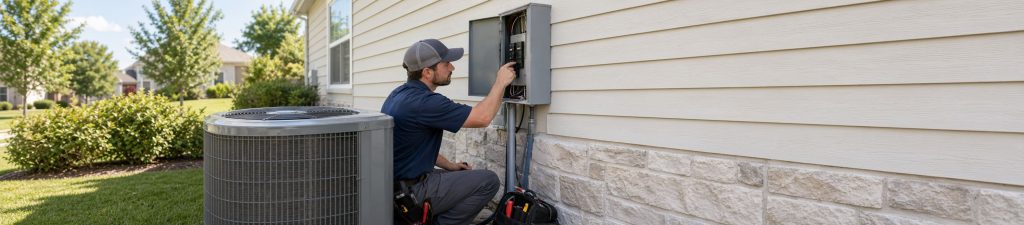
If your AC breaker keeps tripping, leave the affected circuit off. Repeated trips can mean excessive current or an electrical fault in the compressor, fan motor, capacitor, wiring, contactor, or supply circuit. A breaker may be protecting the equipment and wiring rather than failing itself.
Tell the technician whether it trips as cooling starts, when the outdoor unit attempts to run, or after several minutes. That timing helps narrow the tests, but it cannot identify the failed part on its own. Do not repeatedly reset the breaker to get the AC running.
Why an AC Circuit Breaker Trips
A standard circuit breaker trips when an overload or short-circuit current exceeds its protective limits. Ground faults can also cause high fault current, while GFCI or AFCI devices have additional protective functions. A compressor briefly draws extra current at startup, but a correctly installed AC circuit must accommodate normal startup without repeated breaker trips.
Many central systems use separate circuits for indoor and outdoor equipment, so the label of the breaker that opened matters. Electrical faults can be in the AC itself or in the breaker, wiring, and disconnect supplying it. Do not remove the electrical panel cover or open HVAC electrical compartments to find out.
Seven Common Reasons an AC Breaker Keeps Tripping
These seven areas are worth testing. A humming outdoor unit or a trip at startup is a clue, not proof that the compressor or capacitor must be replaced.
Weak or Failed Capacitor
Many conventional condensers use start or run capacitors in compressor or fan-motor circuits. A failed capacitor can prevent normal starting and contribute to unusually high current. Inverter-driven systems may use different electronics and require different tests.
Humming without startup or a slow condenser fan can be clues, but they also occur with motor, compressor, or voltage problems. Capacitors can retain a dangerous charge after power is disconnected.
Compressor Hard-Starting or Electrical Fault
A compressor may attempt to start without rotating normally, drawing very high current in a locked-rotor condition. Shorted windings, a fault to ground, or serious mechanical damage can also be involved.
Compressor replacement should not be assumed until supply voltage, starting components, circuit condition, and motor tests have been evaluated.
Condenser Fan or Blower Motor Problem
Damaged motor windings, worn bearings, internal electrical faults, or mechanical resistance can produce abnormal current. A failed outdoor fan can also reduce heat rejection and raise compressor operating stress.
Whether the affected breaker feeds indoor or outdoor equipment matters when deciding which motor and circuit to inspect.
Shorted or Damaged Wiring
Vibration, moisture, worn insulation, loose connections, and overheating can damage HVAC wiring. A short circuit or fault to ground may trip a breaker quickly, sometimes before cooling begins.
Do not open electrical panels, pull the disconnect, or touch damaged conductors to investigate.
Contactor, Disconnect, or Electrical Connection
A contactor or disconnect with damaged contacts, loose terminals, or insulation failure may develop overheating, arcing, or an electrical fault. Buzzing, scorching, or a burning smell requires prompt attention.
A contactor problem does not always cause a breaker trip; a contactor that fails to close can simply prevent startup. The actual electrical fault must be confirmed.
Defective or Incorrectly Sized Breaker
A breaker or its connection can be defective, but a trip often means the protection is responding correctly. Circuit sizing must be checked against the outdoor unit nameplate, including Minimum Circuit Ampacity (MCA), Maximum Overcurrent Protection (MOCP), conductor ratings, and the manufacturer's instructions.
Never replace it with a larger breaker merely to stop trips. A licensed electrician must verify the circuit and approved protection before any breaker change.
Dirty Outdoor Condenser and High Load
Heavy dirt on the condenser coil restricts heat rejection and can raise compressor operating temperature and load. This may contribute to a trip after the system has been running, but it is less likely to explain a breaker that opens before the equipment starts.
A dirty coil alone does not confirm the cause of a breaker trip. Electrical tests are still needed.
When Does the AC Breaker Trip?
Record when the breaker opens, ideally without trying to reproduce the problem. The pattern helps a technician decide which tests come first.
| Timing | Possible areas to investigate |
|---|---|
| Immediately when cooling starts | Short circuit, fault to ground, wiring damage, or compressor electrical fault. |
| As the outdoor unit attempts to start | Capacitor, compressor, condenser fan, contactor, or supply circuit. |
| After several minutes | Compressor or motor overheating, excessive running current, poor condenser heat rejection, or electrical connection fault. |
| Mainly during very hot weather | Higher operating load, restricted outdoor coil, or equipment already close to an electrical or thermal limit. |
| Intermittently or at random | Loose connection, damaged wiring, intermittent motor fault, or breaker issue. |
What You Can Safely Check
These checks require no tools, exposed wiring, or HVAC cabinet removal. If the panel or equipment is hot, wet, sparking, or making electrical crackling sounds, keep clear instead.
Set the thermostat to OFF. Leave the tripped circuit off until the repeated trip has been diagnosed.
Note its label and whether the indoor blower, outdoor condenser, or both lost power. Do not remove the panel cover.
Did the outdoor unit hum, did a fan start, or did cooling run for several minutes? Do not reset power to recreate the sound.
From a safe distance, note debris blocking the condenser or a visibly dirty accessible filter. A clogged filter usually causes airflow or icing problems, not a direct breaker fault.
Capacitors may hold a dangerous charge even after shutdown. Leave disconnects, terminals, and breaker replacement to qualified professionals.
Why Repeated Breaker Resets Are Unsafe
A breaker interrupts a potentially hazardous condition. Re-energizing the circuit again and again can expose damaged wiring, a shorted motor, or overheated connections to further stress. Leave the circuit off after repeated trips. Never install a higher-rated breaker to force the system to run.
If you see sparks, smoke, melted insulation, or damage at the electrical panel, stay away and contact a licensed electrician; call emergency services for an active fire or immediate danger. The Electrical Safety Foundation International also recommends professional inspection for frequent breaker trips.
How a Technician Finds the Cause
Testing begins with the tripped circuit. An HVAC technician evaluates equipment faults; a licensed electrician is needed when the fault involves the panel, breaker, branch wiring, or circuit protection.
- Identify the affected indoor or outdoor circuit and compare the installed breaker and conductors with the equipment's MCA, MOCP, and electrical specifications.
- Inspect wiring, connections, the disconnect, and the breaker for overheating, damage, or loose terminations.
- Measure supply voltage and compressor and motor starting and running currents using appropriate procedures.
- Test capacitors on conventional systems, contactors, motors, compressor windings, and ground faults as indicated by the measurements.
- Check outdoor-coil condition, fan operation, and system load. Confirm the circuit operates safely after correcting the fault.
For HVAC-side assessment, see HVAC diagnostics in Orange County.
Frequently Asked Questions
Why does my AC breaker trip immediately?
A short circuit, damaged wiring, a fault to ground, or an equipment electrical fault may be involved. Immediate tripping does not prove the compressor is bad. Leave the circuit off and have it tested.
Why does it trip after a few minutes?
Motor or compressor running current, a heating electrical connection, or poor condenser heat rejection may become relevant as the equipment operates. Measurements are needed to distinguish them.
Can a failed capacitor trip the breaker?
Yes, on systems that use conventional motor capacitors. A failure can prevent normal starting and contribute to high current, but compressor, motor, wiring, and voltage faults can produce similar symptoms.
Can a clogged filter trip the AC breaker?
A dirty indoor filter usually causes low airflow or coil icing, not an electrical trip directly. Do not assume changing it resolves a breaker that repeatedly opens.
Does a breaker trip mean the breaker itself is bad?
No. It may be functioning correctly. A licensed electrician can check the breaker, branch circuit, and compliance with the equipment nameplate before considering replacement.
Should I call an HVAC technician or electrician?
An HVAC technician can evaluate the compressor, fans, contactor, and other AC equipment. A licensed electrician should inspect suspected panel, breaker, or branch-circuit faults. Some cases require both.
Next step: Leave the affected breaker off, note which circuit opened and when, and request electrical testing rather than another reset or a guessed parts replacement.
For a confirmed HVAC fault, see air conditioning repair or emergency AC repair.
One Response