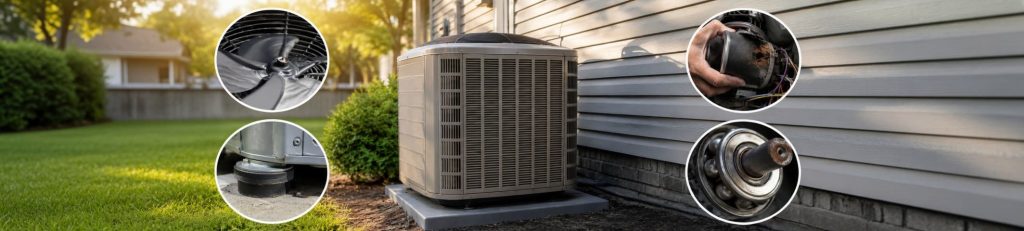
Air conditioners normally produce airflow, fan, motor, relay and refrigerant sounds. The important distinction is whether a sound is familiar and brief or new, persistent, unusually loud and accompanied by weak cooling, reduced airflow, ice, vibration, an electrical odor or repeated breaker trips. The sound name alone cannot identify a failed component, but its location, timing and effect on system operation can narrow the likely cause.
A low, steady hum, a single click or a brief pressure-equalization sound may be normal for some equipment. Repeated buzzing during a failed start, strong rattling, grinding, scraping, smoke, sparks, a burning odor or violent cabinet movement is not normal. Turn the thermostat off when a fan, motor or compressor appears unable to start or when rotating parts may be rubbing or striking another component.
When an unusual AC noise means you should stop the system
Set the thermostat to Off if the equipment is grinding, scraping, shaking strongly, repeatedly buzzing without starting or making a sound that suggests a fan is striking its housing. Turning the thermostat off ends the operating request, but it does not electrically isolate every component inside the equipment.
If you see smoke, sparks, melted wiring or active fire, keep away from the equipment, leave the immediate area and contact the appropriate local emergency service. Do not remove a panel, touch a disconnect or repeatedly reset a tripped breaker.
Use these urgency levels as general guidance. The owner's manual and safety instructions for the exact model take priority.
A brief, familiar sound that matches the equipment's established startup, operation or shutdown sequence.
A mild new sound without reduced cooling, weak airflow, electrical symptoms or visible vibration.
A persistent or worsening sound accompanied by changed airflow, cooling performance or cycle length.
Grinding, scraping, severe vibration, repeated failed-start buzzing, smoke, sparks or breaker trips.
Use the system's previous behavior as the baseline. Central air conditioners, heat pumps, packaged units, variable-speed equipment and ductless systems do not all follow the same sound pattern. A familiar brief sound is less concerning than a new sound that becomes louder, lasts longer or appears with another symptom.
Air conditioner noise guide by sound, location and timing
Use the table to identify the system area that deserves attention. It cannot confirm a failed capacitor, motor, compressor, contactor or refrigerant component without testing.
| Sound | Likely location | When it occurs | What it may indicate | Safe next step | Urgency |
|---|---|---|---|---|---|
| Low hum | Indoor or outdoor equipment | Steady during operation | Normal transformer, motor or compressor sound when the system starts and operates normally | Compare it with the usual sound and confirm that cooling and airflow remain normal | May be normal |
| Loud buzz | Outdoor electrical, motor or compressor area | At startup or while a fan or compressor does not run | Control-circuit instability, contactor vibration, motor-start difficulty, wiring damage or another failed-start condition | Turn cooling off if the sound repeats or the fan or compressor does not start | Diagnosis needed |
| Rattle | Cabinet, grille, duct, mount or fan area | At one speed or during startup and shutdown | Loose panel, bracket, fastener, debris, fan imbalance, deteriorated mount or duct vibration | Observe from a safe distance and stop the system if a moving part appears to strike something | Check promptly |
| Grinding | Indoor blower or outdoor fan motor | Whenever the affected motor or fan rotates | Bearing or bushing deterioration, motor damage or friction between moving and stationary parts | Turn the thermostat off and avoid further operation | Stop operation |
| Scraping | Blower housing or outdoor fan shroud | During rotation or while the fan slows down | Loose blower wheel, bent blade, shifted motor mount or debris touching a rotating component | Turn the thermostat off; do not reach through a grille or remove an access panel | Stop operation |
| Whistle | Filter slot, return grille, register or duct joint | While the indoor blower runs | Air moving through a narrow opening, filter restriction, poor filter fit, blocked grille or excessive duct resistance | Check the accessible filter and visible grilles without opening equipment panels | Safe checks first |
| Brief hiss | Indoor coil, refrigerant line or heat-pump section | Briefly after startup, shutdown or a mode change | Refrigerant movement, pressure equalization or heat-pump valve operation | Monitor the duration and confirm that performance remains normal | May be normal |
| Persistent hiss | Coil, copper line, register or duct connection | Continuously or repeatedly during operation | Air leakage, register restriction, normal metering-device sound or a refrigerant-circuit problem | Arrange diagnosis if cooling has weakened, ice is present or operating cycles have become longer | Diagnosis needed |
Similar noises can travel through tubing, sheet metal, walls and mounting surfaces. The point where a sound is loudest is not always the component that produced it.
Why an air conditioner hums or buzzes
Air conditioner humming is often smooth, low and continuous. Buzzing is usually sharper and may involve electrical or mechanical vibration. Either sound becomes more important when a fan or compressor is not starting, the noise repeats rapidly or cooling stops.
Contactor and control-circuit vibration
An outdoor contactor uses a low-voltage coil to close line-voltage contacts. A faint coil sound may occur while it is energized. Loud chatter or rapid clicking can occur when the contactor does not hold steadily because of unstable control voltage, damaged contacts, a coil problem or another interruption in the control circuit.
Repeated clicking does not establish that the contactor itself has failed. Thermostats, relays, circuit boards, low-voltage connections and safety controls can also interrupt the operating signal.
Motor and compressor-start difficulty
A pronounced hum with a stationary fan or a compressor that does not start may mean that a component is receiving power but cannot complete its startup sequence. Possible causes include a weak run capacitor where the design uses one, motor damage, mechanical obstruction, incorrect voltage, damaged wiring or compressor-start difficulty.
The capacitor explanation does not apply equally to every system. Conventional PSC fan motors commonly use run capacitors, while ECM motors use electronic controls. Inverter-driven compressors also use power electronics and follow a different startup process.
Do not open an electrical compartment to investigate a buzz
Air-conditioning equipment may contain multiple voltage sources, and capacitors can retain charge after power has been disconnected. Do not remove an access panel, press a contactor, spin a fan blade or test wiring unless you are qualified to perform the work with the required procedures and instruments.
Why an air conditioner rattles or vibrates
Rattling usually involves a loose, unbalanced or resonating part. The source may be the HVAC equipment, a duct section, a mounting surface or an object near the unit.
Panels and fasteners
An access panel, grille, line cover, drain pan or mounting bracket may rattle only at a particular fan speed. Pressure changes can also make sheet metal flex without an internal component failure.
Debris near a fan
Leaves, seed pods or twigs can touch an outdoor fan or vibrate against the cabinet. Turn the system off if a rotating part appears to strike an object. Do not reach through the top grille.
Fan or blower imbalance
A bent fan blade, damaged blower wheel, cracked hub, deteriorated motor mount or heavy dirt buildup can create rhythmic vibration that increases with speed.
Duct and grille resonance
A loose damper, unsupported duct section, return grille or register vane can rattle even when the air handler itself is operating correctly.
Why grinding or scraping requires prompt attention
Grinding is commonly associated with mechanical friction, bearing deterioration or internal motor damage. Scraping more often suggests that one component is physically rubbing against another. Continued operation may enlarge the damage.
Motor bearing or bushing wear
Indoor blower and outdoor fan motors depend on bearings or bushings to keep the shaft aligned. Wear can cause grinding, rumbling, squealing, shaft movement, heat and increasing vibration. The sound may be strongest at startup or while the motor slows down.
Fan blade or blower wheel contact
A loose blower wheel can shift and rub against its housing. An outdoor fan blade may contact a shroud, grille, wire or refrigerant tube if the blade bends or a motor mount moves. The thermostat should be turned off until the source is evaluated.
Noise near the compressor
A deep mechanical sound near the outdoor compressor does not necessarily originate inside the compressor. Refrigerant tubing, fan vibration, cabinet resonance and mounting hardware can transmit sound through the same area. The actual source should be isolated before any major component is condemned.
Why an air conditioner whistles or hisses
Whistling at a filter or grille
Whistling usually occurs when air moves quickly through a narrow opening. Check the accessible filter, visible return grilles and supply registers. Furniture, curtains, rugs and stored objects should not block these openings.
A clogged filter increases resistance in the air path and can reduce airflow. Its effect on motor speed, current and energy use depends on the blower motor and control strategy. A constant-airflow ECM may increase speed to compensate, while other motor types may simply deliver less airflow.
A filter that is the wrong size or poorly seated can whistle around its edges. Other possible causes include a restricted return path, partially closed damper, duct leakage, register-vane geometry or excessive total external static pressure.
The U.S. Department of Energy notes that filter condition and installation affect airflow and HVAC performance. See the guidance on proper HVAC filter installation and airflow.
Sound alone cannot measure duct pressure. A small opening may create a loud whistle, while a major restriction may be comparatively quiet. Persistent airflow noise may require static-pressure and airflow measurements interpreted against manufacturer limits.
Brief hissing during a cycle
A short refrigerant-flow or pressure-equalization sound can be normal for some equipment. Heat pumps may also change tone when the reversing valve changes mode or the system enters or leaves defrost.
Persistent hissing with reduced performance
A continuing hiss near a coil or refrigerant line deserves attention when it appears with reduced cooling, ice, longer operating cycles or an abrupt performance change. Oily-looking residue near a connection can be a clue, but it does not prove that an active leak is present.
Do not loosen fittings, bend tubing or add refrigerant without locating the cause. The U.S. Environmental Protection Agency advises homeowners to have refrigerant leaks evaluated and repaired by appropriately qualified personnel. See the EPA's refrigerant guidance for homeowners and consumers.
Safe observations you can make without opening the equipment
The most useful information is the sequence in which the noise occurs. Make observations from a safe position without placing hands, tools or a phone near moving equipment.
Locate the sound. Identify whether it is loudest at the indoor unit, outdoor unit, return grille, supply register, duct section or refrigerant tubing.
Note the timing. Record whether it occurs before startup, as a fan begins, while the compressor runs, during a speed change, at shutdown or while a fan coasts down.
Observe system operation. Note whether the indoor blower and outdoor fan run, whether cooling remains normal and whether the system starts and stops repeatedly.
Check for related symptoms. From a safe position, look for visible ice, water leakage, cabinet movement, error codes, electrical odors or a tripped breaker.
Record the sequence safely. A short video may document timing and visible vibration, although phone microphones can distort low-frequency sounds.
Information that helps during diagnosis
Record the equipment type, approximate age, sound description, location, timing, duration and whether the noise is becoming worse. Note any changes in cooling, airflow, cycle length, filter condition, recent electrical work, ice, water, odors, error codes or breaker operation.
What not to do when an air conditioner makes an unusual noise
- Do not remove an electrical or mechanical access panel to locate the sound.
- Do not touch capacitors, contactors, terminals, circuit boards or exposed wiring.
- Do not reach through a fan grille or insert an object into the cabinet.
- Do not repeatedly reset a breaker that trips again.
- Do not keep cycling the thermostat when a motor hums but does not start.
- Do not assume that every hiss is a refrigerant leak or every hum is a failed capacitor.
- Do not loosen a refrigerant fitting or add refrigerant without locating the underlying problem.
- Do not continue operating equipment that is grinding, scraping, smoking, sparking or moving violently.
How HVAC noise is professionally diagnosed
A reliable diagnostic process begins by reproducing the sound and separating indoor equipment, outdoor equipment, ductwork and building-transmitted vibration. The exact steps depend on the system design and the conditions under which the noise occurs. If the noise is tied to an active cooling fault, see our AC repair service.
Mechanical inspection may include panels, supports, motor mounts, fan blades, blower wheels, tubing contact points and nearby objects. Electrical evaluation may include supply voltage under load, control voltage, current draw, terminal condition, capacitor capacitance where applicable and the stability of the operating signal.
Airflow-related noise may require checking filter fit, register position, blower configuration, duct restrictions and total external static pressure. Refrigerant-circuit evaluation may involve pressure, temperature and other measurements appropriate to the equipment and outdoor conditions.
The U.S. Department of Energy describes HVAC diagnostics as a measurement-based process in which airflow and refrigerant-related readings are interpreted together rather than in isolation. See the DOE publication on airflow and refrigerant-charge diagnostics.
After a correction, the system should be operated under similar conditions to confirm that the noise source has been removed and that airflow, temperature response, electrical operation and safety controls remain appropriate.
Frequently asked questions
Is a low hum from the outdoor air conditioner normal?
A low, steady hum may be part of normal operation when the system starts, cools and moves air normally. It becomes more concerning when it grows louder, changes into a harsh buzz, is accompanied by repeated clicking or occurs while the outdoor fan or compressor does not start.
Can a dirty air filter make an air conditioner noisy?
Yes. A clogged or poorly fitted filter can increase airflow resistance and create whistling near the filter slot or return grille. The effect on blower speed and electrical demand depends on the motor and control design. A filter problem does not explain grinding, metal scraping or electrical buzzing.
Why does an air conditioner rattle only at startup?
Startup changes fan speed, refrigerant pressure and cabinet vibration. A loose panel, bracket, duct section, fan component or mounting point may rattle only during that transition.
Does hissing always mean a refrigerant leak?
No. Brief hissing may come from normal refrigerant movement or pressure equalization, while a hiss at a grille may be moving air. A persistent sound near a coil or refrigerant line becomes more significant when cooling weakens, ice forms or cycle length changes.
Can I keep using an air conditioner that is grinding or scraping?
Continued operation is not recommended. Grinding or scraping can indicate bearing deterioration or contact involving a fan blade, blower wheel, housing or motor. Turn the thermostat off and avoid restarting the system until the source has been evaluated.
Sources and further reading
- Trane: HVAC smells and noises explained
- Trane: Heat-pump troubleshooting
- U.S. Department of Energy Building Science Education: Proper HVAC filter installation
- U.S. Department of Energy: Airflow and refrigerant-charge diagnostics
- U.S. Environmental Protection Agency: Refrigerant guidance for homeowners
- U.S. Environmental Protection Agency: Stationary refrigeration and air-conditioning resources
This article provides general educational information. Normal sounds, diagnostic procedures and acceptable operating values vary by equipment design, operating conditions and manufacturer documentation.