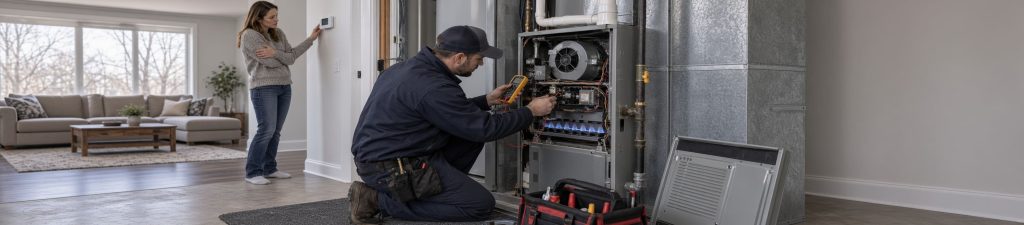
Quick answer: A gas furnace may blow cold air when the thermostat fan runs without the burners, the burners cannot stay on, restricted airflow causes overheating, or an ignition, flame-sensing, blower, or safety-control problem interrupts the heating cycle.
First, confirm that the thermostat is set to HEAT and the fan to AUTO. Then check the air filter. If the furnace still cannot provide steady heat, further diagnosis is needed.
What Cold Air From a Gas Furnace Usually Means
A brief period of cooler airflow does not always mean the furnace has failed. Air already inside the ducts may reach the vents before heated air arrives, and the blower may continue running briefly after the burners shut off.
Persistent cool air during an active heating call is different. If the blower keeps running but the home is not warming up, the furnace may not be producing or maintaining normal heat.
Often Normal
The air feels cool only briefly at startup or shutdown and then changes to normal warm airflow.
Needs Investigation
The blower continues running but the air stays cool, the burners stop unexpectedly, or the home cannot reach the thermostat setting.
This guide covers gas furnaces. If your system is a heat pump, see Heat Pump Blowing Cool Air in Heating Mode because heat pumps operate differently.
Thermostat Fan Set to On Instead of Auto
When the thermostat fan is set to ON, the indoor blower can run even when the gas burners are off. In that situation, the vents may deliver room-temperature air instead of heated air.
Set the thermostat to HEAT and the fan to AUTO. If the furnace still blows cool air during a heating call, the problem is likely elsewhere in the heating sequence.
Burners Are Not Staying On
A furnace may sound as though it is running even after the burner flame has stopped. The blower or inducer can continue operating while the furnace is no longer producing useful heat.
Burner operation can be interrupted by:
- ignition failure;
- loss of flame verification;
- restricted airflow and overheating;
- venting or pressure-switch problems;
- a safety-control response;
- wiring or control-board faults.
Timing helps narrow the diagnosis. Flame that disappears almost immediately after ignition points toward a different group of problems than burners that operate for several minutes and then shut down.
Airflow Restriction and Furnace Overheating
A gas furnace needs adequate airflow across the heat exchanger. If airflow becomes restricted, internal furnace temperature can rise above the normal operating range.
Common causes of restricted airflow include:
- a heavily loaded or incorrect air filter;
- blocked return-air paths;
- closed or obstructed supply registers;
- a dirty blower wheel;
- weak blower performance;
- duct restrictions;
- incorrect blower setup.
If the furnace overheats, the high-limit control may stop burner operation while the blower continues running to remove heat. The air coming from the vents can then change from warm to cool.
Typical pattern: the furnace heats normally at first, then the burners stop while the blower keeps running.
High-Limit Safety Shutdown
The high-limit control is designed to stop burner operation when furnace temperature becomes excessive. Repeated high-limit shutdowns usually indicate that the cause of the overheating or airflow restriction needs to be identified.
Do Not Bypass Furnace Safety Controls
Limit and rollout controls are part of the furnace safety system. Jumping or bypassing these controls removes an important protection without correcting the condition that caused the shutdown.
Ignition Problems
If the thermostat calls for heat but the burners never establish flame, the furnace cannot produce normal heated airflow.
Depending on the furnace, ignition may use a hot-surface igniter, spark ignition, or an older pilot-based system. The heating sequence can also involve the inducer, pressure switch, gas valve, burners, flame sensor, and control board.
Ignition-related problems can include:
- a failed or damaged igniter;
- spark or pilot ignition problems on applicable equipment;
- a gas-valve command or gas-supply problem;
- pressure-switch or venting faults;
- wiring or control-board problems.
For more detail about this failure mode, see Furnace Ignitor Problems: Why the Furnace Won’t Light .
On high-efficiency condensing furnaces, a restricted condensate drain or trap can also interfere with pressure conditions and prevent the furnace from completing a normal heating sequence.
Flame-Proving Problems
After ignition, the furnace must verify that burner flame is present. If the control board does not receive the expected flame signal, it closes the gas valve for safety.
A common symptom is burners that ignite normally and then shut off again within a few seconds.
A contaminated flame sensor can contribute to this problem, but sensor position, grounding, wiring, burner condition, gas delivery, and control problems can produce a similar symptom.
See Furnace Flame Sensor Problems: Burners Shut Off for a focused explanation.
Blower Timing and Control Problems
Furnace controls determine when the blower starts and how long it continues after burner shutdown. If the blower receives the wrong command, it may continue moving air even though the furnace is no longer producing useful heat.
Possible causes include thermostat fan commands, blower relay problems, control-board faults, low-voltage wiring problems, zoning controls, or ECM/blower-motor control problems on applicable systems.
Continuous blower operation can point to a thermostat, control, or safety-command problem rather than a failed blower motor.
Duct or Return-Air Conditions
If most of the home receives normal heat but one room or area remains unusually cool, the problem may be in the duct system rather than the furnace burners.
Possible duct and airflow problems include:
- air leakage from ducts in an attic, crawlspace, garage, or other unconditioned area;
- damaged or disconnected duct sections;
- restricted return airflow;
- poor supply-air balance;
- long or poorly insulated duct runs.
If every supply vent is delivering cool air, the furnace heating sequence is generally the more logical place to begin diagnosis.
What Can You Check Safely?
Homeowner checks should stay limited to thermostat settings, accessible airflow items, and observations that do not require opening gas components, bypassing safety controls, or working around live electrical terminals.
- Confirm the thermostat is set to HEAT.
- Set the thermostat fan to AUTO.
- Raise the set temperature above the current room temperature.
- Check whether the air filter is heavily restricted.
- Make sure return grilles and supply registers are not blocked.
- Observe whether the burners light and remain on.
- Note a visible furnace fault code without defeating a door switch.
If You Smell Gas
Leave the building immediately. Do not operate light switches, thermostats, electrical equipment, appliances, or other possible ignition sources inside the building. From a safe location, contact the gas utility or emergency services.
Official guidance: SoCalGas Natural Gas Leak Safety .
If a Carbon Monoxide Alarm Sounds
Move outside to fresh air immediately and call 911 or local emergency services. Do not re-enter the building until emergency responders say it is safe.
How a Technician Diagnoses a Furnace That Blows Cold Air
“Furnace blowing cold air” describes a symptom rather than a specific failed part. Diagnosis usually follows the heating sequence to identify where normal operation stops.
- Confirm the heat call. Check thermostat settings, low-voltage signals, and any zoning controls affecting the heating demand.
- Check ignition and flame. Determine whether the burners fail to light, lose flame shortly after ignition, or operate until another control interrupts them.
- Evaluate airflow and temperature rise. Check the filter, blower, return airflow, supply airflow, and furnace operating temperature.
- Check the safety circuit. Review limit, rollout, pressure-related controls, and stored furnace fault codes.
- Verify blower and control operation. Check blower commands, relays, motor controls, wiring, and operating sequence.
A furnace fault code can help narrow the diagnosis, but it does not automatically mean the component named by the code should be replaced.
When Furnace Repair Is Needed
Professional furnace diagnosis is appropriate when basic thermostat and filter checks do not restore normal heat or when the furnace cannot complete a stable heating cycle.
- the burners do not ignite;
- the furnace heats normally at first and then begins blowing cool air;
- a safety control repeatedly interrupts operation;
- the blower keeps running without normal heat output;
- the home cannot reach the thermostat setting.
If the main symptom is repeated short heating cycles rather than continuous cool airflow, see Why Does My Furnace Keep Turning On and Off? .
Related Furnace Guides
If the basic checks above do not restore normal heat, MaksBuilder provides furnace diagnosis and repair in Orange County.