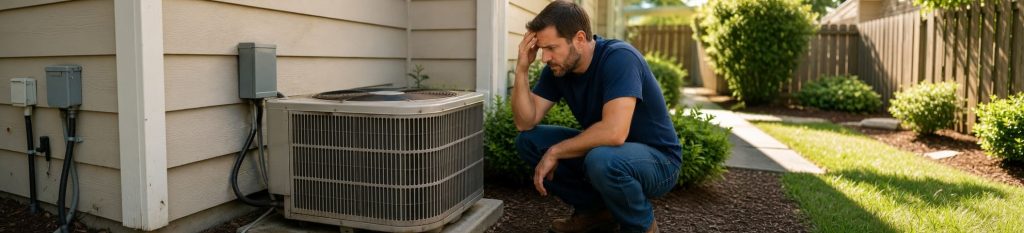
Outdoor AC troubleshooting
Outdoor unit stays off during a cooling call: The thermostat may still be calling for cooling and the indoor blower may still run while the condenser stays off. First confirm outdoor power and the cooling-control signal. If power and the control signal are present, the fault is inside the outdoor equipment.
If the condenser stays off, first check outdoor power and the cooling-control signal. Once outdoor power and the cooling signal are confirmed, use the unit's behavior—silent, clicking, humming, cycling, or overheating—to narrow the possibilities.
This guide applies mainly to conventional split-system central air conditioners. Heat pumps, ductless mini-splits, inverter systems, and packaged units may use different power, control, and startup arrangements.
Thermostat and control problems
Under normal operation, the outdoor unit starts when the control system receives and passes along a request for cooling. First confirm that the thermostat is set to COOL, the target temperature is below the current indoor temperature, and the fan is set to AUTO.
A schedule, energy-saving override, low thermostat battery, communication fault, damaged control wiring, low-voltage problem, or control-board issue can interrupt the cooling request before it reaches the outdoor unit.
After changing the thermostat, allow several minutes before deciding that the condenser will not start. Many systems use compressor protection or an anti-short-cycle delay, often around five minutes, but the exact delay depends on the thermostat and equipment controls.
The indoor blower may continue running while the outdoor unit remains off. This can happen because the indoor and outdoor sections use different circuits or control stages, or because the thermostat fan setting is commanding continuous circulation.
Breaker and outdoor power problems
A conventional outdoor condenser normally has a dedicated high-voltage circuit. If that circuit loses power, the indoor blower may still run even though the compressor and outdoor fan remain off.
AC circuit breaker
Check whether the breaker labeled AC, air conditioner, condenser, heat pump, or outdoor unit appears to have tripped.
Do not repeatedly reset a tripped breaker. See why an AC breaker keeps tripping if the outdoor circuit opens again. If you notice heat, odor, smoke, or electrical damage, leave the system off until the cause has been identified.
Outdoor disconnect
The service disconnect is normally mounted near the outdoor unit. From outside the enclosure, confirm only that the external handle or control appears to be in its normal operating position.
Do not open the disconnect enclosure or touch internal terminals. Incoming voltage may still be present even when the equipment side is disconnected.
A breaker that repeatedly trips can indicate excessive current, damaged wiring, a motor fault, a compressor problem, or another electrical failure. Repeated resetting can increase the risk of further damage.
Safety controls can intentionally stop the outdoor unit
Not every no-start condition is caused by a failed component. HVAC systems may intentionally interrupt cooling when a protective control detects a condition that could damage the equipment or surrounding area.
Condensate protection
If an indoor condensate drain becomes blocked, water may rise in the drain pan until a float switch interrupts the cooling circuit. Depending on the wiring, the outdoor unit may stop while other parts of the HVAC system still appear to have power.
Look for water near the indoor unit, moisture in an auxiliary pan, or discharge from an emergency drain.
Thermal and electrical protection
Motors and compressors may also stop when protection devices respond to overheating, abnormal current, unstable voltage, excessive pressure, or other unsafe operating conditions.
A protective shutdown usually means the system detected an unsafe operating condition that should be corrected before the system is restarted. This does not necessarily mean the protective device has failed.
Do not bypass, tape down, remove, or force-reset a condensate float switch or other safety device. If a safety control has opened, the condition that triggered it should be corrected.
If the Outdoor Unit Has Power but Still Will Not Start
If the thermostat is requesting cooling and the outdoor unit has power but still will not start, the likely fault is inside the condenser. Common possibilities include the capacitor, contactor, fan motor, compressor, wiring, or controls. These parts are involved in starting or operating the condenser, and their symptoms can overlap, so electrical testing is usually needed to identify the failed part.
Capacitor
Many conventional condensers use a run capacitor in the compressor and condenser-fan circuits. A weak or failed capacitor can cause humming, difficult startup, intermittent operation, or failure of one of the connected loads to start correctly.
Similar symptoms can also result from a motor, compressor, wiring, or voltage problem, so capacitor failure should be confirmed by testing.
Contactor
On many conventional condensers, the contactor is an electrically operated switch that connects line voltage to the outdoor components when cooling is requested.
Burned contacts, a failed coil, damaged wiring, or missing control voltage can prevent normal startup. A no-start symptom by itself does not prove that the contactor is defective.
If the contactor is the suspected component, see AC contactor failure symptoms for component-specific signs and diagnostic distinctions.
Outdoor fan motor
An outdoor fan that will not start can be caused by damaged windings, worn or seized bearings, overheating, an electrical connection problem, or a motor-control fault.
A stationary fan does not automatically mean the motor itself is bad; the fan may also be missing the voltage or control conditions needed to operate.
Compressor
A compressor can fail to start because of thermal overload, unstable or low voltage, damaged terminals, electrical winding problems, mechanical seizure, or a fault elsewhere in the starting circuit.
Compressor failure should not be assumed until power, controls, safety circuits, wiring, and the relevant starting components have been evaluated.
Capacitors, contactors, compressor terminals, and other parts inside the condenser are connected to line-voltage circuits. Capacitors may also retain stored electrical energy after power has been disconnected. Keep equipment panels closed unless the system is being serviced by a qualified person.
What different outdoor AC symptoms may mean
The way the condenser behaves can narrow the possibilities, but no single sound or symptom reliably identifies the failed component.
| What you observe | Possible causes | Safe response |
|---|---|---|
| Outdoor unit is completely silent | No cooling request, restart delay, breaker or disconnect problem, safety circuit, control fault, contactor, or wiring problem | Check normal controls and external power without opening panels |
| Unit hums but does not start | Capacitor, motor, compressor startup problem, voltage issue, or wiring fault | Turn the cooling system off rather than allowing repeated failed starts |
| Outdoor fan stays stationary | Fan motor, capacitor, wiring, missing power, or control problem | Do not push the fan blade or insert anything through the grille |
| Unit starts and quickly stops | Thermal protection, voltage problem, motor or compressor fault, pressure condition, or control problem | Stop repeated cycling and have the operating condition diagnosed |
| Breaker has tripped | Excessive current, wiring fault, motor problem, compressor problem, or another electrical failure | Do not keep resetting the breaker if the reason for the trip is unknown |
| Indoor fan runs but condenser stays off | Outdoor power loss, control problem, safety shutdown, or outdoor component fault | Check outdoor power and the cooling-control signal next |
What you can safely check without opening the condenser
Inside the home
- Confirm COOL mode.
- Set the fan to AUTO.
- Lower the target temperature below room temperature.
- Check that the thermostat display is operating normally.
- Look for an obviously blocked accessible air filter.
- Check for water near the indoor equipment or drain pan.
At the outdoor unit
- Check for obvious cabinet or conduit damage.
- Look for visible ice on accessible refrigerant tubing.
- Remove loose leaves without reaching through the grille.
- Note whether the unit is silent, clicking, humming, or cycling.
- Watch for smoke, unusual heat, or a burning electrical odor.
- Keep vegetation from pressing against the condenser coil.
- The breaker has tripped repeatedly.
- There is smoke, sparking, or a burning odor.
- The condenser hums without starting.
- The cabinet becomes unusually hot.
- The equipment repeatedly starts and stops.
- You hear grinding or electrical arcing.
- Water is overflowing from indoor equipment.
- Wiring, conduit, or refrigerant tubing is visibly damaged.
Never try to push-start the condenser fan with a stick, screwdriver, or another object. The fan can start unexpectedly, and the cabinet contains high-voltage electrical equipment.
How an outdoor AC no-start problem is diagnosed
Diagnosis typically begins by confirming that the thermostat is requesting cooling and that the outdoor equipment has the required electrical supply. From there, the testing sequence depends on the system design and the symptom being observed.
Confirm the cooling request, low-voltage controls, breaker, disconnect, and relevant safety circuits.
Evaluate the components used by that system, which may include the contactor, capacitor, fan motor, wiring, and controls.
Voltage, current draw, temperatures, compressor condition, and the equipment's actual operating sequence help identify the root cause.
If the cooling call and outdoor power are present, testing moves to the safety circuit and condenser startup components. For broader cooling-system troubleshooting and repair information, see the air-conditioning repair guide .
Does a condenser that will not start need replacement?
A no-start symptom alone is not a reason to replace the complete HVAC system. Many causes involve controls, wiring, capacitors, contactors, fan motors, or other repairable components.
Replacement may make sense when a major failure occurs on an older system with significant corrosion, repeated refrigerant problems, unavailable parts, or several major system faults. The decision should be based on the diagnosed problem and overall equipment condition.
Frequently asked questions
Why is my outdoor AC unit not turning on?
Common causes include a thermostat or control problem, loss of outdoor power, a safety shutdown, or a fault involving the capacitor, contactor, fan motor, or compressor. Start by confirming outdoor power and the cooling signal before blaming a specific component.
Can the indoor fan run when the outside AC unit is off?
Yes. The indoor blower and outdoor condenser may use different power circuits and control stages. The blower can also run continuously when the thermostat fan setting is set to ON.
How long should I wait for the outside unit to start?
Allow several minutes after changing the thermostat or restoring normal controls. Many systems use compressor protection that delays startup, often for about five minutes, although the exact timing varies by equipment.
Does a condenser that will not start mean the compressor is bad?
No. A compressor problem is only one possibility. Controls, power, safety circuits, wiring, the capacitor, contactor, and fan circuit may produce similar no-start symptoms.