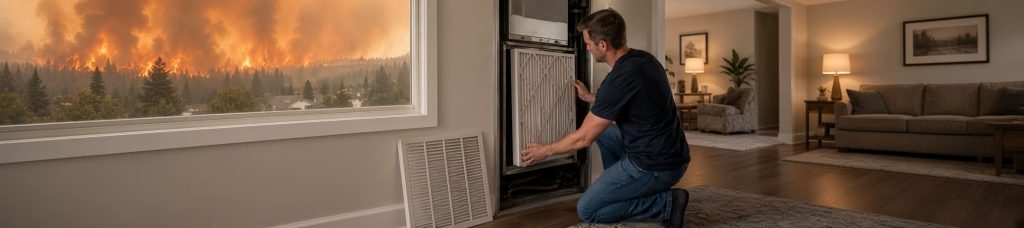
Wildfire smoke places very different demands on a residential HVAC filter than ordinary household dust. One of the main concerns is PM2.5—fine particulate matter small enough to remain suspended in indoor air and pass through filtration that was designed mainly to protect HVAC equipment from larger debris. A central forced-air system can reduce these particles, but the result depends on filter efficiency, filter fit, pressure drop, blower airflow, recirculation and how much outdoor smoke continues to enter the home.
For many residential forced-air systems, a properly fitted MERV 13 filter is a reasonable target during wildfire smoke if the blower can maintain acceptable airflow with that filter installed. More filtration is not automatically better when added resistance causes airflow to fall. During heavy smoke, central filtration works best when unnecessary outdoor-air intake is reduced, indoor air is recirculated through the filter and portable filtration is added in frequently occupied rooms when needed.
What Wildfire Smoke Changes Indoors
A normal HVAC filter may spend most of its service life collecting household dust, hair, fibers and larger airborne particles. Wildfire smoke introduces a much larger concentration of fine particles that can remain airborne for long periods and infiltrate a home even when windows are closed.
PM2.5 is especially important because these particles are much smaller than the debris basic residential filters are primarily intended to catch. If the filter has low fine-particle efficiency, a significant share of those particles can pass through the media and return to occupied rooms.
Central filtration is therefore only one part of smoke control. The amount of particulate removed over time depends on how efficiently the filter captures small particles, how much indoor air reaches it and how quickly outdoor smoke is entering the building at the same time.
Filter Fit Comes Before Filter Rating
MERV describes the performance of the filter media under standardized test conditions. It does not account for air leaking around the installed filter inside a residential return cabinet or filter grille.
If the filter is undersized, bent, poorly seated or installed in damaged tracks, part of the return airflow may take the easier path around the frame. This is filter bypass. The bypassed air reaches the blower without receiving the filtration expected from the filter's rating.
A MERV 13 filter cannot deliver MERV 13-level particle removal to air that is moving around the filter rather than through it.
The filter should match the dimensions of the rack or cabinet, sit squarely in its intended position and follow the airflow direction marked on the frame. The rack itself should not have damaged tracks or gaps large enough to create an obvious alternate airflow path.
Why MERV Alone Is Not Enough
MERV stands for Minimum Efficiency Reporting Value. Higher MERV ratings generally indicate better particle-removal efficiency in the particle-size ranges used by the rating system. For wildfire smoke, that matters because basic low-MERV filters are much less effective at removing fine particulate matter.
MERV 13 is commonly used as a practical target for wildfire-smoke filtration in central HVAC systems that can accommodate it. It offers substantially better fine-particle capture than filters intended mainly for equipment protection.
| Filtration level | During wildfire smoke | What matters in practice |
|---|---|---|
| Basic residential filter | Can catch larger debris while allowing more fine smoke particulate to pass. | Useful for equipment protection does not necessarily mean effective PM2.5 control. |
| MERV 13 | Provides substantially better capture of fine airborne particles than basic filters. | The system must still maintain acceptable airflow with the filter installed. |
| Higher-efficiency media | May provide stronger particle removal when properly integrated into the system. | Filter area, media depth, blower capability and actual pressure drop become increasingly important. |
Filter resistance depends on the media design, filter depth, surface area, airflow velocity and how heavily the filter is loaded. Two filters with the same MERV rating can have different pressure-drop characteristics.
Pressure Drop Determines Whether the System Can Use the Filter
An HVAC blower must overcome resistance throughout the air path: return grilles, return ducts, the filter, the indoor coil, supply ducts and registers. Technicians evaluate that resistance using static-pressure measurements.
The filter creates part of the total pressure drop. As smoke and other particulate matter accumulate in the media, that resistance can increase. If total system resistance becomes too high, airflow may fall below the range required for proper heating or cooling operation.
Depending on the equipment, low airflow may show up as weak register airflow, increased air noise, reduced heating or cooling capacity, longer run times or abnormal operating temperatures. A variable-speed blower may increase its output to compensate for additional resistance, but there is a limit to how much pressure it can overcome.
That is more useful than simply asking for the highest MERV rating that will physically fit in the filter slot.
A small one-inch filter grille, restrictive return ductwork or an already dirty indoor coil may leave little room for additional filter resistance. In other systems, a deeper media cabinet with more surface area can support higher-efficiency filtration without the same pressure-drop penalty.
Recirculation Makes Central Filtration More Effective
A filter removes particles only while air is moving through it. With the thermostat fan set to Auto, the blower in many systems runs mainly during a heating or cooling call. That can leave long periods when suspended particles are not passing through the central filter.
During a smoke event, longer fan operation can increase the amount of indoor air filtered over time. A dedicated Recirculate setting can be particularly useful when it circulates indoor air without intentionally bringing additional outdoor air into the system.
Extended fan operation should still be considered in the context of the actual HVAC system. A heavily loaded filter, restrictive return path or existing airflow problem should be corrected rather than masked by simply running the blower longer.
Fresh-Air Intake Settings Matter During Heavy Smoke
Many residential central HVAC systems only recirculate indoor air, but some homes have mechanical ventilation that intentionally introduces outdoor air. This may include a dedicated fresh-air duct, ventilation controller, energy-recovery ventilator, heat-recovery ventilator or another outdoor-air system.
When outdoor PM2.5 is high, bringing that air indoors can increase the amount of smoke the filtration system has to remove. If the ventilation equipment has a homeowner-accessible control that allows outdoor-air intake to be reduced or temporarily closed during smoke, using that setting can limit unnecessary smoke entry.
A controlled ventilation-air intake is not the same as a combustion-air opening or another safety-related building opening. Air openings serving fuel-burning equipment should not be blocked simply because the air outside is smoky.
Normal ventilation can be restored when outdoor air quality improves. Leaving a home indefinitely in a reduced-ventilation condition can allow pollutants produced indoors to accumulate.
Portable Air Cleaners Can Add Filtration Where It Matters Most
A portable air cleaner can complement central HVAC filtration by concentrating clean-air delivery in a bedroom, living room or another space where people spend significant time.
For wildfire smoke, smoke Clean Air Delivery Rate (CADR) is more useful than relying only on broad marketing claims about room coverage. A practical sizing target is a smoke CADR of at least about two-thirds of the room's floor area in square feet.
The unit should have clear space around its intake and outlet. Curtains, furniture or walls placed directly against the cleaner can reduce airflow and lower the amount of filtered air delivered to the room.
HEPA filtration is widely used in portable air cleaners for high-efficiency particle removal. HEPA specifications and MERV ratings both address particle filtration, but they are different classifications and should not be treated as interchangeable rating systems.
In California, portable indoor air-cleaning devices sold to consumers must meet California Air Resources Board requirements. For electronic units, CARB certification includes limits on ozone emissions. That certification does not establish how effectively a particular model removes wildfire smoke, so smoke CADR and the actual filtration method remain important when comparing units.
Smoke Events Can Shorten Filter Life
A normal filter-replacement schedule assumes normal conditions. A prolonged wildfire event can expose the filter to much higher particle concentrations while the blower may also be operating for more hours each day.
For that reason, the calendar should not be the only trigger for replacement during wildfire smoke. A heavily loaded filter can create more resistance than it did when new and may reduce airflow before its usual replacement date arrives.
- Inspect the filter before heavy smoke reaches the area. Starting with a filter that is already heavily loaded reduces available capacity and may already be increasing pressure drop.
- Check it more frequently during prolonged smoke. Fine-particle loading can occur faster than it does under ordinary household conditions.
- Replace it when it is visibly dirty, heavily loaded or develops an odor. Do not keep a smoke-loaded filter in service solely because the usual replacement date has not arrived.
- Check the fit of the replacement. Correct dimensions and proper seating remain just as important with a new filter.
- Inspect it again after outdoor conditions improve. Even a relatively short smoke episode can deposit a large amount of fine particulate in the media.
Where HVAC Filtration Reaches Its Limits
Particle filters do not remove every component of smoke
MERV ratings and HEPA filtration specifications address particle removal. Wildfire smoke also contains gases and vapors. A conventional particulate filter should not be expected to remove the full range of those compounds.
Activated carbon and other sorbent media can reduce certain gases and odors, but their performance depends on the amount of sorbent, contaminant type, airflow and contact time. A thin carbon-treated filter is not equivalent to a purpose-designed gas-phase filtration system.
The filter cannot seal the house
Outdoor smoke can enter around doors, windows, attic accesses, utility penetrations and other leaks in the building envelope. HVAC filtration can remove particles after they enter the conditioned space, but it cannot eliminate those infiltration pathways.
Return-duct leakage can add unfiltered air
Leaks on the return side of the duct system can draw air from attics, wall cavities or other surrounding spaces depending on the duct layout. During a smoke event, that can undermine indoor-air control even when a good filter is installed.
Higher efficiency does not compensate for poor airflow
A very efficient filter provides little benefit if system airflow falls so far that too little air is being cleaned. Actual clean-air delivery depends on both filtration efficiency and airflow through the media.
Indoor sources still matter
Cooking, candles, smoking, frying and other activities can add particles indoors while the home is already dealing with smoke entering from outside. Reducing avoidable indoor particle sources decreases the filtration burden during a wildfire event.
Practical HVAC Steps During Wildfire Smoke
- Check outdoor air quality rather than relying on visibility alone. Smoke concentrations can change during the day even when the sky looks similar.
- Keep windows and exterior doors closed when outdoor smoke is heavy. Reduce avoidable smoke entry while maintaining safe indoor temperatures.
- Confirm that the HVAC filter fits the rack correctly. Look for gaps, damage, bowing or other conditions that allow filter bypass.
- Use an appropriate level of filtration for the equipment. MERV 13 is a useful target for many forced-air systems when adequate airflow can be maintained.
- Increase indoor-air recirculation when the system supports it. More passes through an effective filter increase total particle removal.
- Reduce controlled outdoor-air intake during heavy smoke. Use the intended ventilation controls rather than covering unknown openings.
- Use portable filtration in high-use rooms when additional clean-air delivery is needed. Size the unit using smoke CADR rather than room-size marketing alone.
- Inspect both central and portable filters more often. Heavy wildfire smoke can load filtration media much faster than normal household use.
If Airflow Drops After a Filter Upgrade
A noticeable reduction in airflow after installing a higher-efficiency filter should not automatically be blamed on the MERV number. The new filter may be exposing a restriction that was already present elsewhere in the system.
Undersized return ducts, small return grilles, a restrictive indoor coil, closed registers, damaged ductwork or a small filter cabinet can all contribute to high static pressure.
Total external static pressure and pressure drop across the installed filter can help identify whether the primary restriction is the filter itself or another part of the HVAC airflow path.
If the filter face area is too small, a larger or deeper media cabinet may allow effective fine-particle filtration with less resistance than trying to move the same volume of air through a small filter opening.
Indoor Air Quality Depends on the Whole Airflow Path
Filtration is only one part of indoor-air management. Duct leakage, ventilation, equipment configuration, airflow, humidity and outdoor-air entry can all affect indoor conditions. For a broader evaluation of those factors, see Indoor Air Quality services in Orange County.
Frequently Asked Questions
Is MERV 13 a good filter for wildfire smoke?
MERV 13 is a useful target for many central forced-air systems because it provides substantially better fine-particle filtration than basic residential filters. The specific HVAC system must still be able to maintain acceptable airflow with that filter installed.
Should I run the HVAC fan continuously during wildfire smoke?
Longer blower operation can increase the amount of indoor air passing through the filter. An On or dedicated Recirculate setting can therefore improve particle removal when the system is suitable for extended fan operation and the filter is not creating excessive resistance.
Should a fresh-air intake be closed during a smoke event?
A controllable outdoor-air intake may be reduced or closed during heavy smoke when the ventilation equipment is designed to operate that way. Combustion-air openings and unidentified safety-related openings should not be blocked.
How often should an HVAC filter be replaced during wildfire smoke?
There is no single interval that applies to every event. Inspect the filter more frequently than usual and replace it when it becomes visibly dirty, heavily loaded, deformed or develops an odor.
Does MERV 13 remove the smell of wildfire smoke?
MERV describes particle filtration, not gas or odor removal. A MERV 13 filter can reduce airborne smoke particles while some gaseous compounds and odors remain.
Is a portable HEPA air cleaner still useful with central HVAC?
Yes. A properly sized portable unit can provide additional particle removal in a bedroom or living area while the central HVAC system filters recirculated air throughout the house.
Can a higher-efficiency filter reduce HVAC airflow?
It can if the filter's pressure drop is too high for the existing blower, ductwork and filter area. Media construction, filter size, surface area, system resistance and blower capability all affect the result, so MERV should not be evaluated by itself.
What Matters Most During a Smoke Event
Central HVAC filtration can meaningfully reduce indoor wildfire-smoke particles when the filter fits properly, captures fine particulate effectively and allows the system to maintain adequate airflow.
For many residential systems, MERV 13 is a practical target rather than an automatic requirement. If airflow falls after a filter upgrade, the correct response is to evaluate pressure drop, filter area, return airflow and other system restrictions instead of simply choosing another filter based on its MERV number.
During heavy smoke, recirculating indoor air, limiting controlled outdoor-air intake, checking filter loading more often and adding a properly sized portable air cleaner can improve particle control. These measures cannot remove every gas or stop every infiltration path, but they address the parts of wildfire-smoke exposure that mechanical filtration can realistically influence.