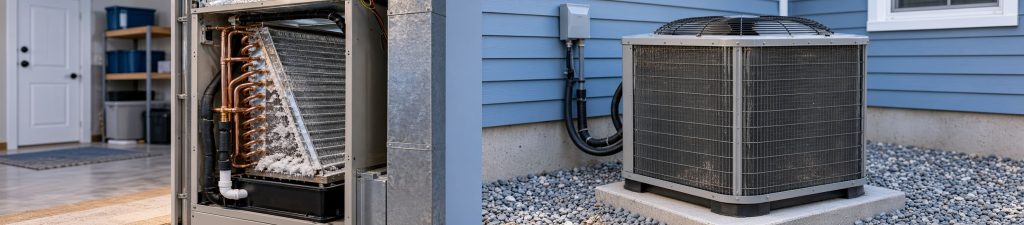
The evaporator coil and condenser coil do opposite jobs. The indoor evaporator absorbs heat from your home's air; the outdoor condenser releases that heat outside.
Both are heat exchangers connected by sealed refrigerant tubing. An iced indoor coil calls for airflow and operating-condition checks; debris packed into the outdoor fins calls for an inspection of condenser airflow and heat rejection. Neither symptom, by itself, proves the coil is leaking or needs replacement.
Evaporator Coil vs Condenser Coil at a Glance
Evaporator Coil
Location: inside the air handler or a coil cabinet near the furnace in a typical central split system.
Job: absorbs heat from air blown over its fins. Moisture may also condense on the cold coil and drain away.
Common concerns: dust buildup, restricted airflow, icing, corrosion or a refrigerant leak.
Condenser Coil
Location: around or inside the outdoor condensing unit, usually behind its protective grille.
Job: releases heat into outdoor air while high-pressure refrigerant vapor condenses into liquid.
Common concerns: dirt, leaves, blocked fins, physical damage, corrosion or a refrigerant leak.
These names describe the coils in cooling mode. On a heat pump in heating mode, refrigerant flow reverses and the indoor and outdoor coils exchange roles.
How the Two Coils Work Together
An air conditioner does not make heat disappear. It moves heat from indoors to outdoors. Refrigerant circulates through the two coils, the compressor and a metering (expansion) device. Fans move air across the coils, but the indoor air and refrigerant stay separated by metal tubing.
- 1. Indoor evaporator coilLow-pressure refrigerant absorbs heat and evaporates into vapor.
- 2. CompressorVapor is compressed to a higher pressure and temperature.
- 3. Outdoor condenser coilHeat leaves the refrigerant; it condenses into high-pressure liquid.
- 4. Expansion deviceRefrigerant pressure drops before it enters the evaporator again.
The cycle repeats at the indoor coil ↺
At the evaporator, low-pressure refrigerant absorbs heat and changes mainly from liquid to vapor. The compressor then raises the vapor's pressure and temperature. At the condenser, the hotter refrigerant gives up heat to outdoor air and condenses into liquid. The expansion device drops its pressure before it returns to the indoor coil.
In a central ducted system, the indoor blower pushes household air across the evaporator. The outdoor fan moves ambient air across the condenser. A failure in either airflow path can make a sound coil perform poorly.
Where Are the Evaporator and Condenser Coils Located?
In many homes, the evaporator is an A-shaped or slab-shaped coil in a cabinet attached to the furnace or inside a dedicated air handler. It may be in a closet, attic or garage, depending on the installation. The evaporator coil is not the furnace's combustion heat exchanger; they are separate components that may share the same ducted airflow path.
The condenser coil is part of the outdoor AC cabinet, commonly wrapping around its sides behind fins and protective grilles. The compressor and outdoor fan are housed in the same unit, but they are different components. A homeowner may call the entire box a “condenser”; that does not mean the condenser coil is what failed.
Packaged systems and ductless mini-splits arrange the parts differently. The underlying heat-transfer jobs remain the same in cooling mode.
Common Evaporator Coil Problems
The indoor coil needs a clean heat-transfer surface and sufficient airflow. Problems here often appear as weak cooling, long runtimes or moisture-related symptoms near the air handler.
Dust and debris on the fins
Dirt can restrict air passing through the coil and insulate its surface. Cooling and moisture removal may suffer even though the compressor and outdoor fan are running.
Ice on or near the coil
Low indoor airflow or an abnormal refrigerant-side condition can make the coil cold enough to ice over. As ice builds, airflow drops further. A frozen coil does not, by itself, mean the metal heat exchanger has failed.
Corrosion or a refrigerant leak
Damage to tubing or connections can let refrigerant escape. That requires leak confirmation; a cooling complaint or an oily-looking mark by itself cannot identify the leak location.
Common Condenser Coil Problems
The outdoor coil releases heat into the surrounding air. When the coil is blocked or the outdoor fan cannot move enough air, the system has a harder time getting rid of that heat.
Clogged outdoor fins
Grass clippings, lint, leaves and dust can collect on the coil. The AC may cool poorly, run longer or shut down on a protective limit when operating conditions become excessive.
Bent fins or restricted clearance
Flattened fins and plants pressed against the cabinet reduce the free area available for airflow. Restricted ventilation can look like a coil problem without any refrigerant leak.
Tubing damage or corrosion
A puncture, deteriorated joint or corrosion-related leak can impair cooling. Cleaning will not fix leaking refrigerant tubing; a qualified technician must locate and assess the damage.
A stopped outdoor fan is not evidence that the condenser coil itself is bad. Fan motors, capacitors, wiring and controls need their own diagnosis.
Evaporator Coil vs Condenser Coil: Symptom Comparison
Symptoms can overlap because both coils belong to the same refrigerant circuit. The table shows which area a symptom may point toward, not what part should be replaced.
| What you notice | Indoor evaporator side | Outdoor condenser side |
|---|---|---|
| Weak cooling or very long run times | A dirty coil can limit heat absorption; low indoor airflow can produce similar results. | A dirty or poorly ventilated coil can restrict heat rejection. Either side remains possible. |
| Little air coming from indoor vents | Heavy dirt or ice may obstruct airflow, though the filter, blower and ducts should be checked first. | A condenser-coil problem does not normally cause weak airflow at indoor vents directly. |
| Ice on the indoor coil or suction line | The indoor coil is where icing appears; restricted airflow is one possible cause. | Not a reliable sign of a failed condenser coil. Other cooling-system conditions need testing. |
| Outdoor unit runs very hot or stops during cooling | Not a clear evaporator-coil signature. | Heat rejection may be restricted, but fan operation, refrigerant conditions and compressor protection also matter. |
| Water around the indoor air handler | Melting coil ice or condensate problems can cause water nearby; a blocked drain is a separate component fault. | Usually not a direct condenser-coil symptom. |
| Visible fin damage or possible oily residue | May call for coil inspection or leak testing, depending on where the mark appears. | May indicate damaged fins, tubing or a fitting. A visual mark alone does not prove refrigerant loss. |
Neither weak cooling nor a particular pipe temperature confirms a bad coil. A technician considers indoor and outdoor airflow, temperature and pressure readings, the system's operating mode and leak-test results together.
Coil Problem vs Compressor Failure
The coils exchange heat. The compressor moves refrigerant and raises its pressure. A coil can be dirty or leaking while the compressor works correctly, and a compressor can fail while both coils are physically sound.
More consistent with a coil or airflow problem
Visible debris on coil fins, blocked outdoor clearance or a measured loss of airflow across the indoor coil suggests a heat-transfer restriction. A confirmed leak at coil tubing points to coil damage.
More consistent with a compressor or electrical problem
The compressor does not start, hums without running, trips a protection device or has abnormal electrical test results. A capacitor, control or wiring fault can produce some of the same observations.
Grass packed into the outdoor coil or a failed condenser fan can drive operating pressures and temperatures higher, sometimes triggering compressor protection. A shutdown under those conditions does not establish that the compressor is damaged. For the separate signs of starting, motor and electrical faults, see AC compressor failure symptoms.
How a Technician Determines Which Part Is at Fault
A technician should check indoor airflow and outdoor fan operation before drawing conclusions from refrigerant readings. A dirty coil changes heat transfer; a leak changes how much refrigerant remains in the circuit; a failed fan or compressor creates a different operating problem. These faults need different evidence, even when all cause weak cooling.
- Identify the system type, refrigerant, cooling mode, recent symptoms and whether both the indoor blower and outdoor fan operate correctly.
- Inspect the filter, return-air path, visible coil surfaces, outdoor clearances, fan operation and condensate condition before drawing conclusions from refrigerant readings.
- If the evaporator is iced, allow it to thaw and correct airflow problems first. Then check air temperatures and airflow or static pressure as needed, followed by refrigerant pressures and line temperatures under suitable conditions and per the equipment's service instructions.
- If a leak is suspected, use suitable leak-detection methods to locate it instead of assuming the indoor or outdoor coil is the source.
- Confirm the failed component and document what supports the finding: visible restriction, fan or electrical test, leak location, or abnormal operating measurement. Review manufacturer-approved repair and replacement options.
Ask what the tests showed before approving a major repair. “The condenser is bad” could refer to clogged fins, an outdoor fan failure, a compressor fault or a leak in the condenser coil. The diagnosis should identify the specific part rather than use the name of the entire outdoor unit.
When Can an AC Coil Be Repaired, and When Should It Be Replaced?
Cleaning or minor correction may be enough
If the tubing is sound but fins are dirty, appropriate coil cleaning may restore heat transfer. A technician may straighten limited fin damage where the coil design allows it. A loaded air filter or blocked outdoor clearance should be fixed without replacing a sound coil.
An accessible connection leak may be repairable
A confirmed leak at an accessible connection or approved repair point can sometimes be fixed without replacing the coil. Repairability depends on whether the joint can be serviced safely, the tubing material and the manufacturer's instructions. Leak testing and refrigerant recovery, evacuation and recharging belong to qualified technicians.
Coil replacement is often more practical
Multiple leaks through corroded finned tubing, inaccessible tube damage or a coil whose repair would not be reliable generally favor replacement. The replacement must be approved for the system's refrigerant, capacity and connected equipment—not simply fit inside the cabinet.
Consider full-system replacement when appropriate
For an older system with a costly coil failure, compare the full repair price with replacement of a manufacturer-approved indoor/outdoor combination. Include parts availability, existing defects, remaining warranty, refrigerant requirements and expected service life rather than using system age alone.
What Homeowners Can Safely Check
Simple observations help narrow a service call. They should not involve opening a coil cabinet, touching electrical components or connecting gauges to the refrigerant circuit.
If the AC is operating normally and you want the coils inspected before heavy use, an AC tune-up may be appropriate. An active cooling failure calls for diagnosis rather than routine maintenance.
When Should You Turn Off the AC?
Turn off cooling if the indoor coil or refrigerant line is heavily iced, the outdoor fan has stopped while the equipment attempts to run, the breaker trips repeatedly, or a burning electrical odor appears. Keep clear of water around electrical equipment. Continuing to force operation can increase damage.
Refrigerant-circuit work requires appropriate training and EPA Section 608 certification where applicable. Do not vent refrigerant or try to replace a pressurized coil yourself.
Frequently Asked Questions
What is the main difference between an evaporator and a condenser coil?
In cooling mode, the evaporator absorbs heat from indoor air while the condenser rejects that heat outdoors. The coils are connected, but they perform opposite heat-transfer functions.
Is the evaporator coil part of the furnace?
It may be mounted in a cabinet immediately above or beside a furnace and share its blower and ducts. It is not the furnace's combustion heat exchanger.
Does ice on the evaporator mean the coil needs replacement?
No. Ice can result from restricted indoor airflow, blower trouble or refrigerant-side conditions. The reason for freezing must be identified before deciding whether the coil itself needs work.
Can a dirty condenser coil damage the compressor?
A severely restricted condenser can increase operating temperatures and pressures and place extra stress on the compressor. That does not mean the compressor has already failed; the cause and actual condition need testing.
Can you clean both AC coils yourself?
You can keep filters maintained and remove loose debris around the outdoor unit. Thorough coil cleaning—especially inside an air handler—is generally better handled by a technician because fins, electrical parts and refrigerant tubing can be damaged.
How do you tell a bad condenser coil from a bad compressor?
A confirmed leak or physical restriction at the coil points to the heat exchanger. Compressor failure requires separate electrical and operating tests. Weak cooling by itself does not distinguish them.
Do both coils have to be replaced together?
No. A compatible replacement for one failed coil may be enough. The technician must confirm that the indoor and outdoor components are approved to work together, including refrigerant and metering-device requirements. For a new matched combination, ask whether an AHRI Certified Reference Number is available.
Do evaporator and condenser coils switch roles in a heat pump?
Yes. In heating mode a reversing valve changes refrigerant flow, and the outdoor coil absorbs heat while the indoor coil releases it. This article describes their usual roles during cooling.
Bottom line: the evaporator coil removes heat from indoor air, and the condenser coil releases it outdoors. Dirt can limit either coil without damaging its tubing. A refrigerant leak, a stopped fan and a failed compressor are different faults that require different repairs.
If cooling has already deteriorated, a diagnosis should identify the actual component and explain the evidence before parts are replaced. See the air-conditioning repair overview for what a cooling-system inspection may involve.
Technical references: ENERGY STAR maintenance checklist (coil care and airflow); Trane frozen-coil guidance (switching cooling off); AHRI matched-system information (indoor/outdoor compatibility); and U.S. EPA Section 608 requirements (refrigerant service).