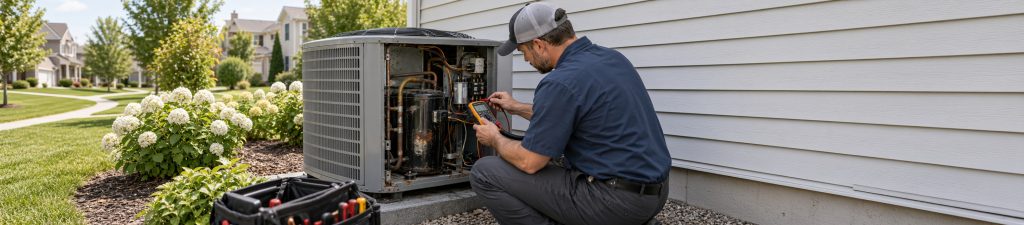
Common AC compressor failure symptoms include humming without starting, repeated shutdowns, unusual mechanical noises, poor cooling, and circuit breaker trips. Sometimes the outdoor fan keeps spinning even though the compressor is not running.
These signs deserve attention, but they don't automatically mean you need a new compressor. A failed capacitor, damaged contactor, or electrical problem can make a working compressor appear to be broken. The first step is finding out which part has actually failed.
What Does an AC Compressor Do?
The compressor is the part of your air conditioner that keeps refrigerant moving through the cooling system. It also raises the refrigerant's pressure so the heat collected inside your home can be released outdoors.
In a typical central AC system, the indoor coil absorbs heat from household air. The compressor moves refrigerant through the system, and the outdoor condenser releases that heat outside.
If the compressor cannot operate, the air conditioner cannot complete its normal cooling cycle. The indoor blower may still push air through your vents, but that air will not be cooled as expected.
The fan moves air across the outdoor coil. The compressor moves and pressurizes refrigerant. On many conventional systems, the fan can run even when the compressor has stopped. Seeing the fan spin is not proof that the compressor is working.
Most residential central air conditioners use a sealed compressor assembly. If its internal motor or mechanical parts are seriously damaged, the entire compressor usually needs replacement rather than an internal repair.
Common Compressor Failure Symptoms
What your AC does when it tries to start can tell a technician a great deal. A brief hum followed by silence points toward a different set of problems than a compressor that runs for ten minutes and then stops.
Use the observations below to describe what is happening. The possible causes are not a diagnosis, but they can help you decide how urgently the system needs attention.
1. Outdoor fan runs, but the AC does not cool
2. A brief humming sound followed by a click
3. Compressor starts, then shuts off unexpectedly
4. New grinding, knocking, or unusually loud vibration
5. Breaker trips when the AC tries to start
This guide mainly describes conventional residential split-system air conditioners. Inverter-driven, variable-speed, and some heat-pump systems use different compressor controls and may behave differently.
Compressor Tries to Start but Stops
If your outside AC compressor is not turning on, pay attention to whether it remains completely silent, hums briefly, or runs for a short time before stopping.
Hums, clicks, and never starts
On some conventional systems, a compressor that cannot start will hum briefly before an internal overload protector shuts it down. That protector may reset after the motor cools, allowing another attempt.
A weak run capacitor can cause this behavior even when the compressor motor is still usable. Low voltage, damaged wiring, and internal motor or mechanical problems are other possibilities.
This is why a technician should check the electrical supply and starting components before recommending compressor replacement.
Starts normally but stops during cooling
A compressor can also start successfully and then shut down because it becomes too hot or because a control detects an abnormal operating condition.
A condenser fan that is not moving enough air, a blocked outdoor coil, abnormal system pressure, or an electrical issue can contribute to these shutdowns.
Often, yes. Many thermostats and AC controls delay compressor startup for several minutes after a shutdown. That is different from a compressor that repeatedly hums, struggles to start, or cuts off while the thermostat still requests cooling.
If the compressor keeps kicking on and off without completing normal cooling cycles, stop using the system until the reason is identified. Repeated failed starts can put additional stress on the motor and its electrical components.
Outdoor Unit Runs but Cooling Is Poor
Imagine standing beside your outdoor AC unit. The fan is spinning, and you can hear the equipment running. Inside, however, the house keeps getting warmer.
One possibility is that the fan is operating but the compressor is not. The outdoor unit sounds active, yet the refrigeration cycle is not doing its job.
Another possibility is that the compressor is running but the system is not cooling effectively. A refrigerant leak, restricted airflow, dirty coils, or other refrigeration problems can reduce cooling even with a functioning compressor.
The technician checks whether the compressor is receiving power, whether its starting components are working, and whether a protective device has shut it down.
The technician checks airflow and refrigerant-system performance to find out why the equipment is not removing enough heat from the house.
If the main problem is warm air coming from the vents, start with why your AC is blowing warm air. That guide covers other common causes without assuming the compressor is responsible.
Compressor Noise: What Sounds Are a Warning?
A working AC compressor is not silent. You may hear a low hum during normal operation and a brief change in sound when the cooling cycle begins or ends.
What matters is a sound that is new, substantially louder than usual, or accompanied by a loss of cooling.
The motor may be trying to start without turning. This can happen with a starting-component fault or a damaged compressor.
A mechanical problem is possible, but the outdoor fan can make similar sounds if its bearings, blade, or mounting parts are damaged.
The sound could come from the compressor, loose equipment mounting, or refrigerant tubing vibrating against another surface.
A click during startup may come from the contactor or another electrical control. Clicking by itself does not identify a compressor failure.
Avoid opening the outdoor cabinet to locate a sound. A technician can check the fan, motor, compressor mounting, and refrigerant piping to find its source.
If the equipment suddenly makes violent knocking or grinding noises, turn off cooling rather than letting it continue running.
Can Compressor Problems Trip a Breaker?
Yes. A damaged AC compressor can trip the circuit breaker. A motor with an electrical short or a compressor that cannot turn may draw excessive current, causing the breaker to interrupt power.
But the compressor is not the only component connected to the outdoor electrical circuit. Problems with the condenser fan, wiring, terminals, or other electrical parts can also trip the breaker.
The timing provides a useful clue. A breaker that trips as soon as the AC starts may involve a different fault than one that opens after several minutes of operation.
A technician can measure electrical current, inspect the motor circuit, and check for damaged insulation or abnormal voltage. Those findings help determine whether the compressor or another component caused the trip.
Do not repeatedly reset a tripped AC breaker. If the breaker has opened unexpectedly, leave the affected equipment off and have the cause checked. If you notice smoke, sparking, or a burning smell, stay clear of the equipment and seek urgent assistance.
A compressor fault is only one reason an outdoor circuit may shut down. For other electrical and mechanical causes, see why your AC breaker keeps tripping.
Compressor vs. Capacitor: How Are the Symptoms Different?
A failed AC capacitor is one of the problems that can make a compressor appear to be broken.
Many conventional residential AC systems use a run capacitor as part of the compressor motor circuit. If the capacitor is weak or fails, the compressor may hum, struggle to start, or fail to run.
The compressor itself may still be in working condition.
On a system that uses a compressor capacitor, the technician measures its capacitance and checks the relevant voltage, wiring, and motor circuit. If the capacitor is defective but the compressor passes its other checks, replacing that external component may restore operation without replacing the compressor.
There is one important exception: inverter-driven compressors use different motor-control electronics. A conventional capacitor test does not apply to every modern AC system. The technician must follow the correct procedure for the equipment model.
Humming and hard starting can occur with either problem. Read more about bad AC capacitor symptoms and how a technician can distinguish a capacitor fault from a motor problem.
Compressor vs. Contactor: What Is the Difference?
A contactor is an electrical switch used in many conventional outdoor AC units. When the thermostat requests cooling and the system controls allow operation, the contactor closes to supply electrical power to the outdoor equipment.
If the contactor has damaged contacts, a failed coil, or an interrupted control signal, the compressor may not receive the power it needs.
A homeowner might hear clicking from the outdoor unit and assume the compressor has failed. In reality, the compressor may never have received the correct electrical supply.
The technician checks whether the contactor is receiving its control signal and whether its contacts are supplying the expected voltage. This can separate a switching problem from a motor fault.
For more on this particular component, see AC contactor failure symptoms.
Compressor vs. Condenser Fan Motor
The condenser fan pulls or pushes outdoor air across the condenser coil. That airflow helps the AC release heat removed from your home.
If the fan motor stops working, the compressor may still attempt to operate. Without enough airflow across the outdoor coil, system pressure and temperature can rise, and protective devices may shut the compressor down.
That can look like a compressor problem even though the original issue is the fan motor, its electrical circuit, or restricted airflow through the condenser.
Another possibility is the opposite situation: the fan works normally, while the compressor fails to start.
From a safe distance, note whether the outdoor fan is spinning during a cooling request. Do not reach through the grille or try to push-start the fan. The fan can start unexpectedly, and the cabinet contains hazardous electrical components.
If the outdoor unit is completely silent and neither the fan nor the compressor starts, read why your outdoor AC unit is not turning on. That situation calls for checking power and controls before focusing on the compressor.
What Can You Check Safely Before Calling a Technician?
You do not need to open the condenser to collect useful information. A few observations can help narrow the problem before a service visit.
- Check the thermostat. Make sure it is set to Cool, the fan is set to Auto, and the target temperature is below the current room temperature.
- Allow for a normal startup delay. After changing the thermostat, wait several minutes. A built-in delay may temporarily prevent the compressor from starting.
- Listen and observe from outside. Note whether the outdoor unit is silent, the fan spins, you hear a hum, or the equipment starts and stops.
- Look at the breaker position. If the AC breaker has tripped, leave it off rather than repeatedly attempting to restart the system.
- Write down the pattern. Does the problem happen every time the AC starts? Only during hot afternoons? After a few minutes of cooling? These details may help the technician.
If the filter is easily accessible, you can also inspect it for obvious blockage. A dirty filter can affect cooling, although it does not establish that the compressor has failed.
Do not remove outdoor electrical panels, touch capacitor terminals, force a contactor closed, test live wiring, or bypass a safety switch. Capacitors may retain dangerous electrical energy even after the equipment has been disconnected.
Can an AC Compressor Be Repaired?
Sometimes the AC can be repaired without replacing the compressor at all. It depends on whether the compressor itself is damaged or another component is preventing it from operating.
A bad capacitor, contactor, wiring connection, or control component may be repairable. Once the actual fault is corrected, an otherwise healthy compressor may operate normally.
If the compressor has a confirmed internal electrical or mechanical failure, the situation is different. Most home AC compressors are sealed units. Their internal motors and moving parts generally are not rebuilt during ordinary service.
In that case, replacing the compressor assembly may be necessary.
Does a bad compressor mean replacing the entire AC?
Not always. It may be possible to replace only the compressor and keep the rest of the system.
The decision depends on the equipment's age, the condition of the indoor and outdoor coils, refrigerant compatibility, parts availability, warranty coverage, and the cost of the work.
For an older unit with other significant problems, installing a replacement compressor may cost enough that replacing more of the cooling system becomes worth considering.
A reliable comparison should account for the entire repair, not just the price of the replacement compressor. Refrigerant recovery, installation labor, required parts, evacuation, testing, and any cleanup following an electrical burnout may affect the final cost.
Before You Approve Compressor Replacement
Replacing a compressor is a major repair. Before approving it, ask the contractor to explain these four points:
If a contractor suggests installing a hard-start kit instead, ask why it is appropriate for your specific equipment. These accessories can help in some approved applications, but they cannot repair damaged motor windings or a mechanically seized compressor.
How a Technician Diagnoses Compressor Failure
A proper diagnosis should answer two questions: Why is the compressor not working correctly, and is the compressor itself the failed part?
The checks vary by equipment type, but the investigation usually covers the following areas.
Confirm that the AC is requesting cooling
The technician checks the thermostat, control signals, normal startup delays, and safety controls. A compressor cannot start if the system is not allowing it to operate.
Check the electrical supply and starting circuit
Voltage, wiring, contactor operation, and applicable capacitors or motor-drive electronics are checked. If the compressor is not receiving the correct power, that problem must be addressed before deciding its motor is bad.
Test the compressor motor when appropriate
Electrical tests can identify certain faults inside the compressor motor, including damaged windings or insulation. Current measurements and manufacturer-specific procedures can help distinguish a failed start from a failed compressor.
Evaluate how the cooling system operates
When safe operation is possible, refrigerant pressure and temperature readings, airflow checks, and condenser performance help show whether the system is moving heat properly. These measurements are important when the compressor runs but cooling remains poor.
Explain the fault and recommend the appropriate repair
The final recommendation should identify the failed component, address any underlying cause that could damage replacement parts, and explain whether repairing the existing equipment makes financial sense.
A confirmed failure may involve electrical test results showing damaged motor windings, a short to ground, or a compressor that cannot start despite verified operating conditions and functioning starting components. In other cases, operating measurements and equipment-specific testing may establish an internal mechanical problem. The diagnosis should be supported by findings, not just by an unusual sound.
MaksBuilder provides air-conditioning repair and diagnostics in Orange County, including troubleshooting outdoor-unit failures, electrical problems, and poor cooling performance.
Frequently Asked Questions
How do I know if my AC compressor is bad?
Humming without starting, repeated shutdowns, unusual noises, and poor cooling are possible signs. A technician must check the electrical circuit and compressor operation to determine whether the compressor itself has failed.
Can the outside AC fan run when the compressor is not working?
Yes. Many conventional units have separate fan and compressor motor circuits. The fan can continue running even if the compressor has stopped or cannot start.
Why is my outside AC compressor not turning on?
The problem may involve a normal startup delay, loss of power, a control or safety shutdown, a failed capacitor, damaged wiring, or an internal compressor fault. Check normal thermostat settings first, then arrange service if the compressor still will not start.
Why does my AC compressor keep kicking on and off?
Possible causes include overheating, voltage problems, abnormal system pressure, a control fault, or a compressor problem. If the compressor repeatedly stops during an active cooling request, avoid continued operation until the cause is checked.
Can a bad capacitor make an AC compressor sound broken?
Yes. On systems that use a compressor run capacitor, a failed capacitor can cause humming, difficult starting, or no startup at all. Replacing the capacitor may solve the problem if testing confirms the compressor is otherwise healthy.
Can a failing compressor still cool the house?
Sometimes. Certain compressor problems may be intermittent, and some internal mechanical faults can reduce performance before complete failure. But weak cooling also has many other possible causes, so a compressor should not be replaced based on reduced cooling alone.
Is replacing an AC compressor worth it?
It can be, particularly when the rest of the system is in good condition and the compressor is covered by a parts warranty. For older equipment, compare the complete installed repair cost with a suitable replacement system before making a decision.
Technical References
Copeland — Compressor Troubleshooting Guide: Not Starting/Running
Is Your AC Compressor Not Starting or Cooling Properly?
Before paying for a new compressor, find out what has actually failed.
MaksBuilder provides residential AC diagnostics and repair in Foothill Ranch, Lake Forest, Irvine, Mission Viejo, Aliso Viejo, Rancho Santa Margarita, Laguna Hills, and Laguna Woods Village.
MaksBuilder · California Contractor License #1095368