Your thermostat is set to cool, but the outdoor AC unit only hums. The condenser fan may be standing still, or the system tries to start and shuts off. A failing capacitor is one possible cause of these problems.
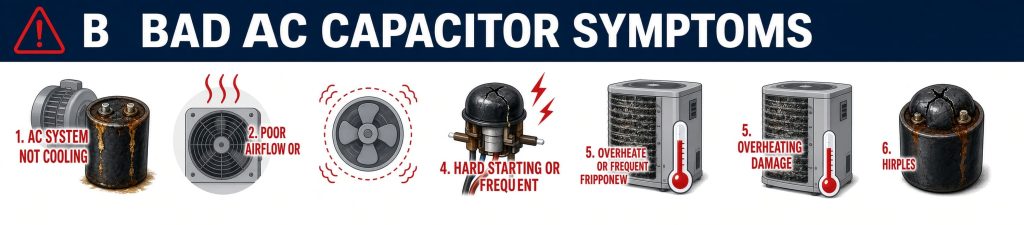
Common bad AC capacitor symptoms include humming without normal startup, a condenser fan that will not start, repeated startup attempts, and a compressor that struggles to run. A failed capacitor may bulge or leak, but it can also look completely normal. These symptoms are clues, not proof of capacitor failure.
What Does an AC Capacitor Do?
A capacitor helps certain electric motors start and run. In many conventional central air conditioners, the outdoor unit has a run capacitor connected to the compressor, the condenser fan motor, or both.
Some outdoor units use a dual-run capacitor. It contains two capacitor sections in one housing: one for the compressor and one for the fan. Both sections serve run-capacitor functions.
When a capacitor fails, the connected motor may struggle to start or stop working altogether. The indoor blower can still push air through your vents even when the outdoor equipment is no longer producing cooling.
These symptoms mainly apply to conventional capacitor-dependent motors. Inverter compressors and electronically controlled motors may use different electrical designs.
7 Common Bad AC Capacitor Symptoms
You do not need to recognize every sign. One clear startup problem is enough to justify checking what is happening outside.
Outdoor Unit Hums but Does Not Start
You hear a steady hum, but the fan or compressor does not start normally. A weak capacitor may prevent the connected motor from starting.
Condenser Fan Is Not Spinning
The thermostat calls for cooling, but the outdoor fan remains still. The fan capacitor, motor or power circuit may be responsible.
AC Has Trouble Starting
The outdoor unit attempts to start, stops, or tries again later. A deteriorating capacitor can cause difficult motor startup.
Compressor Does Not Start
The condenser fan may run while the compressor stays off. A compressor-side capacitor fault is one possibility, along with compressor and electrical problems.
Outdoor Unit Works Intermittently
Cooling starts on some calls but fails on others. A weakened capacitor can contribute, although intermittent power and motor faults can behave the same way.
Breaker Trips During Startup
A motor unable to start properly may draw excessive current. Breaker trips can also indicate wiring, motor or compressor faults.
Capacitor Is Bulging or Leaking
A damaged capacitor may have a swollen housing or visible leakage. Do not open the electrical cabinet to look for these signs yourself.
A capacitor does not have to show all seven symptoms. Some failures produce only one noticeable problem.
How to Tell If Your AC Capacitor May Be Bad
The most useful clue is which part of the air conditioner stops working. Here is what different symptoms may suggest.
Outdoor Unit Hums, Fan Stays Still
Check for a fan capacitor or fan motor problem. The compressor may also be affected.
Fan Runs, Compressor Does Not
A compressor capacitor, compressor protection or compressor fault may be involved.
Neither Outdoor Component Starts
Power, contactor and control-circuit problems deserve attention before blaming the capacitor.
Indoor Fan Runs, Air Is Not Cold
Your indoor blower may be working while the outdoor cooling equipment is not operating.
These observations help describe the fault. They do not replace electrical measurements.
AC Hums but Does Not Start
If you hear a hum from the outdoor unit but the fan or compressor does not begin running, the motor may be receiving power without starting correctly.
A failed capacitor is one possible reason. Other possibilities include a seized fan motor, a compressor problem or abnormal supply voltage.
What to do: Turn cooling off at the thermostat if the outdoor unit continues humming without starting. Repeated restart attempts can overheat an already struggling motor.
Condenser Fan Does Not Start Normally
The condenser fan pulls or pushes outdoor air through the condenser coil so the system can release heat.
If the fan stops, the AC may lose the airflow needed for normal cooling. Refrigerant pressure can rise, and a safety control may stop operation.
A failed fan capacitor is one possible cause, but the fan motor itself may have damaged windings, worn bearings or another fault.
Do not push the fan blades. Never try to start a stopped condenser fan with your hand, a stick or a screwdriver. The fan can start unexpectedly.
AC Has Trouble Starting
Some capacitor problems first appear as difficult startup rather than complete failure. You may hear a hum or click followed by the outdoor unit stopping.
If the compressor draws excessive current or becomes too hot, its internal overload protection may interrupt operation. It may try again after cooling down.
This pattern is not unique to capacitors. A compressor or power-supply fault can cause similar repeated attempts.
Changing the thermostat temperature repeatedly will not correct an electrical startup problem.
Can a Bad Capacitor Trip a Breaker?
Yes, a capacitor fault can contribute to a breaker trip. If a connected motor struggles to start, it may draw excessive current. Certain capacitor failures can also create electrical faults.
However, some motors stop through internal overload protection without tripping the circuit breaker.
If the breaker trips repeatedly, leave the equipment off. See why an AC breaker keeps tripping for the other electrical and compressor-related causes.
Capacitor vs Contactor Failure
These two parts are easy to confuse because both can prevent the outdoor unit from starting. They do different jobs.
AC Capacitor
What it doesSupports the operation of a connected motor or compressor circuit.
Possible failureThe motor receives power but struggles to start or run normally.
AC Contactor
What it doesActs as an electrically controlled switch supplying power to outdoor equipment.
Possible failureThe equipment may not receive power correctly, or the contacts may fail to operate reliably.
A contactor can click without delivering power correctly. Likewise, humming does not prove that a capacitor is bad.
Learn more about AC contactor failure symptoms .
Capacitor vs Fan Motor vs Compressor Problem
Replacing a capacitor will not fix a worn fan motor or an internally damaged compressor. The symptoms may overlap, but the tests differ.
Run Capacitor
Possible symptomHard starting or humming.
How it is checkedCapacitance is measured and compared with the correct rating and tolerance.
Condenser Fan Motor
Possible symptomFan stops, overheats or makes abnormal noise.
How it is checkedMotor condition, voltage, current and related components are evaluated.
Compressor
Possible symptomHumming, overload trips or failure to start.
How it is checkedElectrical condition, operating current and refrigeration performance are evaluated.
Contactor or Power Circuit
Possible symptomOutdoor components do not start correctly.
How it is checkedControl voltage, contact operation and electrical supply are checked.
More than one component can be faulty. A technician should confirm what failed before selecting replacement parts.
Can a Capacitor Look Normal and Still Be Bad?
Yes. Many failed AC capacitors look completely normal. A capacitor may lose capacitance without bulging, leaking or showing visible damage.
Its electrical value is measured in microfarads (µF). The measured value must be compared with the rating and tolerance specified for that particular capacitor.
A dual-run capacitor marked 45/5 µF contains two rated sections. In a typical residential application, the 45 µF section supports the compressor and the 5 µF section supports the condenser fan motor.
The acceptable measurement depends on the manufacturer's tolerance. The appearance of the capacitor alone cannot establish whether it is functioning correctly.
What Can You Safely Check Yourself?
You can collect useful information without removing the outdoor unit's electrical cover.
Check the Thermostat
Make sure cooling is selected and the requested temperature is below the current indoor temperature.
Listen to the Outdoor Unit
From a safe distance, note humming, clicking or repeated startup attempts.
Observe the Condenser Fan
Look from outside the cabinet. Do not touch the fan, remove the grille or open electrical panels.
Check Indoor Airflow
Air moving through the vents does not mean the outdoor compressor is working.
Stop if the Unit Behaves Abnormally
Persistent humming, repeated breaker trips or electrical odors are reasons to turn the equipment off.
Some systems have a normal startup delay. A short pause is different from repeated unsuccessful attempts to start.
Why DIY Capacitor Testing Can Be Dangerous
Outdoor air conditioners contain line-voltage electrical circuits. Capacitors are designed to store electrical energy, and turning off the thermostat does not make the electrical compartment safe to touch.
Do not open the electrical access panel, touch capacitor terminals, short terminals with a screwdriver or attempt a replacement based only on visible symptoms.
A replacement must also have the correct electrical specifications and connections for the equipment.
How a Technician Confirms Capacitor Failure
The technician checks how the system responds to a cooling request and identifies which component is not operating correctly.
After following appropriate electrical safety procedures, the capacitor can be isolated and measured. Its actual capacitance is compared with its rated value and tolerance.
If the capacitor tests within specification, the investigation continues with the motor, contactor, wiring, voltage or compressor, depending on the observed problem.
A confirmed capacitor failure does not automatically mean the compressor is damaged. The repair should be based on the test results.
Frequently Asked Questions
What are the first signs of a bad AC capacitor?
Common signs include outdoor-unit humming, difficulty starting, a fan that does not begin spinning and a compressor that struggles to start.
Can the indoor fan work with a bad outdoor capacitor?
Yes. In a typical split system, the indoor blower may continue moving air even when the outdoor condenser is not operating.
Can a bad capacitor stop the AC from cooling?
Yes. If the failed capacitor prevents the compressor or condenser fan from operating, cooling may be reduced or lost entirely.
Will a bad capacitor always trip the breaker?
No. Some capacitor failures cause difficult startup without tripping the breaker. Internal motor protection may stop operation instead.
Can a capacitor fail without visible damage?
Yes. A capacitor can look normal while measuring outside its specified tolerance. Electrical testing is needed to confirm its condition.
AC Not Starting Normally?
If your outdoor AC unit hums, the condenser fan does not start or the compressor repeatedly struggles to run, the problem may involve a capacitor or another electrical component.
MaksBuilder provides HVAC diagnostics in Foothill Ranch, Lake Forest, Irvine, Mission Viejo and nearby Orange County service areas.
One Response