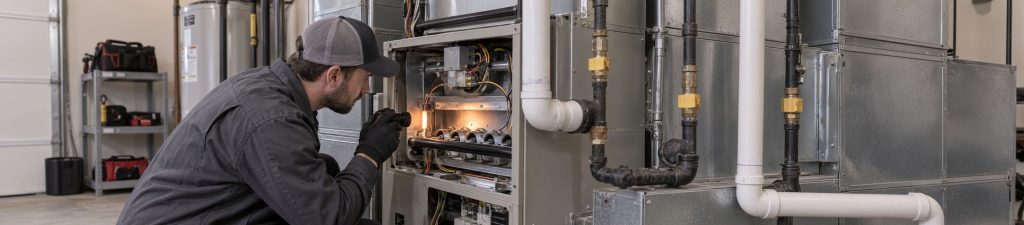
What Does a Furnace Ignitor Do?
A furnace ignitor provides the ignition source that starts burner flame. Many modern gas furnaces use a hot surface ignitor (HSI) that heats until it can ignite the gas. Other furnaces use electronic spark ignition instead.
The ignitor works only after the furnace control confirms that earlier steps in the heating sequence are satisfied. Depending on the furnace, those steps can include thermostat demand, inducer operation, draft verification, pressure-switch response, and closed safety circuits.
What Are the Symptoms of a Bad Furnace Ignitor?
A furnace ignitor problem usually shows up before stable burner flame is established. Common signs include:
No burner flame
The furnace starts its heating sequence, but the burners never ignite.
Hot surface ignitor does not glow
The furnace reaches the expected ignition stage, but the ignitor remains dark.
Repeated ignition attempts
The furnace may try to start several times and then enter a temporary ignition lockout.
Intermittent no-heat condition
Some heating calls succeed while others stop before burner ignition.
These symptoms do not prove that the ignitor itself has failed. The same no-flame condition can result from a control, draft, wiring, gas-delivery, or burner problem.
Where the Ignitor Fits in the Furnace Startup Sequence
The most useful diagnostic clue is often where the startup sequence stops. A typical gas furnace may operate in this order:
- Thermostat calls for heat.
- Inducer motor starts.
- Draft is verified.
- Ignitor is energized. An HSI glows, or a spark system begins sparking.
- Gas valve is commanded open.
- Burners ignite.
- Flame is proven.
- Circulating blower starts after the appropriate delay.
If your furnace does not even reach the normal ignition stage, the cause may be broader than the ignitor. See: Why Won’t My Furnace Start on the First Cool Night?
What If the Ignitor Does Not Glow?
On a hot-surface ignition furnace, no glow can mean the ignitor has failed. It can also mean the furnace control has not allowed the ignition step to begin.
Possible causes include:
- a failed or electrically open hot surface ignitor;
- damaged wiring or a loose connector;
- an inducer or draft-related problem;
- a pressure-switch circuit that has not proven the required condition;
- an open limit, rollout, or other safety circuit;
- a control-board output problem;
- incorrect electrical supply to the ignition circuit;
- ignition lockout after previous failed attempts.
The key question is whether the furnace is actually commanding the ignitor to operate. Replacing the ignitor without checking that step can result in replacing a good part.
What If the Ignitor Glows but the Burners Do Not Light?
If a hot surface ignitor glows but no burner flame appears, the ignitor circuit has at least reached the heating stage. The next diagnostic focus shifts toward gas delivery, burner ignition, and furnace controls.
- gas supply to the furnace;
- whether the gas valve receives the correct command;
- gas-valve operation;
- ignitor position relative to the burner;
- burner condition and ignition point;
- flame carryover between burners;
- control-board timing or output;
- wiring and safety circuits.
Furnace Ignitor vs Flame Sensor
The simplest difference is when the failure happens. The ignitor helps create flame. The flame sensor or flame-proving circuit confirms that flame remains present after ignition.
| What happens | More consistent with ignition-side problem | More consistent with flame-proving problem |
|---|---|---|
| Hot surface ignitor does not glow | Yes | No |
| Burners never establish flame | Yes | No flame exists yet to prove |
| Burners light normally | Ignition has occurred | Flame-proving stage begins |
| Burners light and shut off within seconds | Less consistent with a simple failed ignitor | Common flame-proving symptom |
If the burners light and then shut off within seconds, see: Furnace Flame Sensor Problems: Why Burners Light and Then Shut Off .
Can an Ignitor Work Intermittently?
Yes. A deteriorating ignitor can work on some heating calls and fail on others. Intermittent wiring, connectors, control-board output, or another startup-sequence fault can produce the same pattern.
Possible causes include:
- a developing crack in the ignitor element;
- a heat-damaged or loose electrical connection;
- unstable or incorrect voltage;
- an intermittent control-board output;
- a pressure-switch or safety-circuit problem that stops only some startup attempts.
Because intermittent faults may disappear temporarily, diagnosis may require observing more than one complete heating cycle.
What Else Can Prevent Burner Ignition?
Inducer or venting problem
The furnace may stop before ignition if it cannot establish the required draft conditions.
Pressure-switch circuit
A pressure-switch, tubing, drainage, or draft-related fault can interrupt the sequence before the ignitor is allowed to operate.
Gas supply or gas valve
The ignitor can operate normally while the burners remain unlit because gas is not reaching the burner assembly as required.
Burner or flame-carryover problem
Burner contamination, alignment, or poor carryover can interfere with reliable ignition across the burner assembly.
Control or safety circuit
A control-board fault, open safety circuit, or wiring problem can stop the sequence at the wrong stage.
How a Technician Diagnoses an Ignition Failure
A technician should first determine where the startup sequence stops, then test the components involved at that stage. To confirm that the ignitor itself has failed, the diagnosis may include:
- Inspecting the ignitor. A hot surface ignitor may show a visible crack or damaged element, although some electrical failures are not visible.
- Checking whether the furnace is commanding ignition. The technician verifies that the control sequence has reached the ignition stage and checks the electrical supply to the ignitor circuit.
- Testing the ignitor electrically. Continuity or resistance can be checked and compared with the specification for the installed furnace and ignitor. A universal resistance value should not be assumed across all models.
- Checking gas and burner operation. If the ignitor operates, the technician verifies gas-valve command, gas delivery, burner condition, and ignition position.
- Verifying another complete heating cycle. After repair, the furnace should ignite, prove flame, run, and shut down normally.
When the Furnace Should Be Left Off
Some ignition failures require more caution than a simple no-heat condition.
Leave the building and treat the situation as urgent if you notice:
- a natural-gas odor;
- a hissing sound that may indicate escaping gas;
- a carbon monoxide alarm.
Leave the furnace off and schedule service if you notice:
- delayed ignition or a boom when the burners light;
- soot or scorch marks near the burner area;
- flame rollout or signs of overheating;
- a persistent electrical-burning odor;
- repeated ignition failures or lockout that returns after a reset.
Do not bypass safety switches or continue resetting a furnace that repeatedly fails to ignite.
Frequently Asked Questions
How do I know if my furnace ignitor is bad?
A bad hot surface ignitor can prevent the burners from lighting even though the furnace starts its normal heating sequence. Confirmation requires checking whether the furnace reaches the ignition stage, whether the ignitor receives the correct electrical command, and whether the ignitor passes the appropriate electrical test for that model.
Should a furnace ignitor glow?
A hot surface ignitor normally glows during the ignition stage. A furnace with spark ignition does not use a glowing element and instead produces a spark.
Why does my furnace ignitor glow but there is no flame?
If the hot surface ignitor glows but the burners do not light, possible causes include gas supply, gas-valve operation, burner condition, ignitor position, wiring, or control problems.
Can a furnace ignitor fail intermittently?
Yes. A deteriorating ignitor or an intermittent wiring, voltage, control, pressure-switch, or safety-circuit problem can allow some heating cycles to start normally while others fail.
Is a furnace ignitor the same as a flame sensor?
No. The ignitor helps establish burner flame. The flame sensor or flame-proving circuit confirms that flame remains present after ignition. If the burners light and then shut off within seconds, see the furnace flame sensor troubleshooting guide.
Why does my furnace keep trying to ignite?
The furnace may repeat an ignition attempt when flame is not successfully established or proven. After several unsuccessful attempts, some furnaces enter a temporary lockout. The cause can involve the ignitor, gas delivery, burners, controls, draft verification, wiring, or flame proving.
Furnace Won’t Ignite in Orange County?
If your furnace starts but the burners never establish a flame, MaksBuilder can trace the heating sequence and diagnose the ignitor, gas valve, burners, controls, draft circuit, and related safety components before recommending a repair.