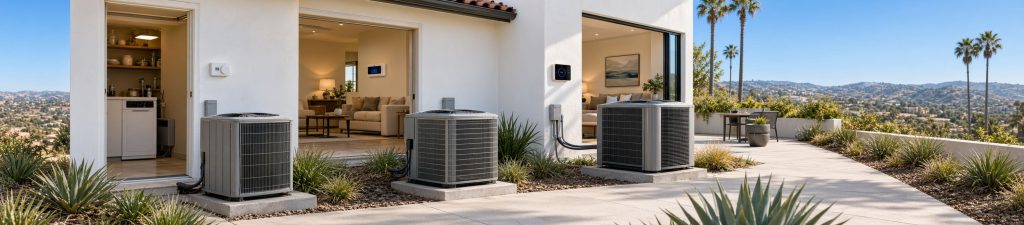
Single-stage AC runs at one cooling capacity. Two-stage AC switches between low and high output. Variable-speed AC uses an inverter-driven compressor to adjust output across a wider range.
All three can cool a house effectively when properly sized and installed. The difference is how they respond when your home needs less than full cooling capacity—and what that means for noise, temperature stability, energy use, and price.
Quick Comparison
The terms describe compressor capacity control—not necessarily the speed of the indoor blower.
Single-Stage AC
One cooling level: on or off.
- Compressor capacity
- One fixed setting
- Temperature control
- Normal thermostat cycling
- Noise
- Full-output sound when running
- Upfront cost
- Generally lowest
- Best fit
- Simple replacement and tighter budgets
Two-Stage AC
Lower output for mild loads; higher for heat.
- Compressor capacity
- Low and high
- Temperature control
- Usually steadier at light loads
- Noise
- Often quieter in low stage
- Upfront cost
- Generally midrange
- Best fit
- Balance of comfort and cost
Variable-Speed AC
Compressor adjusts across multiple output levels.
- Compressor capacity
- Modulates within a model-specific range
- Temperature control
- Typically the most consistent
- Noise
- Often quieter at reduced output
- Upfront cost
- Generally highest
- Best fit
- Quiet operation and steady comfort
Single-Stage AC
A single-stage compressor runs at one cooling capacity. When the thermostat calls for cooling, it turns on at full output and shuts off after the thermostat reaches its setting.
That makes operation straightforward, and single-stage equipment often costs less upfront. But even on a mild day, the compressor cannot reduce its output to match a small cooling load.
A correctly sized single-stage system can still be efficient and comfortable. Short, frequent cycles become more likely when equipment is oversized or the system has other problems.
Two-Stage AC
A two-stage AC has a lower and a higher compressor capacity. It can run at low stage when the house needs moderate cooling and switch to high stage when demand rises.
Many models provide roughly two-thirds of full capacity in low stage, though the actual percentage varies. Longer low-stage operation can reduce noticeable temperature swings and outdoor sound.
Two-stage AC still cycles on and off. Unlike an inverter system, it cannot adjust continuously through many compressor speeds.
Variable-Speed and Inverter Systems
An inverter-driven compressor can change speed and adjust cooling output within its designed range. It may run at reduced output for a long stretch, then increase capacity as the home warms.
Do not confuse a variable-speed compressor, which adjusts cooling capacity, with a variable-speed indoor blower, which adjusts airflow. A home can have a variable-speed blower paired with a single-stage outdoor AC.
The capacity range, controls, and minimum operating output differ by model. Variable-speed does not mean the unit runs continuously or can cool any house regardless of duct conditions.
Temperature Stability
Single-stage AC delivers full cooling output in cycles. Two-stage equipment can spend more time at lower output, while variable-capacity equipment can adjust more closely to changing demand.
As a result, a properly configured inverter system often maintains a more consistent temperature near the thermostat.
That does not mean every room will match the thermostat. Hot upstairs bedrooms may have restricted supply ducts, poor return-air paths, or heavy afternoon sun exposure.
Humidity Control
AC removes moisture when indoor air passes over a cold evaporator coil and water drains away. Extremely short cooling cycles can limit that process.
Two-stage and variable-capacity systems may help by operating longer at reduced capacity. Results depend on coil temperature, indoor airflow, settings, and sizing—not simply the number of stages.
For many inland Orange County homes, dry heat is the greater concern. Coastal humidity conditions can be different.
Noise
Single-stage equipment operates at full compressor output when running. Two-stage units are often quieter in low stage; inverter equipment can also reduce compressor and fan speeds when demand is light.
For a fair comparison, check published sound ratings for the specific models. Outdoor-unit location and nearby walls matter too.
Indoor noise may come from restrictive return grilles or undersized ductwork, even when the outdoor AC is quiet.
Energy Use
Modulating cooling capacity can improve efficiency when the house needs less than full output. But a variable-speed label alone does not guarantee the lowest electricity bill.
A lower-power system can run longer and still use less electricity. For illustration, 1,000 watts for two hours equals 2 kWh; 3,000 watts for one hour equals 3 kWh. These are examples, not measured AC performance.
Compare the equipment ratings
SEER2 reflects seasonal cooling efficiency under standardized conditions. EER2 describes efficiency at a specified test condition.
Use ratings for the actual matched indoor and outdoor equipment, along with installed cost and expected cooling use. The ENERGY STAR homeowner guide explains related efficiency improvements.
Ductwork Requirements
An inverter compressor cannot fix undersized, leaking, or crushed ducts. All three AC types need adequate air moving through the indoor coil and into occupied rooms.
Static pressure is the resistance the blower must work against. Technicians measure total external static pressure to help evaluate airflow conditions against equipment specifications.
A variable-speed blower may increase speed against some restrictions, but that can raise noise and power use. It cannot compensate for every poorly designed duct system.
ENERGY STAR's HVAC quality-installation guidance also addresses proper sizing, airflow, refrigerant charge, and ductwork.
What needs attention before replacement?
- Supply and return duct capacity.
- Filter and return-grille restrictions.
- Leaky or disconnected attic ducts.
- Kinked or compressed flexible duct runs.
- Duct insulation and uneven room airflow.
- Measured static pressure and equipment airflow requirements.
Furnace and Air Handler Compatibility
In many Southern California homes, a gas furnace provides the indoor blower for central AC. Replacing the outdoor unit does not automatically require a new furnace, but the entire cooling system must be compatible.
Single-stage: Existing indoor equipment may be suitable if the coil, blower, controls, and airflow meet the replacement system's requirements.
Two-stage: Both cooling stages need appropriate control and airflow. Some single-stage heating furnaces can be paired with two-stage cooling.
Variable-speed: Specific indoor coils, air handlers, furnaces, or communicating controls may be needed. An otherwise functional furnace might not support a particular inverter system.
Ask for the matched system
Request model numbers for the condenser or heat pump, indoor coil, furnace or air handler, and controls. The AHRI Directory of Certified Product Performance can help verify certified equipment combinations and published ratings.
Which Type Makes Sense in Southern California?
A coastal home with moderate cooling needs is different from an inland house with west-facing windows and hot attic ductwork. Choose equipment around the actual cooling load and the comfort improvements you value.
Single-stage for a straightforward replacement
A reasonable choice when the house cools evenly, the ducts perform well, and the upfront price matters most.
Two-stage for changing daily loads
Low-stage operation can handle mild conditions, with high stage available during hotter afternoons.
Variable-speed for quieter, steadier cooling
Worth comparing if the household values reduced-output operation and the indoor system supports it.
What about a hot second floor?
Suppose the downstairs thermostat reads 74°F but upstairs bedrooms remain warm. Before upgrading compressor technology, check upstairs airflow, return-air paths, attic insulation, and window heat gain. Better capacity control cannot repair a damaged branch duct.
What to ask before accepting an estimate
- How was the cooling capacity calculated?
- Which exact indoor and outdoor models are included?
- What are the certified SEER2 and EER2 ratings?
- Can the existing ducts handle the required airflow?
- Will the furnace and thermostat remain compatible?
- What electrical, refrigerant, drainage, permit, and startup work is included?
Frequently Asked Questions
Short answers to the questions homeowners commonly ask when comparing AC types.
Is two-stage AC worth it?
It can be worth the extra cost when quieter low-stage operation and more consistent temperatures matter to you. Compare the actual equipment and installation prices; the improvement is not the same in every home.
Is variable-speed AC worth the extra money?
It may be, especially when comfort and quiet operation matter more than the lowest upfront price. Financial payback depends on equipment cost, local electric rates, and annual cooling use.
Does variable-speed AC run all the time?
No. It can run for long periods at reduced capacity, but it still shuts off when cooling is unnecessary or when demand falls below its minimum operating capacity.
Which AC type uses the least electricity?
A highly efficient, properly matched variable-capacity system may use less electricity than comparable lower-efficiency equipment. Compare certified ratings and installation conditions rather than relying on compressor staging alone.
Can I keep my existing furnace and ducts?
Possibly. The ducts must deliver enough air, and the indoor coil, blower, furnace or air handler, and controls must be approved for the selected system. Some inverter configurations require indoor upgrades.
Will a two-stage or variable-speed AC fix a hot bedroom?
Not by itself. A hot room may have limited airflow, a poor return-air path, inadequate insulation, or strong solar heat gain. Those causes need to be addressed directly.
Making the Right AC Choice for Your Home
Single-stage AC offers straightforward cooling and usually the lowest initial cost. Two-stage AC gives the system a low and high cooling setting. Variable-speed AC offers finer capacity control, often improving quiet operation and temperature stability.
For an Orange County home, proper sizing, duct airflow, indoor equipment compatibility, and installation quality matter as much as compressor type.
For equipment matching, sizing, and replacement considerations, see the MaksBuilder AC installation and replacement guide.