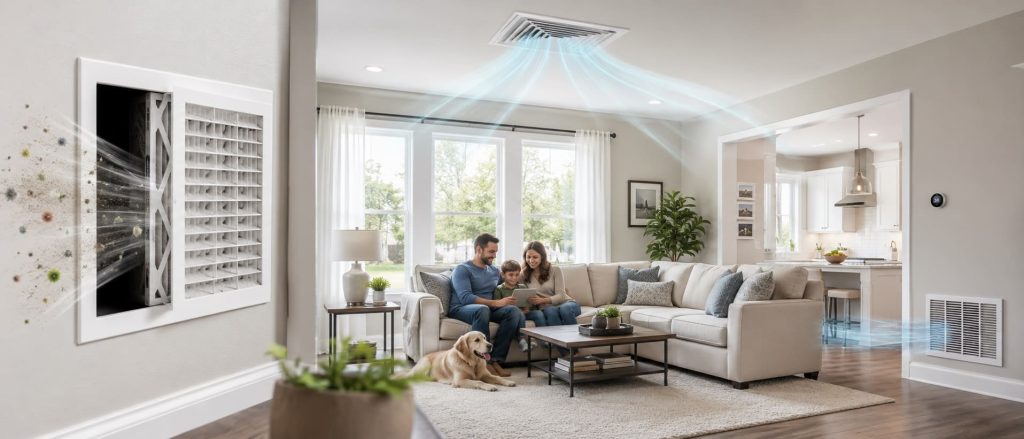
Cleaner indoor air depends on filtration, airflow, ventilation, and source control
A heating and cooling system can influence particle filtration, room-to-room air movement, moisture removal during cooling, and overall comfort. Its effect on indoor air quality depends on system design, maintenance, building conditions, outdoor air, and the source of the problem.
What Your HVAC System Can Do for Indoor Air
HVAC equipment can support better indoor air by filtering recirculated air and maintaining air movement, but it cannot correct every pollutant or moisture source. Start with the problem you actually notice. Persistent dust calls for a look at filter fit and return ducts; a musty smell calls for moisture and drainage checks; stale rooms may need better ventilation or air distribution.
Why indoor air quality problems often involve the HVAC system
Indoor air concerns are often noticed through ordinary changes in the home: particles collecting quickly on surfaces, a bedroom that feels stale with the door closed, an odor when the system starts, uneven temperatures, or irritation that appears worse in particular rooms.
The cause may involve more than one condition. Filter bypass, leaky return ducts, damaged insulation, construction debris, pet dander, outdoor smoke, moisture, cooking emissions, garage air, and air entering from unconditioned spaces can all affect what reaches occupied rooms.
Start by finding where the dust, odor, or moisture is coming from—not by buying a higher-rated filter. Installing a more efficient filter may provide limited benefit if air bypasses the media, the return system is restricted, the coil is dirty, or pollutants continue to enter from an uncontrolled source.
What to Check Before Buying an Air Purifier or HVAC Upgrade
Indoor air quality products should not be selected solely from a symptom such as dust, odor, or stale air. A staged review helps identify whether the main limitation is filtration, airflow, moisture, ventilation, or pollutant source control.
How an HVAC system affects indoor conditions
- Particle filtration: Return air should pass through the filter before reaching the blower and coil. Performance depends on filter efficiency, fit, exposed media area, loading, and replacement condition.
- Air circulation: Restricted or poorly distributed airflow can leave some rooms stale, create temperature differences, and reduce how much room air reaches the filter.
- Moisture removal: Air conditioning removes moisture only while the system is cooling and draining properly. Oversizing, short cycles, dirty coils, low airflow, and drainage defects can reduce dehumidification.
- Ventilation: Filtration treats recirculated air, while ventilation introduces outdoor air and removes stale indoor air. Ventilation must be designed so it does not create unacceptable heat, humidity, smoke, or pressure problems.
MERV ratings explained in practical terms
MERV means Minimum Efficiency Reporting Value. It is a standardized rating based on measured particle-removal efficiency across several particle-size ranges between 0.3 and 10 microns.
A higher MERV rating generally indicates greater particle capture, but the rating does not describe filter pressure drop, cabinet fit, media area, service life, or compatibility with a particular blower and duct system.
| MERV range | General application | Important limitation |
|---|---|---|
| MERV 1–4 | Basic capture of relatively large debris, primarily for equipment protection. | Limited performance for smaller household particles and smoke-related concerns. |
| MERV 5–8 | Common residential filtration for larger household particles. | Performance still depends on tight installation and timely replacement. |
| MERV 9–12 | Improved capture for homes seeking stronger general particle filtration. | Filter pressure drop and available return-air capacity should be considered. |
| MERV 13 | Higher-efficiency residential or light-commercial particle capture when the system is compatible. | Compatibility should be confirmed through equipment data and airflow or pressure evaluation. |
| MERV 14–16 | Higher-efficiency applications commonly requiring purpose-designed filter assemblies. | These filters should not be treated as direct replacements for every standard residential filter slot. |
HEPA is a separate filtration classification and should not be treated as another ordinary MERV level. Whole-building HEPA applications generally require equipment and airflow arrangements designed for the associated resistance.
Measurements used to evaluate airflow and filter compatibility
A visual inspection alone may not show whether a filter or duct system is restricting airflow. A technical assessment can include several measurements interpreted against the equipment manufacturer’s specifications.
- Total external static pressure: The pressure difference measured at the prescribed external test points of the air-handling equipment and interpreted against the manufacturer’s specifications.
- Pressure drop across the filter: Helps determine how much resistance the selected media creates at the operating airflow.
- Pressure drop across the coil: Can help determine whether coil condition or airflow is contributing to excessive system resistance.
- Airflow estimation or measurement: Airflow may be evaluated using manufacturer fan-performance data, pressure readings, or direct measurement methods appropriate to the installed system.
- Room and duct observations: Supply and return restrictions, closed-door effects, damaged ducts, grille sizing, and blower configuration should be reviewed together rather than interpreted separately.
There is no single universal static-pressure or airflow value that applies to every HVAC system. Results should be compared with the published data and limits for the installed equipment.
Maintenance checks that support cleaner airflow
Maintenance cannot remove every indoor pollutant, but it can identify conditions that reduce filtration, create moisture, or allow unfiltered air to enter the system.
Filter condition and bypass
A clogged, loose, bent, damp, collapsed, or incorrectly sized filter can reduce performance. Gaps around the frame matter because bypassed air reaches the blower and coil without passing through the intended media.
Evaporator coil and blower compartment
Coil and blower condition affect heat transfer, airflow, and cleanliness. A restricted coil can reduce capacity and increase pressure loss, while contamination around the blower may be redistributed through the duct system.
Condensate drain and pan
Cooling systems produce condensation. A restricted drain, damaged pan, poor slope, wet insulation, or recurring overflow can create odors and moisture conditions that should be corrected at the source.
Ducts and return pathways
Disconnected ducts, leaky returns, crushed flexible duct, poorly sealed cabinets, and gaps to attics, crawlspaces, garages, or utility areas can introduce unwanted air before filtration occurs.
Why different homes may require different IAQ strategies
Indoor air quality depends on climate, building design, occupant activities, equipment runtime, ventilation, and outdoor conditions. Homes in humid climates may require greater attention to moisture removal and drainage, while homes in hot or dry regions may experience long cooling cycles, attic heat, and faster filter loading.
Areas affected by wildfire smoke may require temporary changes in filtration and window operation. During smoke events, filters can load more quickly, so inspection and replacement intervals may need to be shortened.
Recommendations should therefore be based on the actual building and system. Return layout, duct location, air leakage, room doors, equipment capacity, filter cabinet design, and pollutant source all influence which corrective action is appropriate.
When source control and ventilation matter more than filtration
Mechanical filters primarily remove particles carried in the airflow. They do not automatically remove every gas, vapor, odor, biological source, or moisture problem.
Source control may include repairing water entry, isolating garage pollutants, venting cooking appliances correctly, removing contaminated materials, controlling combustion sources, and sealing unintended air pathways. For HVAC-related filtration, airflow, humidity, or ventilation concerns, see our indoor air quality services.
Ventilation may help when indoor air is stale or pollutant concentrations are elevated, but outdoor air should not be introduced without considering temperature, humidity, smoke, pollen, building pressure, and equipment capacity.
- Persistent particles: Investigate filter bypass, return leakage, damaged ducts, building-envelope openings, renovation debris, and outdoor particle entry before relying on a higher filter rating.
- Recurring odors: Check drains, coils, moisture, return locations, stored materials, cooking, garage air, and non-HVAC sources. Odor alone does not identify the pollutant or its health significance.
- Moisture concerns: Identify and correct the moisture source. HVAC inspection may reveal drainage or airflow problems, but it should not be used to identify mold species or health risk without appropriate expertise and evidence.
- Smoke exposure: Use the most efficient filter the installed system can support, operate suitable recirculation or portable filtration, and inspect filters more frequently during prolonged smoke conditions.
What ordinary HVAC filters do not remove
A standard mechanical HVAC filter is designed primarily for particles. It should not be represented as protection against every indoor contaminant.
- Carbon monoxide: Particle filters do not remove carbon monoxide. Combustion appliances require proper venting, maintenance, and working carbon-monoxide alarms.
- Radon: Ordinary HVAC filtration does not correct radon entry. Radon requires appropriate testing and mitigation methods.
- Many gases and vapors: Volatile compounds and gaseous pollutants may require source removal, ventilation, or specifically selected sorbent media. Mechanical particle efficiency alone does not describe gas removal.
- Active moisture sources: Filtration cannot repair leaks, condensation defects, wet materials, or water intrusion. The moisture source must be identified and corrected.
How targeted indoor air testing should be selected
There is no single universal indoor air quality test that answers every question. Testing should be selected according to the suspected problem and interpreted together with building conditions, occupant activities, outdoor air, and equipment operation.
| Concern | Useful evaluation | Important caution |
|---|---|---|
| Airborne particles or smoke | Particle measurements, filter review, return leakage assessment, and comparison with outdoor conditions. | A single short measurement may not represent changing conditions throughout the day. |
| Humidity or condensation | Relative humidity trends, surface moisture, drainage, cooling runtime, airflow, and building-envelope inspection. | Humidity varies by season, room, temperature, and equipment operation. |
| Combustion safety | Carbon-monoxide monitoring, appliance inspection, draft and venting evaluation, and combustion-safety testing. | This requires suitable instruments and qualified personnel. |
| Odors or chemical emissions | Source investigation, ventilation review, material inventory, and pollutant-specific testing when justified. | Broad untargeted sampling may produce results that are difficult to interpret. |
| Suspected mold or moisture damage | Moisture-source investigation, material inspection, humidity review, and specialist assessment when required. | Air sampling alone does not replace inspection or moisture correction. |
How to interpret common indoor air complaints
If the main complaint is weak cooling, noisy returns, or a filter that becomes dirty unusually quickly, begin with filter fit, airflow, duct restrictions, and unintended air entry.
If a musty odor appears during cooling, inspect the evaporator coil, drain pan, condensate line, nearby insulation, duct materials, and other moisture sources rather than assuming the filter is responsible.
If rooms feel stale without a clear equipment defect, review return pathways, door position, room pressure, ventilation, occupant density, and pollutant sources.
The main limitation of HVAC filtration is that it primarily addresses particles moving through the system. Gases, combustion hazards, water intrusion, active biological growth, and chemical emissions require appropriate source-specific action.
FAQ: Indoor air quality and HVAC
Can an HVAC system improve indoor air quality?
It can support indoor air quality by filtering recirculated air, distributing conditioned air, and removing some moisture during cooling. Results depend on filter fit, airflow, duct condition, maintenance, ventilation, and the source of the concern.
Is a higher-MERV filter always better?
No. Higher particle-capture efficiency may also produce greater resistance. The filter should be compatible with the cabinet, return system, blower, and airflow requirements of the installed equipment.
Why does dust return quickly after cleaning?
Possible causes include filter bypass, leaky returns, damaged ducts, outdoor air entry, insulation particles, renovation debris, pets, open windows, and ordinary occupant activity. The first step is to determine whether air is passing through the filter correctly.
Can HVAC maintenance help with allergy concerns?
Maintenance can support cleaner airflow by checking filters, coils, blower areas, drains, and duct-related problems. Allergy symptoms may have many causes, so HVAC maintenance should not be treated as diagnosis or medical advice.
When is indoor air testing appropriate?
Testing is most useful when there is a defined concern that cannot be resolved through inspection and basic correction. The test should be selected for the suspected pollutant or condition rather than used as a general-purpose screening package.
Technical references
These official resources provide additional information about filter ratings, residential air cleaning, ventilation, combustion pollutants, radon, and moisture control.
- EPA: What is a MERV rating? — Explanation of the Minimum Efficiency Reporting Value system.
- EPA: Guide to Air Cleaners in the Home — Capabilities and limitations of HVAC filters and portable air cleaners.
- ASHRAE Standards 62.1 and 62.2 — Ventilation and acceptable indoor air quality standards for buildings.
- EPA: Carbon Monoxide’s Impact on Indoor Air Quality — Sources, risks, and control of indoor carbon monoxide.
- EPA: Radon — Information about radon testing and mitigation.
- EPA: Mold — Moisture control, cleanup principles, and mold-related guidance.