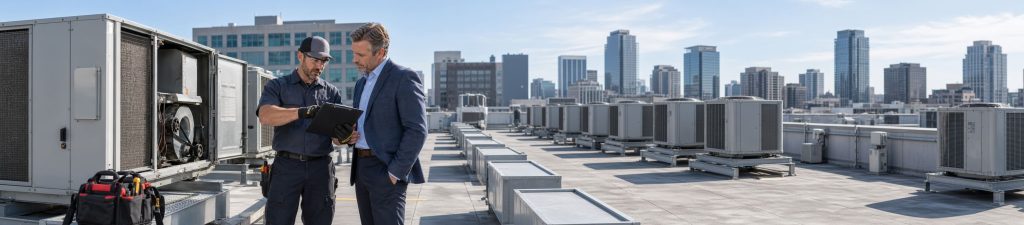
For each commercial HVAC unit, record what was checked, what was completed, and what still needs attention. A finished inspection and an unresolved equipment fault are two different results.
Use the checklist below to compare a contractor's planned tasks with the service report for each rooftop unit (RTU), packaged system or air handler. It is for managing work and approvals—not for performing electrical, refrigerant, gas or rooftop maintenance yourself. For recurring service, see commercial HVAC maintenance in Orange County.
Commercial HVAC Maintenance Checklist at a Glance
Start with an equipment inventory. Assign each unit an ID and record its manufacturer, model, serial number, rated capacity, roof or mechanical-room location, served tenant or zone, filter specifications, last service date and next planned visit. “Five units serviced” is not an adequate record when you need to trace a repeat failure to RTU-04.
Before the visit
Confirm the unit inventory, safe roof-access arrangements, tenant hours, complaints, unresolved findings from the last visit and the agreed task scope.
During the visit
For each unit, require the status of every applicable task, relevant readings with test conditions and photographs or fault codes when a defect is found.
After the visit
Reconcile the report against every asset ID; assign an owner and follow-up date to each open finding, and track repair authorization separately from completed maintenance.
| Component | Maintenance Task | Record to Keep |
|---|---|---|
| Equipment / RTU ID | Match the nameplate, unit number and thermostat or served area to the property inventory. | Unit ID, manufacturer, model, serial number, rated capacity, location and zone. |
| Air filters | Inspect loading and fit; replace when required by condition and the agreed scope. | Size, quantity, type, replacement date and status. |
| Filter pressure drop | Check differential pressure where test points or monitoring are available and the method applies. | Reading and applicable filter limit when measured. |
| Belts and pulleys | On belt-driven units, inspect wear, alignment and tension; adjust if included. | Condition, adjustment and any replacement request. |
| Supply fan / motor | Check for abnormal noise, vibration, damage and operating response. | Observed condition; motor current if measured. |
| Condenser coil | Inspect for debris, fin damage and restricted airflow; clean when justified and included. | Condition before and after any cleaning; unresolved restrictions. |
| Evaporator coil | Review accessible coil surfaces for buildup, icing or deterioration. | Observed condition, photographs of defects, next action. |
| Drain pan / trap / line | Inspect accessible condensate components for standing water, obstruction or leakage. | Condition, drain service completed and unresolved leaks. |
| Electrical components | Qualified technician checks accessible wiring, contactors, disconnects and capacitors where equipped. | Defects, readings recorded, test conditions and any follow-up. |
| VFD / fan controls | Where fitted, check indicated alarms, fan speed response and visible condition. | Fault history, settings or operating observations. |
| Thermostat / BAS | Verify occupied schedules and response to heating, cooling and fan commands. | Schedule verified, faults and affected zone. |
| Economizer | Where installed, inspect damper, actuator, linkage, sensors and response to a control command. | Commanded versus observed movement; defects. |
| Outdoor-air intake | Inspect accessible louvers, screens and outdoor-air path for blockage or damage. | Visible restrictions; separate airflow test result where commissioned. |
| Cooling operation | Check response and relevant operating temperatures; investigate abnormal signs as needed. | Operating conditions, readings recorded and any diagnostic action. |
| Heating section | Verify the applicable gas/electric or heat-pump heating sequence and safety response. | Mode tested, observed faults and safety concerns. |
| Cabinet / roof curb | Note accessible panel, seal, corrosion and water-entry concerns without assuming roof repairs are included. | Location, photographs and responsible trade. |
Use two independent fields in the service report:
- Task status: Completed (the specified inspection or work was carried out), Not completed (record why and when it will be addressed), or Not applicable (the component or task does not apply to that unit).
- Finding priority: No issue, Monitor, Repair approval needed, or Urgent, based on the technician's findings and site conditions.
Example: An economizer movement test can be marked Completed while the failed damper receives Repair approval needed. Do not mark the inspection Not completed merely because it found a fault. Give that finding its own issue ID, responsible person and target decision date so it does not disappear when the maintenance visit is closed.
Example maintenance planning by season
Before the cooling season
Review cooling response, condenser condition, condensate drainage, outdoor-air controls and any problems left open from the prior summer.
During heavy operation
Schedule filter and drain checks based on loading, operating hours and site conditions. Follow tenant complaints and repeat fault trends between planned visits.
Before the heating season
Verify the installed heating equipment's operation and applicable safeties, then check occupied schedules and unresolved control faults.
These are planning windows, not mandatory service intervals. Set each task's actual frequency using the manufacturer's instructions, the building's operating conditions, the agreed maintenance plan and applicable requirements. An active fault should not wait for a seasonal visit.
Rooftop Units and Packaged Systems
Where several rooftop units look alike, cross-check the roof label against the thermostat or building automation system (BAS) zone before testing. If the mapping is uncertain, record that as an identification issue rather than assigning measurements to the nearest cabinet.
A packaged RTU may combine cooling, supply-air movement, condensate drainage, heating and outdoor-air controls in one cabinet. The service checklist must reflect its actual components; a gas/electric RTU and a packaged heat pump do not have identical heating checks.
Gas/electric RTUs
Include the manufacturer-specified ignition, venting and heating-safety checks. A suspected combustion or heat-exchanger defect needs a qualified assessment, not an “OK” based only on a visual glance.
Packaged heat-pump RTUs
Verify the heating-mode response appropriate to that model. Defrost, reversing-valve and control problems require heat-pump diagnosis, not a gas-furnace checklist.
Before a rooftop visit, confirm hatch or ladder access, permitted work hours, tenant shutdown constraints and who can approve unplanned work. Trained personnel must manage fall protection, equipment isolation and safe roof access.
Filters, Belts, Fans and Coils
Filters: log the size, quantity and type installed in each unit, then mark whether they were inspected or replaced. Check loading and fit; a replacement interval depends on conditions and any applicable pressure-drop limit. A higher-efficiency filter must remain compatible with the fan and allowable system resistance.
Belts and fans: on belt-driven equipment, inspect for cracking, glazing, pulley misalignment and incorrect tension. Direct-drive fans have no belt. Abnormal vibration, bearing noise or motor current should be linked to the specific asset and its operating conditions, not just marked “fan checked.”
Coils: debris on an outdoor condenser coil can reduce heat rejection; buildup on an indoor evaporator coil can restrict airflow and heat transfer. Specify whether the coil was inspected, cleaned or recommended for cleaning. More extensive cleaning or disassembly may need a separately approved scope.
Condensate: record standing water, a blocked drain or trap, and leaks by unit and affected interior location. Active water intrusion, especially near electrical equipment or occupied space, needs prompt evaluation instead of a note to revisit next season.
Electrical Components and Controls
Electrical checks belong to qualified personnel following the equipment's isolation, testing and safety procedures. The applicable scope may cover wiring condition, contactors, disconnects, fuses, capacitors and indications of overheating. The report should identify defects rather than merely state “electrical checked.”
When a technician records voltage, motor current or another reading, it should have enough operating context to interpret: which unit, which component and under what load or mode. A figure without the model's reference conditions may not establish whether a part is healthy.
Check the operating schedule, not only the thermostat
Verify the occupied and unoccupied schedules and the RTU's response to the relevant heating, cooling and fan commands. Wrong BAS zone assignments, outdated schedules and sensor faults can cause complaints while the compressor and fans still operate. Document the command tested and the affected area; changing control sequences may require separate authorization.
Economizers, Dampers and Ventilation
An air-side economizer can use suitable outdoor air to reduce mechanical cooling demand. Its dampers, actuator, linkage and sensors must respond to the control strategy. A unit may still cool a tenant space even when its economizer is stuck in the wrong position.
- Identify whether the RTU has an economizer and which sensors or BAS commands control it.
- Compare the commanded damper position with actual movement, including whether the linkage binds.
- Inspect accessible outside-air louvers and screens for debris or obstruction.
- Document unusual sensor readings, actuator faults or damper behavior for follow-up.
Damper position is not proof of ventilation airflow. If outside-air quantity or a ventilation complaint must be verified, that may require airflow measurement, testing or balancing work beyond the maintenance visit. For fault-specific diagnosis, see commercial HVAC economizer problems.
Equipment Records and Service Reports
Before approving the service report, trace each abnormal result to the affected RTU, the evidence collected, a named follow-up owner and an open action. That lets you approve completed inspections without accidentally closing unresolved repairs.
Too vague to verify
“RTU-04 serviced. Filters checked. Unit OK.” This does not establish whether filters were changed, what the technician tested or whether a complaint was resolved.
Specific enough to act on
“RTU-04 / Suite 210: two filters replaced (sizes and type logged); condenser coil inspected, cleaning not required; economizer damper did not move on an opening command. Diagnosis needs approval.”
Example: RTU-04 maintenance complete, repair still open
- Location / zone
- East rooftop section · Suite 210
- Asset details
- Sample manufacturer · model DEMO-75-GE · serial SAMPLE-RTU-0004 · 7.5-ton gas/electric packaged RTU
- Filter details
- Two 16 × 25 × 2 in. pleated filters · MERV 8 (illustrative specification)
- Service history
- Previous visit: April 15, 2026 · Next scheduled visit: April 15, 2027
- Visit
- October 15, 2026 · Example Service Crew
- Task status
- Completed — two filters replaced, condenser coil inspected, economizer movement test carried out
- Finding priority
- Repair approval needed — economizer damper did not respond to an opening command; cause not confirmed
- Next action
- Request approval for economizer diagnosis; keep the fault open under RTU-04 until the damper is repaired and retested
- Work order / approval
- SAMPLE-WO-1046 · diagnosis authorization pending
- Follow-up owner / date
- Property manager · approval decision due October 16, 2026 (illustrative)
Fictional, fully filled-in example—not an actual MaksBuilder visit or a prescribed maintenance interval. Model, serial number, filter size, dates and contractor name are sample data only.
Attach photographs of damaged components, measured findings with operating conditions, replaced-material details and quotes where they support a decision. Keep the related issue or work-order number in the asset history, so recurring belt wear, drain backups or control failures can be compared across visits.
ASHRAE Standard 180 provides a framework for commercial HVAC equipment inventories, scheduled inspection and maintenance, and documentation. The property's agreed task plan should still reflect its equipment, manufacturer instructions and applicable requirements.
Maintenance vs Corrective Repair
A scheduled visit can reveal a defect without resolving it. The service agreement determines which adjustments, materials and repairs are included; request a separate scope and approval for work outside those terms.
Planned maintenance
Scheduled equipment checks, agreed filter replacements, accessible drain work, condition-based cleaning and unit-level reporting within the contracted scope.
Corrective work to approve
Fault diagnosis, failed motors or boards, refrigerant leak repairs, substantial electrical work, combustion defects, coil replacement or major economizer repair unless expressly covered.
Prioritize open findings before approving the next work order
Urgent — safety or active damage
Examples: suspected gas or combustion hazard, electrical arcing or overheating, recurring breaker trips, or water reaching electrical equipment. Follow the site's emergency procedure and the qualified technician's shutdown guidance; do not keep resetting an unsafe unit.
Repair approval needed
Examples: an economizer that fails a commanded test or a fan problem that needs diagnosis or parts. Record the affected zone, operational impact, proposed scope and approving person.
Monitor — documented condition
Examples: minor wear or coil soiling without a demonstrated operating fault. Record the observation, evidence and trigger for reinspection rather than writing only “watch.”
The actual priority depends on the technician's findings, occupant impact, system redundancy and site procedures. An active no-cooling complaint or failed RTU should be handled as a service issue, not postponed until the next routine visit; see commercial rooftop unit repair.
Repair approval rule: Request the asset ID, observed defect and supporting evidence, proposed diagnostic or repair scope, quote or spending limit, authorizing person, response deadline and who will verify completion. EPA Section 608 requires appropriate technician certification for activities that could release refrigerant, including attaching or detaching gauges. Routine maintenance does not require opening the refrigerant circuit on every visit.
FAQ
Can one service report cover several rooftop units?
Yes, if each unit has its own identifiable results. A shared PDF is fine; a single note saying “six RTUs serviced” is not. List the asset ID, tasks performed, findings and next steps for each unit.
What if a scheduled maintenance task is not completed?
Mark it Not completed, state why (for example, roof access was unavailable), and set a responsible person and return date. Do not mark the unit's entire visit complete without identifying that exception.
Can I close a maintenance task if the test finds a fault?
Yes. Mark the test Completed if it was actually performed, but leave the defect open with a separate finding priority, approval decision and follow-up owner. Completion of an inspection is not proof of a successful repair.
What if a tenant reports no cooling between planned visits?
Log the affected suite, time, thermostat setting, observed symptoms and impacted RTU if known. Request a service assessment rather than waiting for the next preventive maintenance date; do not direct tenants to access rooftop equipment.
Should the technician connect refrigerant gauges at every visit?
No. Gauge connection should follow a diagnostic need and the equipment's service instructions, not be an automatic checkbox. Work that can release refrigerant requires an appropriately certified technician under EPA Section 608.
When should a manager request a separate ventilation test?
Consider one when repeated ventilation complaints persist, building use or occupancy changes, or damper operation does not explain the concern. A functioning damper does not establish outside-air volume; verification may require airflow measurements and testing or balancing.
At sign-off, store each unit-level report with its unresolved findings and approval records. Close a fault only when the authorized work and its verification result are documented; carry open issues into the next visit.
For an equipment-specific recurring service scope, see MaksBuilder's commercial HVAC maintenance program.