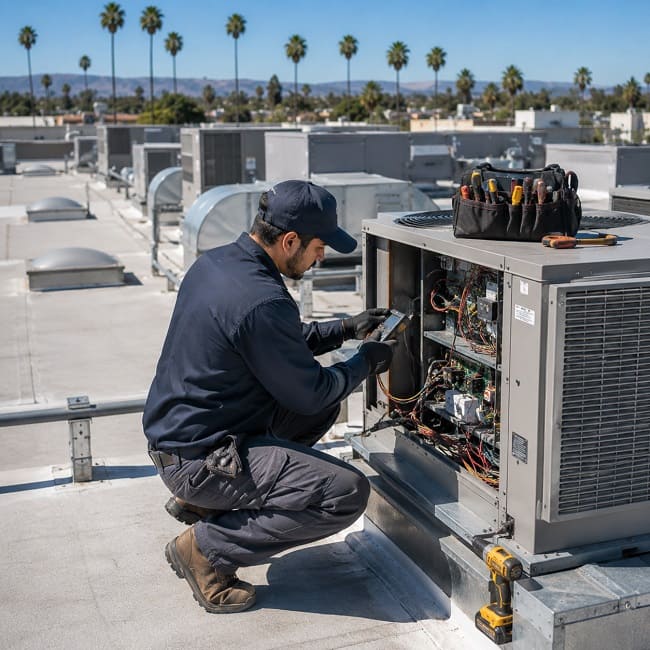
Commercial Rooftop Unit Repair for Cooling, Heating, Airflow and Control Problems
A commercial rooftop unit (RTU) that will not cool, will not heat,
fails to start, loses airflow, trips electrical protection, leaks
condensate, or shuts down intermittently needs the failed operating
function identified before parts are replaced.
MaksBuilder provides commercial rooftop HVAC repair in Orange County
for packaged RTUs. Service starts by confirming the failed function so
the repair is based on the actual equipment fault rather than the
symptom alone. Work can involve thermostat or Building Automation
System (BAS) calls, electrical startup, supply-fan and belt-driven
assemblies, economizers, cooling and heating sections, safeties, and
condensate drainage according to the equipment configuration.
Commercial packaged rooftop units
No-cooling, no-heat and startup faults
Controls, economizers and airflow
Roof-access and tenant coordination
RTU Problems
Commercial Rooftop Unit Problems We Diagnose
A packaged rooftop unit combines controls, airflow, electrical
components, cooling or heating functions, ventilation, and condensate
management in one system. The same building symptom can come from more
than one subsystem, so the symptom is a starting point for diagnosis,
not proof that a particular component has failed.
The examples below are diagnostic starting points rather than a fixed
parts-replacement sequence. The exact sequence of operation depends on
the RTU manufacturer, equipment configuration, installed controls,
safeties, and whether the unit is gas/electric, electric heat, or a
packaged heat pump.
RTU Runs but Does Not Cool
The fan may operate while the space stays warm. Possible areas
include the cooling call, airflow, economizer position, condenser
section, compressor circuit, refrigeration response, or a safety
that is preventing cooling operation. The technician then determines
whether the problem is primarily in controls or airflow, or in the
refrigeration and compressor side of the unit.
Unit Does Not Start
A no-start complaint may involve incoming power, disconnects or
fuses, thermostat or schedule demand, control voltage, a safety
circuit, contactor or board response, or a motor/compressor that
cannot start. The key distinction is whether the unit never receives
a valid start command or receives the command but cannot complete
electrical or mechanical startup.
Supply Fan Runs but Compressor Does Not
If airflow is present but mechanical cooling never starts, the
problem may be in the cooling command, compressor enable circuit,
safeties, contactor, condenser section, wiring, or compressor
startup circuit. Testing determines whether cooling is being blocked
by controls or safeties, or by an electrical fault in the compressor
circuit.
Intermittent Shutdowns
An RTU that starts and later stops can be reacting to a safety,
voltage or phase condition, motor or compressor thermal protection,
condensate switch, control fault, loose connection, or another
condition that appears only during operation. The useful question is
what condition is ending operation after startup, not simply what
originally commanded the unit on.
Economizer Stuck Open or Closed
Incorrect outside-air damper position can involve an actuator,
linkage, sensor input, controller command, minimum-position setup,
or another part of the installed economizer strategy. Some systems
also use temperature, enthalpy, mixed-air, return-air, or BAS inputs.
Testing distinguishes a mechanical damper or actuator problem from
incorrect sensor data or the control logic commanding the damper.
Belt, Blower or Weak-Airflow Problems
Weak airflow can be related to filter or coil restriction,
belt wear or tension, pulley alignment, blower condition, motor
performance, or another restriction in the airside path. Diagnosis
separates a fan-drive or motor problem from an airflow restriction or
control condition that is reducing delivered air.
Condensate Overflow or Water at the RTU
Water problems can involve the drain pan, trap or connection,
a restricted drain line, standing water, coil conditions, or an
overflow switch that is shutting the unit down. Diagnosis identifies
whether water is being caused by a drainage restriction or whether
overflow protection is stopping the RTU.
Thermostat or Control Fault
The issue may be in thermostat demand, occupancy scheduling,
low-voltage wiring, sensor inputs, relays, a unit controller,
or an accessible Building Automation System (BAS) interface. Testing
determines whether the fault is in the external control path or inside
the RTU after the call arrives.
Thermostat or BAS Calls, but the RTU Does Not Respond
When the requested mode appears at the thermostat or BAS but the
unit does not respond, the key question is whether the command
actually reaches the rooftop unit and whether an internal safety,
board, relay, electrical circuit, motor, or compressor prevents the
next operating step. This distinguishes an upstream command or
interface problem from an internal RTU fault.
RTU Runs but Does Not Heat
Heating faults depend on the equipment type. Gas/electric packaged
units can require checks of the heating call, safeties, ignition
sequence, gas valve or burner operation, and supply-fan response.
Packaged heat pumps may instead involve compressor operation,
reversing-valve control, defrost, or auxiliary heat where installed.
The technician determines whether the heat call is missing or the
installed heating section fails after the call arrives.
Fault Isolation
RTU Repair vs Control or Economizer Fault
A comfort complaint can begin inside the rooftop unit or before the
command reaches it. The first useful distinction is whether the correct
heating, cooling, or fan request reaches the RTU and where the expected
response stops.
When the Problem Is Inside the RTU
If the correct call reaches the equipment but the unit cannot
complete fan, compressor, heating, electrical, refrigeration,
safety, or condensate operation, the problem remains in the
rooftop-unit repair scope.
When Controls or the Economizer Need Separate Diagnosis
The service call is organized around the reported symptom and the
equipment's actual sequence of operation. Not every unit uses the same
controls or follows the same sequence, so the technician confirms what
the installed RTU is supposed to do before deciding which subsystem has
failed.
01
Confirm the Complaint and Correct Rooftop Unit
The affected tenant, zone, thermostat or controller is identified
and matched to the correct RTU. Make/model information, equipment
labels, recent service history, and reported fault codes can help
establish context before testing begins.
02
Confirm the Requested Operating Mode
Thermostat demand, occupancy scheduling, accessible BAS signals,
low-voltage controls, sensors, and safeties are checked to see
whether the correct request reaches the unit. A displayed fault
code can help locate where the sequence stopped, but it does not
by itself prove which component failed.
03
Check Electrical and Startup Response
Incoming power, disconnects, fuses, control voltage, contactors,
wiring, motors, compressor startup, and phase or voltage
conditions may be checked as appropriate to the equipment and
symptom.
04
Evaluate Airflow and Economizer Operation
Filters, coils, supply-fan operation, motor performance, airflow
restrictions, belts and pulleys on belt-driven units, and
economizer damper response are reviewed when they relate to the
complaint.
05
Test the Cooling or Heating Section
Cooling diagnosis can include compressor, condenser-fan, coil and
refrigeration response. Heating checks depend on whether the unit
uses gas heat, electric heat, or a heat-pump configuration and are
matched to that equipment's operating sequence.
06
Confirm the Repair Scope
Once the fault is confirmed, the technician can define the
immediate repair, note related conditions that may affect
reliability, and explain whether any separate controls,
maintenance, or replacement work should be considered.
Repair Recommendation
What You Should Know Before an RTU Repair Proceeds
Before repair work proceeds, the service result should separate the
confirmed fault from other equipment conditions and make the next
step clear.
Confirmed fault
The component or subsystem that has been verified as the cause of
the immediate operating problem.
Immediate repair scope
The work needed to restore the failed function, based on testing
rather than on the symptom alone.
Related conditions
Airflow, drainage, control, belt, electrical, or other conditions
that may not be the primary failure but can affect reliability.
Next-step planning
Whether the issue is an isolated repair or should also lead to
controls work, maintenance, or replacement planning.
Commercial Coordination
Roof Access and Tenant Operating Hours
Commercial rooftop work often depends on building access, security
requirements, tenant occupancy, and the hours when equipment can be
shut down or indoor areas can be entered.
Rooftop Access
Tell us whether access requires a roof hatch, fixed ladder, key,
building engineer, property manager, escort, or other authorization.
Access restrictions should be identified before the appointment
whenever possible.
Tenant and Business Schedules
Opening hours, occupied areas, thermostat access, and planned
shutdown windows can be coordinated with the tenant or property
manager to reduce avoidable disruption during service.
Equipment Decision
Repair or Replace the Rooftop Unit?
One failed component does not automatically justify replacement. The
decision should consider the confirmed failure, condition of the
remaining equipment, repair history, parts availability, reliability,
and whether the RTU still serves the building's operating needs.
Repair May Make Sense
The failure is isolated and the rest of the RTU remains in
serviceable condition.
Replacement parts are available and the repair scope is reasonable
for the overall equipment condition.
The unit was meeting the building's cooling, heating, airflow, and
scheduling needs before the failure.
Service history does not show repeated major failures across
unrelated components.
Replacement Planning May Be Better
Major failures are recurring or several important components are
deteriorated.
Reliability problems repeatedly interfere with tenant comfort or
business operation.
Parts availability or equipment condition makes another significant
repair difficult to justify.
Cabinet, coil, refrigeration, electrical, heating, or other
system-wide deterioration has become a larger concern than the
current failed component.
If replacement is justified, the scope changes from repairing a failed
RTU to planning a complete equipment change-out. Equipment selection,
curb compatibility, controls, electrical requirements, duct connections,
access, permitting, scheduling, and lifting requirements can then be
reviewed as part of the project. See
Commercial HVAC Replacement in Orange County. For curb, crane, controls and downtime planning before a change-out, see Commercial Rooftop Unit Replacement Planning.
After the Repair
Maintenance After an RTU Repair
Repairing one failed component does not replace routine maintenance
of the rest of the rooftop unit. Filters, coils, supply-fan
components, belts where used, drainage, electrical connections,
controls, heating components, and economizers still need periodic
attention according to the installed equipment and operating conditions.
For properties with several rooftop units, consistent equipment
identification and service records help distinguish an isolated
failure from a unit that is developing a repeated reliability problem.
For planned service across multiple units, see
Commercial HVAC Maintenance in Orange County.
Commercial HVAC
Need Service Beyond a Rooftop Unit Repair?
Commercial HVAC Services in Orange County
For commercial heating, cooling, HVAC installation, rooftop
equipment, controls, maintenance, replacement, and broader
commercial system needs, visit the main MaksBuilder commercial
HVAC service page.
What can cause a commercial rooftop unit to stop cooling?
A no-cooling condition can come from the thermostat or controls,
an electrical or safety circuit, supply airflow, economizer,
condenser section, compressor circuit, refrigeration system, or
another part of the installed RTU sequence. The same indoor
symptom can therefore require different repairs.
What can cause a commercial rooftop unit to stop heating?
It depends on the RTU configuration. Gas/electric packaged units
can have faults in the heat call, safeties, ignition sequence,
gas valve or burner operation, or supply-fan response. Packaged
heat pumps can instead involve compressor operation, reversing
valve control, defrost, or auxiliary heat where installed.
Can an economizer cause an RTU comfort problem?
Yes. Incorrect damper position, actuator or linkage problems,
sensor inputs, controller logic, or incorrect outside-air
response can affect ventilation and space temperature. The exact
control strategy depends on the installed economizer and RTU.
Does an RTU fault code identify the failed part?
Not always. A fault code can show that a controller or safety
detected a condition or stopped the operating sequence, but the
underlying cause still has to be confirmed. The code is useful
diagnostic information rather than automatic proof that a
particular component should be replaced.
What information should I provide before the service call?
Provide the property address, affected tenant or area, current
symptom, RTU number if known, make/model or equipment-label
photo, thermostat location, roof-access instructions, operating
hours, fault codes, and recent service history when available.
Should I keep resetting a breaker that trips when the RTU starts?
No. Repeated tripping can indicate an electrical or mechanical
problem that needs diagnosis. Repeated resets do not correct the
cause and can make troubleshooting more difficult.
When does RTU replacement make more sense than repair?
Replacement becomes more reasonable when major failures recur,
several important components are deteriorated, parts are
difficult to obtain, reliability is disrupting operations, or
the existing unit no longer fits the building's needs. An
isolated confirmed failure on otherwise serviceable equipment can
still be a practical repair.
“Came out really quickly. I really appreciated their honesty! Would hire them again & recommend to friends!”
Need references for a similar commercial property? Ask when requesting a proposal.
Request Service
Need Commercial Rooftop Unit Repair in Orange County?
Request commercial rooftop HVAC repair if an RTU is not cooling,
not heating, will not start, has weak airflow, leaks condensate,
shuts down intermittently, or has an economizer, electrical,
thermostat, or BAS-related problem. Send the property address,
affected area, known unit information, roof-access details, and
preferred service window.