... ...
Preloader

Commercial HVAC Maintenance in Orange County

Commercial HVAC · Orange County
Planned HVAC Maintenance for Commercial Properties

MaksBuilder provides planned HVAC maintenance for commercial properties throughout Orange County. Each maintenance proposal is based on the equipment installed at the property, operating hours, filter requirements, rooftop or mechanical-room access, and the condition of the systems being maintained.

Service can cover packaged rooftop units, split systems and other commercial heating and cooling equipment, with each unit identified so maintenance history and repair recommendations stay tied to the correct equipment.

California Contractor License #1095368
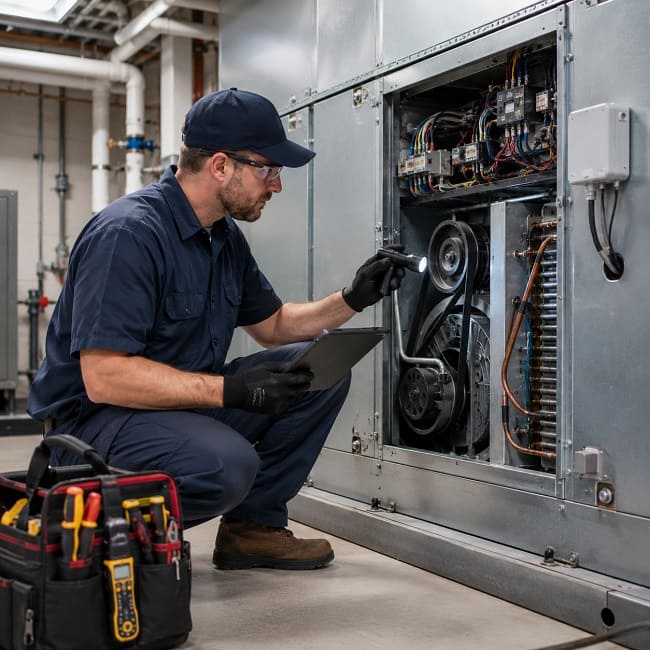
Commercial HVAC technician inspecting belt-driven HVAC equipment
Commercial HVAC maintenance for occupied properties Equipment identification, planned service, operating checks and documented findings.
Equipment inventory Identify each RTU or HVAC system before recurring service begins.
Defined maintenance scope Tasks and materials are established in the property maintenance proposal.
Service reports Completed work and conditions requiring follow-up are documented.
Business-hour coordination Access and equipment shutdowns can be planned around occupied periods.
Maintenance Planning

Start With an Accurate Equipment Inventory

Commercial properties often have several similar rooftop units serving different tenants, zones or parts of the building. Referring to equipment as “the unit over the office” quickly becomes unreliable once repairs, filter changes and repeated faults need to be tracked over time.

MaksBuilder can identify equipment by unit number, equipment type, manufacturer and model information, filter configuration, area served and associated thermostat or control where that information is available.

The same identifiers can then be used on later service reports, helping owners and property managers distinguish a one-time issue from a recurring problem on the same system.

Maintenance Scope

What Commercial HVAC Maintenance Can Cover

Service is matched to the equipment installed at the property. A component that is not present on a particular system is not treated as a maintenance item for that unit.

Filters and Filter Schedule

Filter size, quantity, type and condition can be recorded by unit. Replacement frequency should reflect equipment requirements, operating hours, occupancy and actual filter loading rather than relying on one interval for every building.

Filter efficiency also needs to remain compatible with the system. Installing a higher-efficiency filter is not automatically an upgrade if the added pressure drop reduces required airflow.

Belts, Sheaves and Fan Components

Belt-driven equipment is checked for belt wear, cracking, glazing, deterioration, tension and alignment. Sheave and fan condition can also be reviewed. Direct-drive equipment does not have the same belt-maintenance requirements.

Evaporator and Condenser Coils

Coil surfaces are reviewed for dirt, debris, blocked airflow, damaged fins and visible deterioration. Cleaning needs depend on actual condition, accessibility and the scope established for the property.

Condensate Drainage

Drain pans, drain connections, traps where installed and accessible condensate piping are checked for standing water, restrictions, deterioration and signs of improper drainage.

Overflow switches or other condensate safety devices can also be reviewed when they are part of the installed system.

Electrical Components

Electrical inspection can include disconnects, fuses where installed, contactors, capacitors where applicable, motors, control voltage and visible wiring condition.

Signs such as overheated connections, damaged conductors, abnormal startup behavior or components outside normal operating condition are documented for repair or further diagnosis.

Thermostats and Controls

The service visit can verify thermostat calls, occupied and unoccupied schedules, accessible sensors and the equipment response to normal heating, cooling and fan commands.

Building automation programming or controls integration outside the maintenance agreement is handled as separate work.

Economizer and Outside-Air Components

Where equipped, maintenance can include economizer damper movement, actuator and linkage condition, minimum outside-air position and obvious sensor or control faults that interfere with normal economizer operation.

Heating Operation

Packaged gas/electric units and heat pumps require heating-side checks in addition to cooling maintenance. The heating call, operating sequence, accessible safety controls and normal shutdown response can be reviewed according to equipment type.

Gas-fired equipment may also require ignition, burner and visible heat-exchanger observations appropriate to the unit and maintenance scope.

Operating Measurements

Temperature response and relevant electrical operating readings can be taken when they are useful for evaluating equipment condition. Examples include supply and return-air temperatures, line voltage and motor amperage where applicable.

Capacitors and other electrical components can be tested when their condition or system performance indicates that additional evaluation is appropriate.

Refrigeration measurements are generally used when system performance indicates a need for diagnostic evaluation rather than being opened unnecessarily during every routine visit.

Rooftop and Mechanical Access

Access requirements should be known before service is scheduled. Roof hatches, fixed ladders, keys, escorts, property-manager approval and restricted mechanical areas can otherwise delay planned work.

What is included in commercial HVAC maintenance?

The exact scope depends on the property and equipment. A maintenance agreement can cover equipment identification, filters, belt-driven components, coils, condensate drainage, electrical components, controls, economizers where installed, heating operation and documented operating checks. Failed components and major repairs are handled separately unless the agreement specifically includes them.

Equipment Records

Information Worth Tracking by Unit

A consistent equipment record becomes more useful as the number of rooftop units, tenants or service visits increases.

Equipment Identification

  • RTU or unit identification number
  • Equipment type
  • Manufacturer and model information
  • Filter sizes and quantities
  • Area, tenant or zone served
  • Thermostat or control association

Property and Access Information

  • Roof or mechanical-room access procedure
  • Normal business and occupancy hours
  • Areas requiring advance tenant coordination
  • Known comfort complaints
  • Recent major repairs or equipment changes
  • Property-management reporting requirements
Maintenance Visit

How Scheduled Service Is Organized

A repeatable process keeps the property contact, technician and service records aligned from one visit to the next.

01

Confirm Units and Access

The scheduled equipment and required roof, mechanical-room or tenant access are confirmed before maintenance work begins.

02

Complete the Assigned Maintenance

The technician performs the tasks defined for each unit and notes conditions that differ from normal operation or prior service history.

03

Verify Operation

Equipment response, temperature behavior and relevant electrical or control readings are checked as appropriate to the system and service scope.

04

Document Follow-Up Items

Conditions requiring diagnosis, repair, parts or replacement planning are separated from completed routine maintenance.

Service Reporting

What the Service Report Records

Commercial maintenance records should identify the unit serviced and make it clear what was completed during the visit and what still requires attention.

Typical Report Information

  • Property and service date
  • RTU or equipment identifier
  • Maintenance tasks completed
  • Filter status or filter replacement
  • Observed equipment condition
  • Relevant operating observations
  • Conditions requiring further diagnosis
  • Repairs requiring separate approval

What should a commercial HVAC maintenance report contain?

A useful report identifies the property, service date and specific unit, records the maintenance completed, states the observed equipment condition and separates routine maintenance from repairs or additional diagnosis that still require authorization.

Maintenance vs. Repair

What Routine Maintenance Does Not Automatically Include

Finding a failed component during maintenance does not automatically make its replacement part of the maintenance agreement.

Routine Maintenance

  • Agreed filter service
  • Belt and fan inspection where applicable
  • Coil-condition inspection
  • Condensate-system checks
  • Electrical and control inspection
  • Heating and cooling operating checks
  • Service documentation

Separate Repair or Project Work

  • Failed compressor replacement
  • Motor or control-board replacement
  • Refrigerant leak diagnosis and repair
  • Major electrical repair
  • Coil replacement
  • Duct, curb, roofing or structural repair
  • Building automation programming outside the agreement
  • Crane, lift or specialized access not included in the proposal

Is repair included in commercial HVAC maintenance?

Routine maintenance does not automatically include failed motors, compressors, control boards, refrigerant repairs, major electrical work or equipment replacement. Those items require separate diagnosis and authorization unless the maintenance agreement specifically states otherwise.

Business Coordination

Scheduling Around Building Operations

Planned maintenance should account for occupants, customers, tenants and the building's normal operating schedule.

Some checks require equipment to cycle or shut down briefly. Knowing occupied periods and access restrictions before the visit helps avoid unnecessary interruption and prevents technicians from arriving without access to the equipment or controls.

Business hours Identify periods when temporary HVAC interruption would be least disruptive.
Tenant access Arrange access to thermostats, occupied suites or indoor mechanical areas when required.
Rooftop access Confirm keys, roof hatches, ladders, escorts or building-engineer coordination.
Restricted operating periods Identify areas or systems that cannot be shut down during normal occupancy.
Orange County Service Area

Commercial HVAC Maintenance for South Orange County Properties

MaksBuilder serves commercial properties in Foothill Ranch, Lake Forest, Irvine, Mission Viejo, Aliso Viejo, Laguna Hills, Rancho Santa Margarita and nearby Orange County communities.

Property type, rooftop access and operating schedules can vary significantly between office buildings, retail locations, restaurants, warehouses and multi-tenant properties, so the maintenance proposal is based on the actual site rather than a generic package.

Commercial HVAC FAQ

Commercial HVAC Maintenance Questions

How often should commercial HVAC maintenance be scheduled?

There is no universal maintenance interval for every commercial HVAC system. The schedule depends on equipment type, operating hours, filter loading, building use, environmental conditions and manufacturer requirements. Individual maintenance tasks may also require different inspection frequencies.

Are filters included in commercial HVAC maintenance?

Filter service can be included in the maintenance proposal. The property record should identify filter sizes, quantities, type and replacement responsibility so there is no ambiguity between visits.

Do all commercial rooftop units have belts?

No. Belt inspection applies to units with belt-driven fan assemblies. Direct-drive equipment does not have the same belt and sheave maintenance requirements.

Are economizers checked during maintenance?

Where an economizer is installed and included in the maintenance scope, the visit can include damper movement, actuator and linkage condition, minimum outside-air position and visible control or sensor problems that interfere with normal economizer operation.

Does commercial HVAC maintenance include heating equipment?

It can. Packaged gas/electric rooftop units and heat pumps require heating-side operating checks appropriate to their design. The exact heating maintenance tasks should be stated in the property maintenance proposal.

Can maintenance be scheduled around business hours?

Yes. Occupancy, tenant access, rooftop access and equipment shutdown restrictions can be reviewed before the visit so service is scheduled around the practical operating needs of the property.

Can several rooftop units be included in one maintenance agreement?

Yes. Multiple units can be maintained under one property agreement while keeping separate equipment identifiers, filter information, service history and repair recommendations for each system.

What information is useful when requesting a maintenance proposal?

Useful information includes the property address, approximate number of HVAC units, known equipment types, roof or mechanical-room access requirements, normal operating hours and any existing HVAC service records available for the property.

Commercial HVAC Maintenance

Request a Commercial HVAC Maintenance Proposal

Send MaksBuilder the property address, approximate equipment count, known rooftop or mechanical-room access requirements and preferred service window. The maintenance scope can then be defined around the equipment and operating conditions at the property.

Orange County Service Area

Map & Regions

MaksBuilder serves Foothill Ranch, Lake Forest and nearby Orange County communities.

  • Foothill Ranch
  • Lake Forest
  • Irvine
  • Mission Viejo
  • Aliso Viejo
  • Laguna Hills
  • Laguna Woods
  • Rancho Santa Margarita
Call for service +1 949-740-0410
Working time Mon–Fri: 24 Hours
Weekend hours Sat–Sun: 8:00 AM - 6:00 PM
Office area Foothill Ranch, CA
For urgent HVAC service, call directly or send a request with your city and system issue. Call Now
Service Request
Send a Request

Fill out the form and MaksBuilder will contact you back.

Max file size 5MB. Accepted formats: JPG, PNG, WEBP or PDF.