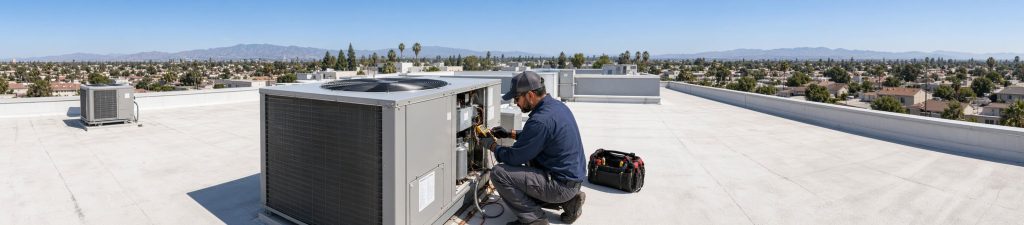
Commercial HVAC short cycling is abnormally frequent starting and stopping of a rooftop unit (RTU) or one of its operating stages, rather than the normal cycling or staging expected for the current building load. It can happen because operation is interrupted by a fault or safety, or because capacity and control conditions cause the system to satisfy demand and restart too frequently.
Commercial equipment may stage compressors and heating capacity while separately controlling fan speed and economizer damper position. For that reason, a compressor turning off is not automatically a fault. The most useful first question is what stops first and whether heating or cooling demand is still active when it stops.
What Short Cycling Means on a Commercial Rooftop Unit
Commercial rooftop units may use multiple compressors, multiple heating or cooling stages, variable-speed or multi-speed fans, economizers, occupancy schedules, zone controls, and commands from a Building Automation System (BAS).
Normal control logic may intentionally remove a compressor stage, change fan speed, or reposition an economizer as building load changes. Those actions should not be confused with short cycling.
Short cycling becomes more likely when the same stage repeatedly starts and stops at unusually short intervals, demand repeatedly returns soon after shutdown, the space cannot maintain the requested condition, or the equipment repeatedly reaches a protective limit.
What Stops First? A Useful Way to Narrow the Problem
The patterns below are most useful when they repeat abnormally or occur while heating or cooling demand remains active. A single compressor shutdown can be part of normal commercial HVAC staging.
Common Causes of Commercial HVAC Short Cycling
1. Thermostat, BAS, or Control Problems
A rooftop unit cannot maintain stable operation if its control command repeatedly appears and disappears. Possible causes include an incorrect occupancy schedule, faulty thermostat or space sensor, loose low-voltage connection, improper staging, BAS overrides, or incorrect controller configuration.
One of the first diagnostic checks is whether the heating or cooling command is still present when the RTU stops. If the command disappears at the same time, the problem may be on the control side rather than inside the refrigeration circuit.
See how these systems are evaluated on the commercial HVAC controls and thermostat service page .
2. Restricted Airflow
Commercial HVAC equipment depends on adequate airflow across the indoor coil and, during applicable heating operation, across the heating section.
A heavily loaded filter, dirty evaporator coil, blower problem, slipping or damaged belt on belt-driven equipment, blocked return path, or incorrect fan operation can change system temperatures and pressures.
In cooling mode, severe airflow restriction can contribute to low evaporator temperature or coil icing. During heating, inadequate airflow can contribute to excessive temperature rise and operation of a temperature limit.
3. Dirty Condenser Coil or Condenser Fan Problems
The condenser must reject heat from the refrigeration system. A heavily restricted condenser coil, failed condenser fan, or inadequate condenser airflow can cause abnormal refrigeration pressures.
Depending on the equipment, a protective control may stop compressor operation when pressure or temperature moves outside the permitted range. If conditions later return to an acceptable range and the compressor is allowed to restart, the repeated shutdown can appear as short cycling.
4. Low-Pressure or Other Refrigeration Conditions
Low-pressure protection may stop compressor operation when refrigerant-side conditions move outside the expected range. Possible causes include poor evaporator airflow, coil icing, insufficient refrigerant because of a leak, a metering problem, unusually low load, or another refrigeration-system fault.
5. Compressor Thermal or Electrical Protection
A compressor that starts, operates for a period, shuts down, and later restarts may be responding to an electrical or thermal condition rather than a thermostat command.
Depending on the equipment, diagnosis may include supply voltage, phase conditions on applicable three-phase equipment, contactors, electrical connections, compressor current, motor protection, condenser performance, and compressor condition.
Commercial rooftop equipment may also use compressor-delay or minimum-off controls to prevent immediate restart. These controls protect the equipment but do not correct the condition that caused the shutdown.
6. Oversizing or Poor Capacity Staging
Oversized equipment can produce frequent short operating cycles under low building load, especially when available staging or modulation cannot reduce capacity enough for current conditions.
Runtime alone does not prove that an RTU is oversized. Equipment capacity has to be considered together with actual building load, zone behavior, airflow, staging, and control configuration.
7. Economizer or Outside-Air Control Problems
Commercial rooftop units may use an economizer to introduce outdoor air for ventilation and, when outdoor conditions are suitable, reduce mechanical cooling demand. Normal economizer operation can therefore change compressor runtime without indicating a fault.
Problems become more likely when damper position, sensor data, actuator response, mixed-air conditions, or control logic repeatedly changes the mechanical cooling requirement in an unintended way.
For a deeper explanation, see Commercial HVAC Economizer Problems: Dampers, Sensors and Control Faults .
8. Condensate Overflow Protection
Some commercial HVAC installations use condensate overflow protection that interrupts part or all of the operating sequence when water reaches an unsafe level.
A restricted drain can therefore create intermittent shutdowns. With an automatic-reset safety, operation may return after the water level falls. Other control strategies may keep the RTU locked out until the condition is cleared or reset.
9. Heating-Side Safety Shutdowns
Short cycling is not limited to cooling. A packaged gas/electric rooftop unit may repeatedly interrupt heating because of airflow or temperature-limit conditions, ignition or flame-verification problems, electrical faults, control interruptions, or other heating safeties.
Warning Signs the Cycling Is Probably Not Normal Staging
- The same compressor repeatedly starts and stops while cooling demand remains active.
- The space repeatedly fails to maintain the thermostat or BAS setpoint.
- The same controller alarm or fault repeatedly returns.
- The compressor repeatedly shuts down while cooling demand remains active and the supply fan continues.
- The equipment restarts after a delay and then repeats the same abnormal shutdown.
- Cycling is accompanied by weak airflow, icing, water, or abnormal noise.
- Electrical protection repeatedly operates.
How Technicians Diagnose Commercial HVAC Short Cycling
The purpose of diagnosis is to identify the event that ends the operating sequence rather than replacing parts based only on the fact that the equipment turns on and off.
- Identify the correct RTU and zone. Match the complaint to the correct thermostat, tenant area, zone, and rooftop unit.
- Confirm whether demand is still present. Determine whether the thermostat, controller, or BAS still requests heating or cooling when the equipment stops.
- Review fault history. Stored alarms, fault codes, run information, and start counts can reveal a repeating pattern when the installed controls provide those functions.
- Check airflow. Filters, coils, fan operation, belts where equipped, dampers, and relevant airflow restrictions are evaluated.
- Check cooling-system conditions. For cooling complaints, condenser performance, compressor operation, refrigerant-side conditions, and applicable safeties may need to be checked.
- Check electrical and control operation. Incoming power, voltage conditions, contactors, connections, controls, motors, and compressor electrical operation are evaluated as appropriate.
- Confirm staging and sequence. Compressors, heating stages, fan operation, economizer control, and BAS commands are compared with the intended sequence of operation.
What You Can Observe Before a Service Visit
Commercial rooftop units involve high voltage, rotating equipment, refrigerant, and rooftop hazards. Building staff should not open energized panels or bypass safety devices.
Useful information can still be collected safely:
- Which room, tenant, or zone is affected.
- Thermostat temperature and setpoint.
- Whether heating or cooling demand remains displayed when the equipment stops.
- Approximately how long the system operates before shutdown.
- Any BAS alarm, controller message, or fault code.
- RTU number, make, and model if safely available.
- Whether control work or maintenance was recently performed.
Can Short Cycling Damage Commercial HVAC Equipment?
Repeated starts can increase electrical and mechanical stress on compressors, contactors, and associated starting components. Frequent cycling can also prevent the building from maintaining stable temperature and may indicate that the system is repeatedly reaching a protective condition.
If compressor-delay or minimum-off timing repeatedly becomes part of the operating pattern, the reason for the preceding shutdown still needs to be identified.
Does Short Cycling Mean the Compressor Has Failed?
No. A compressor may be responding correctly to another problem such as a pressure safety, airflow issue, condenser fault, control interruption, or electrical protection.
A compressor fault can also cause repeated shutdowns, but compressor replacement should follow testing that confirms the compressor itself is the failed component. For broader RTU troubleshooting, see Commercial Rooftop Unit Repair in Orange County .
When Does Short Cycling Become a Replacement Question?
A single airflow, control, electrical, or refrigeration fault does not automatically justify replacing an RTU. Replacement becomes more relevant when short cycling is part of a broader pattern of recurring major failures, deteriorated equipment, difficult parts availability, inappropriate capacity, or repeated operational disruption. For the broader decision process, see Commercial HVAC Replacement in Orange County .
Can Maintenance Reduce Short-Cycling Problems?
Maintenance cannot prevent every failure, but inspection can identify conditions that contribute to unstable operation, including loaded filters, dirty coils, deteriorated belts where equipped, drainage restrictions, fan problems, and visible electrical or control deterioration.
For properties with multiple rooftop units, equipment-specific service records can also make recurring patterns easier to identify. More information is available on the Commercial HVAC Maintenance in Orange County page.
Frequently Asked Questions
Why does my commercial HVAC system turn on and off every few minutes?
Possible causes include unstable thermostat or BAS commands, airflow restrictions, condenser problems, refrigeration faults, protective safeties, compressor electrical protection, poor staging, or excessive equipment capacity.
Can a dirty commercial HVAC filter cause short cycling?
Yes, it can contribute by restricting airflow. Depending on operating mode, that restriction can affect evaporator conditions during cooling or temperature rise during heating.
Can low refrigerant cause a commercial RTU to short cycle?
It can contribute, but a low-pressure condition alone does not prove low refrigerant. Airflow, load, temperatures, charge, and refrigerant-system behavior need to be evaluated together.
Can a Building Automation System cause short cycling?
Yes. Incorrect schedules, overrides, sensor inputs, staging commands, or control logic can repeatedly remove and restore equipment demand.
Is compressor staging the same as short cycling?
No. Commercial equipment may intentionally add or remove individual stages as building load changes. Short cycling is abnormal frequent cycling beyond the expected sequence for the current load and control strategy.
The Shutdown Sequence Usually Reveals the Next Step
Commercial HVAC short cycling can originate in controls, airflow, refrigeration, condenser operation, electrical components, compressor protection, heating safeties, economizer operation, or equipment capacity.
The most useful information is which component or stage stops first, whether demand remains active, whether a fault is recorded, and under what conditions the equipment restarts.
MaksBuilder provides commercial rooftop HVAC diagnostics and repair in Orange County. If possible, have the RTU number, affected area, available fault code, and roof-access information ready.
Request Service Call +1 949-740-0410Technical References
Exact operating sequences, fault limits, reset behavior, and protection logic vary by RTU model and controller. Manufacturer service literature for the installed equipment should be used for model-specific diagnosis.
- Carrier WeatherMaster 48HC Service and Maintenance Instructions: Carrier WeatherMaster 48HC Service and Maintenance Instructions
- Carrier 48LC Commercial Rooftop Technical Specifications: Carrier 48LC Technical Specifications
- Trane condensate overflow safety information: Trane Accessory Drain Pan Overflow Switch