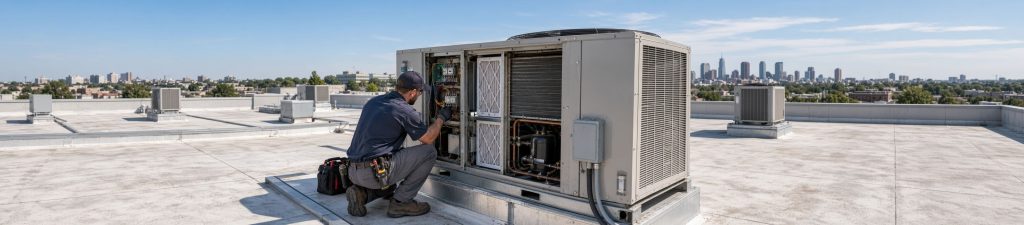
Quick answer: If a commercial rooftop unit is running but not cooling, the cause may be an incorrect thermostat or BAS schedule, restricted airflow, a condenser or fan problem, an economizer fault, an electrical or control issue, a refrigerant-system problem, a compressor fault, or a safety lockout. Start by confirming the cooling call, schedule, accessible filters, airflow, and any visible controller alarms. Do not bypass safeties, open energized electrical panels, or add refrigerant as a troubleshooting test.
What to Check First When a Commercial RTU Stops Cooling
First, determine what the rooftop unit is actually doing. An RTU that is completely off points in a different direction from one with a running supply fan but warm air.
1. Thermostat, BAS, or Operating Schedule Problem
A commercial rooftop unit cannot cool correctly if it is not receiving the expected cooling request. Depending on the building, that command may come from a conventional thermostat, programmable schedule, unit controller, or building automation system.
The RTU may remain in unoccupied mode, use an incorrect setback, or receive a fan command without receiving the expected mechanical cooling call.
- Confirm that the thermostat or controller is in cooling mode.
- Compare the actual space temperature with the cooling setpoint.
- Confirm that the current time and occupied schedule are correct.
- Look for visible thermostat, controller, or BAS alarms.
- Note whether the problem began after a control or scheduling change.
If the controller shows a cooling request but the expected cooling stage does not start, the problem has to be traced at the equipment rather than assuming the thermostat itself has failed.
2. Restricted Filters and Low Airflow
A heavily loaded filter reduces airflow through the evaporator coil. That can reduce cooling capacity and, when airflow becomes sufficiently restricted, may contribute to evaporator icing.
Some rooftop units may also respond to abnormal operating conditions through applicable temperature, pressure, or control safeties, depending on the equipment design.
An accessible filter inspection is therefore a useful first check, but replacing the filter does not prove that airflow is now correct. Restrictions can also come from the blower, evaporator coil, dampers, return path, or duct system.
3. Dirty Condenser Coil
The condenser section has to reject the heat removed from the building. A heavily fouled condenser coil makes that process more difficult and can reduce cooling capacity.
Under heavier cooling loads, a dirty condenser coil or inadequate condenser airflow can raise condensing pressure and, on equipment with applicable protection, may shut down the compressor.
Condenser coil condition should be evaluated together with condenser fan operation and actual system measurements rather than treated as a default diagnosis.
4. Condenser Fan Failure
Condenser fans move outdoor air across the condenser coil. A failed or underperforming fan can reduce heat rejection, increase condensing pressure, reduce cooling capacity, or contribute to a protective shutdown depending on the RTU design.
The fault may involve the fan motor itself or the equipment controlling it, including wiring, relays, contactors, motor controls, a VFD, or other unit-specific components.
5. Supply Blower or Airflow Problem
Mechanical cooling may be operating while the building still feels warm if the RTU cannot move enough conditioned air.
- A failed or underperforming supply-fan motor
- A loose, worn, or broken belt on belt-driven equipment
- Incorrect fan speed or drive operation
- A dirty evaporator coil
- Restricted filters
- Return-air restrictions
- Incorrect damper position
- Duct or distribution problems downstream of the RTU
The pattern inside the building can help narrow the problem. Weak airflow throughout the entire served area suggests a different issue from normal airflow in most rooms with only one office or tenant space staying warm.
A localized hot area may involve ductwork, balancing, zoning, solar exposure, building-envelope conditions, internal equipment loads, or another room-specific airflow problem rather than insufficient RTU cooling capacity.
6. Economizer Damper or Sensor Problem
Many commercial rooftop units use an economizer to control outdoor and return air. When outdoor conditions are suitable, the economizer can reduce mechanical cooling demand by increasing the use of outdoor-air cooling.
Depending on the RTU and its control sequence, economizer operation and compressor cooling may also operate together.
A damper that remains too far open when outdoor conditions are unfavorable can increase the cooling load. Failed sensors, actuators, linkages, or control logic can also interfere with normal cooling and ventilation.
For a detailed breakdown, see Commercial HVAC Economizer Problems: Dampers, Sensors and Control Faults .
7. Cooling Stage, Contactor, or Electrical Control Problem
Sometimes the thermostat or BAS is calling for cooling and the supply fan is running, but one or more cooling components never receive the power or control signal required to operate.
Depending on the RTU, diagnosis may involve contactors, relays, fuses, control transformers, wiring, control boards, phase protection, motor controls, or capacitors where they are actually used.
RTU electrical designs vary, so the failed component should be confirmed from the unit's actual control sequence and electrical measurements rather than replaced because it appears on a list of common faults.
For problems involving commands, staging, sensors, thermostats, and building-control integration, see Commercial HVAC Controls & Thermostat Service .
8. Refrigerant Circuit Problem
Refrigerant-system problems can reduce the amount of heat the rooftop unit removes from the building, but “it needs refrigerant” is not a complete diagnosis.
Possible causes include an incorrect refrigerant charge, a leak, a restriction, a metering-device problem, or another condition affecting refrigerant flow.
Diagnosis depends on the refrigerant type, indoor and outdoor conditions, airflow, equipment staging, manufacturer data, and measured system performance.
If the charge is confirmed to be low, the technician should determine whether refrigerant was lost through a leak or whether the system was previously charged incorrectly.
9. Compressor Problem
Compressor failure is one possible reason an RTU does not cool, but warm supply air alone does not prove that the compressor has failed.
A compressor may be mechanically or electrically damaged, but it may also be healthy and simply not starting because a control command, contactor, safety, condenser problem, or another operating condition is keeping it off.
Compressor diagnosis should therefore include the cooling request, electrical supply, current draw, applicable winding checks, refrigeration conditions, and the operation of the rest of the system before replacement is considered.
10. Safety Lockout or Control Fault
Rooftop equipment uses protective controls to stop operation when certain conditions move outside acceptable limits. The exact protections depend on the equipment.
- High- or low-pressure protection
- Motor overload protection
- Phase or power-monitoring protection
- Freeze protection
- Condensate-related shutdowns on some systems
- Smoke or building interlocks
- Controller-generated equipment faults
A lockout often indicates that a protective control responded to another operating condition, although the sensor or control itself can also be part of the fault.
Repeated resets may clear active fault information or make an intermittent problem harder to diagnose, even when the controller retains some fault history.
What Can a Property Manager Check Safely?
These first checks are meant to narrow the problem, not to replace technical diagnosis.
- Thermostat cooling mode
- Space temperature and setpoint
- Occupied or unoccupied schedule
- Accessible filter condition
- Obvious supply-airflow changes
- Which rooms or zones are affected
- Visible thermostat or controller alarms
- Whether the failure is constant or intermittent
- Energized electrical testing
- Opening electrical compartments
- Bypassing safeties
- Jumpering control terminals
- Refrigerant pressure or charge work
- Compressor electrical testing
- Fan or belt work with the unit energized
- Unsafe or unauthorized roof access
When Does an RTU Need Professional Diagnosis?
Professional diagnosis is appropriate when the cooling call is correct but the RTU still does not cool normally, when the problem returns after a reset, or when electrical, refrigeration, compressor, economizer, or safety controls need to be tested.
- Confirming the cooling request and the actual symptom.
- Checking airflow, blower operation, filters, coils, and dampers.
- Reviewing active faults, safeties, and condenser operation.
- Testing the electrical and cooling sequence where required.
- Evaluating refrigeration-system performance only after airflow and operating conditions are considered.
After the correction, the rooftop unit should be run again to confirm normal cooling, airflow, control operation, and stable operation without an immediate recurring fault.
For commercial RTU diagnosis and repair, see Commercial Rooftop Unit Repair .
Does an RTU That Stops Cooling Need to Be Replaced?
No. A no-cooling complaint by itself does not mean the rooftop unit should be replaced.
A thermostat, airflow, fan, control, economizer, or repairable refrigeration problem is very different from a major compressor or coil failure. Replacement should be evaluated only after the actual failure and the overall condition of the RTU are known.
If replacement is being considered, see Commercial HVAC Replacement in Orange County .
Can Maintenance Reduce RTU No-Cooling Problems?
Preventive maintenance cannot eliminate every component failure, but it can identify airflow restrictions, dirty coils, worn belts, condenser-fan problems, drainage issues, electrical deterioration, economizer faults, and controller problems before some of them develop into a complete loss-of-cooling call.
See Commercial HVAC Maintenance in Orange County for planned inspection and service.
Frequently Asked Questions About Commercial RTUs Not Cooling
Why is my commercial rooftop unit running but blowing warm air?
If the supply fan runs but the air is not being cooled, the mechanical cooling stages may not be starting or may not be operating correctly. Possible areas include controls, safeties, the condenser section, electrical components, the refrigeration system, or the compressor circuit.
Can a dirty filter make a commercial RTU stop cooling?
Yes. A sufficiently restricted filter can reduce airflow through the evaporator and lower cooling performance. Severe airflow restriction may also contribute to evaporator icing. Persistent low airflow should be diagnosed beyond the filter because the blower, coil, dampers, or duct system may also be involved.
Can an economizer make a commercial building too warm?
Yes. An economizer problem can contribute to poor cooling. An outdoor-air damper that remains too far open when outdoor conditions are unfavorable can increase the cooling load, while sensor, actuator, or control-sequence faults can prevent the system from managing outdoor and return air correctly.
Does low refrigerant mean the RTU only needs to be recharged?
No. If the refrigerant charge is confirmed to be low, the reason should be identified. The system may have a leak or may have been incorrectly charged during previous service. Refrigerant measurements also have to be interpreted together with airflow, operating conditions, and manufacturer requirements.
Why are only some rooms warm if the rooftop unit is cooling?
If other areas served by the same RTU are comfortable, the problem may be downstream of the rooftop equipment. Duct restrictions, balancing, dampers, zoning controls, solar exposure, building-envelope conditions, internal heat loads, or local airflow problems may affect only part of the space.
Commercial Rooftop Unit Not Cooling in Orange County?
If the thermostat and operating schedule are correct but the RTU still cannot cool the building, the next step is to determine whether the problem is in airflow, condenser operation, electrical controls, economizer operation, the refrigeration system, or the compressor circuit.
MaksBuilder provides commercial rooftop HVAC diagnosis and repair for qualifying commercial properties in its South Orange County service area.
Commercial Rooftop Unit Repair